


Nasal Strips vs. Dilators vs. Sprays for Snoring: Which One Actually Works for You?
Sleep is a territory we all have to cross every single night. But for some of us, the road is broken. The breath gets caught in the dark. It rattles against the walls of our own throats and noses, waking our partners, waking ourselves, turning the bedroom into a place of exhaustion instead of rest.
We wander down the aisles of pharmacies, staring at the boxes of plastic and saline, wondering what will actually buy us a quiet night.
When you start looking for a fix, the debate usually comes down to nasal strips vs nasal dilators, or maybe a bottle of spray. They all promise the same quiet.
But they do not do the same work. Choosing the wrong one is like trying to fix a leaky roof by locking the front door.
Why Matching the Device to Your Snoring Type Matters
Most people try these products blindly. They throw plastic and salt water at the dark, hoping something sticks. They do not stop to figure out where the noise is actually coming from.
Strips, dilators, and sprays all address snoring from entirely different angles:
- Strips: These widen the nasal passage from the outside. They act like little suspension bridges, lifting the heavy nasal walls.
- Dilators: These keep the nasal passage open from the inside. They are the structural beams you push into the cave of the nostril.
- Sprays: These reduce the mucosal swelling. They wash away the congestion that thickens the walls and narrows the passage.
Here is the hard truth: absolutely none of them will work for throat-based snoring, jaw-based snoring, or sleep apnea. If the collapse is happening deep in your throat, fixing your nose will not stop the thunder.
Identifying your snoring type before buying anything saves you time, money, and a lot of bitter mornings.
- The Nasal Snorer: The sound is higher-pitched, almost like a whistle or a wheeze. You can snore with your mouth completely closed. Congestion is often the villain here.
- The Mouth Snorer: The sound is loud, guttural, and rough. You wake up with a mouth as dry as desert dirt. If someone gently holds your mouth closed while you sleep, the snoring stops.
- The Mixed Snorer: You have elements of both. The nose closes, the mouth falls open, the throat relaxes. You need both nasal and throat-level devices to find peace.

How Each Option Works
Nasal Strips (External Adhesive Dilators)
These are small adhesive bands built with a spring-like plastic splint inside them. You wash your face, dry it tight, and apply the strip directly across the bridge of your nose.
The science is simple. The strip wants to return to its original, flat position. As it tries to straighten out, it pulls the skin with it, lifting the sides of the nose and physically widening the nasal passage. The mechanism reduces external nasal resistance. It makes the hallway wider so the air can walk through without scraping the walls.
They are best for nasal congestion born from seasonal allergies or winter colds. They are meant for mild nasal narrowing, and for the sleepers who simply cannot stand the idea of inserting a piece of plastic inside their nose.
Internal Nasal Dilators (Cones, Vents, Clips)
These are small devices inserted directly into the nostrils. They hold the nasal passage open from the inside out. You can find them made of soft medical silicone, firm plastic, or even stainless steel. They come shaped like cones, ribbed wings, or hollow tunnels.
The mechanism here is direct structural support. They stand exactly at the site of the airway narrowing and refuse to let the walls cave in. They are particularly effective for a condition called nasal valve collapse, which is when the nostril simply caves inward every time you try to pull a breath in.
They are best for that specific nostril collapse. They are also the savior for people with oily skin where adhesive strips slide right off by midnight, and for anyone seeking a reusable, lower-cost option over the long haul.
Nasal Sprays
Sprays do not build scaffolding. They change the landscape.
- Saline sprays: These are just salt and water. They moisturize and flush the nasal passage. They thin out the thick mucus and soothe the angry, irritated skin inside.
- Decongestant sprays (like oxymetazoline): These are chemical hammers. They aggressively shrink swollen nasal tissue. They act fast, opening the airway in minutes.
- Corticosteroid sprays (like fluticasone or budesonide): These fight the long war. They reduce chronic inflammation from allergies, but they require consistent, daily use over days or weeks to reach their full power.
The mechanism is chemical and fluid. They address the inflammation and mucus that cause the congestion, but they do not physically hold the passage open if the cartilage itself is weak. They are best for allergy-driven nasal congestion, chronic inflammatory snoring, or as a pre-bedtime clearance routine before you apply a strip or insert a dilator.
Head-to-Head Comparison
NASAL STRIPS
- Ease of use: Very easy. You peel the paper, you stick it on.
- Comfort: There is no insertion, which many prefer. But the adhesive can cause skin sensitivity, leaving red marks by morning.
- Reliability overnight: They may surrender and come loose if you have oily skin or if you sweat in your sleep.
- Cost: The cost is an ongoing tax. They are disposable, typically running $0.50 to $1.00 per strip.
- Reusability: Single use only. You throw them away with yesterday’s problems.
- Evidence: A well-known JAMA study confirms they successfully reduce snoring for true nasal snorers.
- Best for: Simple nasal congestion, first-time users, and those who hate the feeling of insertion.
INTERNAL NASAL DILATORS
- Ease of use: There is a learning curve. It requires insertion, and figuring out your exact size is a mandatory chore.
- Comfort: There is an initial adjustment period. It feels strange at first. But the body is resilient, and it adapts within a few nights for most people.
- Reliability overnight: They stay in place. They do not care about skin oiliness or sweat. There is no adhesive to fail you.
- Cost: A higher upfront cost, usually $15 to $40 for a good set. But the long-term cost is pennies.
- Reusability: Most are reusable for weeks or even months if washed properly.
- Evidence: Clinical studies show they deliver better airflow improvement than strips specifically for nasal valve collapse. In clinical trials for the Mute Snoring dilator, over 75% of users reported clear improvement.
- Best for: Nasal valve collapse, the victims of adhesive strip failures, and those looking for long-term cost savings.
NASAL SPRAYS (SALINE)
- Ease of use: Very easy. Just point and spray into each nostril.
- Comfort: Highly comfortable. It feels like a cool, moisturizing rain inside the nose.
- Reliability overnight: It provides temporary clearance. The effect may easily fade by the middle of the night as the body produces more mucus.
- Cost: Low ongoing cost. Widely available over-the-counter everywhere.
- Reusability: Not applicable. It is a consumable liquid.
- Evidence: Well-established by decades of medical use for mucus clearance and allergy relief.
- Best for: Pre-sleep nasal clearance, surviving allergy season congestion, and soothing dry nasal passages.
NASAL SPRAYS (DECONGESTANT)
- Ease of use: Very easy.
- Comfort: Comfortable and incredibly fast-acting. You breathe better in minutes.
- Reliability overnight: Works remarkably well, but carries a dark shadow: the risk of rebound congestion.
- Cost: Low and over-the-counter.
- Side effects: This is the trap. Do not use them for more than 3 consecutive days. Rebound congestion (rhinitis medicamentosa) can occur, making your nose more stuffed up than when you started.
- Best for: Acute, sharp congestion like a bad cold or a sinus infection. Short-term relief only.

The Complementary Use Advantage: Using Strips and Dilators Together
Here is the most important and least-known insight in the entire world of snoring remedies: nasal strips and dilators are not enemies. They are not competing options. They can work together.
Used in tandem, they address the nasal airway from both the inside and the outside simultaneously. You pull the roof up while pushing the walls out. Some desperate sleepers find that combining a soft internal silicone dilator with a strong external strip achieves a massive airway opening that neither device could ever reach alone.
In the clinical framing, nasal dilators have been identified as a complementary therapy. They are team players. They work best as part of a multi-device approach to reclaiming the night.
Look at the complementary therapy principle:
- Dilator or strip + MAD (Mandibular Advancement Device): You get nasal opening plus jaw repositioning. This is the holy grail for the mixed snorer, addressing both the nose and the collapsing throat.
- Dilator or strip + anti-snoring pillow: You get the nasal opening plus the proper head and neck alignment to keep the airway straight.
- Strip (external) + saline spray: You pre-clear the dirt and mucus from the passage, and then you mechanically hold the clean hallway open.
Who benefits the most from this combination therapy? Mixed snorers who fight battles on multiple fronts. Allergy sufferers whose chronic inflammation makes their skin too slick for strips to hold overnight. And CPAP users who experience brutal nasal dryness or congestion right alongside their prescribed therapy.
The Antihistamine Paradox: A Critical Insight for Allergy Snorers
Many people reading this take antihistamines for their allergies. They swallow the pill, their nose clears up, and they wonder why their spouse is still kicking them in the shins at 3:00 AM because the snoring hasn’t stopped.
This is the antihistamine paradox. The medicine reduces the nasal inflammation—which helps the nasal snoring—but it also acts as a muscle relaxant. It relaxes the muscles in the soft palate and the deep throat, making them sag and vibrate. It cures the nose but collapses the throat.
The practical result is a frustrated sleeper. Antihistamine users often need to fight the war on two fronts. They need a nasal device for the cleared but still-narrow nasal passage, AND they need a jaw or positional device to tighten up the relaxed, sagging throat.
This is not a reason to stop taking your allergy medicine. It is simply a reason to understand your body, and to add a complementary mechanical device to hold the quiet.
Decision Framework: Which Option Should You Start With?
Start with Nasal Strips if:
- You have never tried any kind of nasal device before in your life.
- Your snoring is clearly and obviously linked to temporary congestion, like spring allergies or a winter cold.
- You prefer the idea of no insertion and want the simplest, lowest-friction first step.
- Your skin is not overly oily, and you do not sweat heavily into your pillows.
Move to (or Start with) Internal Dilators if:
- You tried nasal strips, but they fall off by 2:00 AM because of skin oiliness.
- You have tried strips without full success and want to feel what internal structural support does.
- You suspect you have nasal valve collapse (watch yourself in the mirror—if your nostrils cave inward when you take a sharp breath, that is the collapse).
- You want a reusable device to stop the bleeding of ongoing monthly costs.
- You have an adhesive sensitivity that leaves your nose red and angry.
Add a Nasal Spray if:
- You have chronic, deep nasal inflammation from allergies that simple mechanical widening does not cure.
- You want to use a saline rinse as a clean, pre-sleep routine before putting your mechanical device in place.
- You understand the danger of decongestants and promise not to rely on them for more than 3 consecutive days.
Use All Three in Combination if:
- Your nasal snoring is a complex beast with multiple contributing factors—congestion, structural narrowing, and dryness all at once.
- You are trying to survive the peak of allergy season, where massive inflammation and structural narrowing are both destroying your sleep.
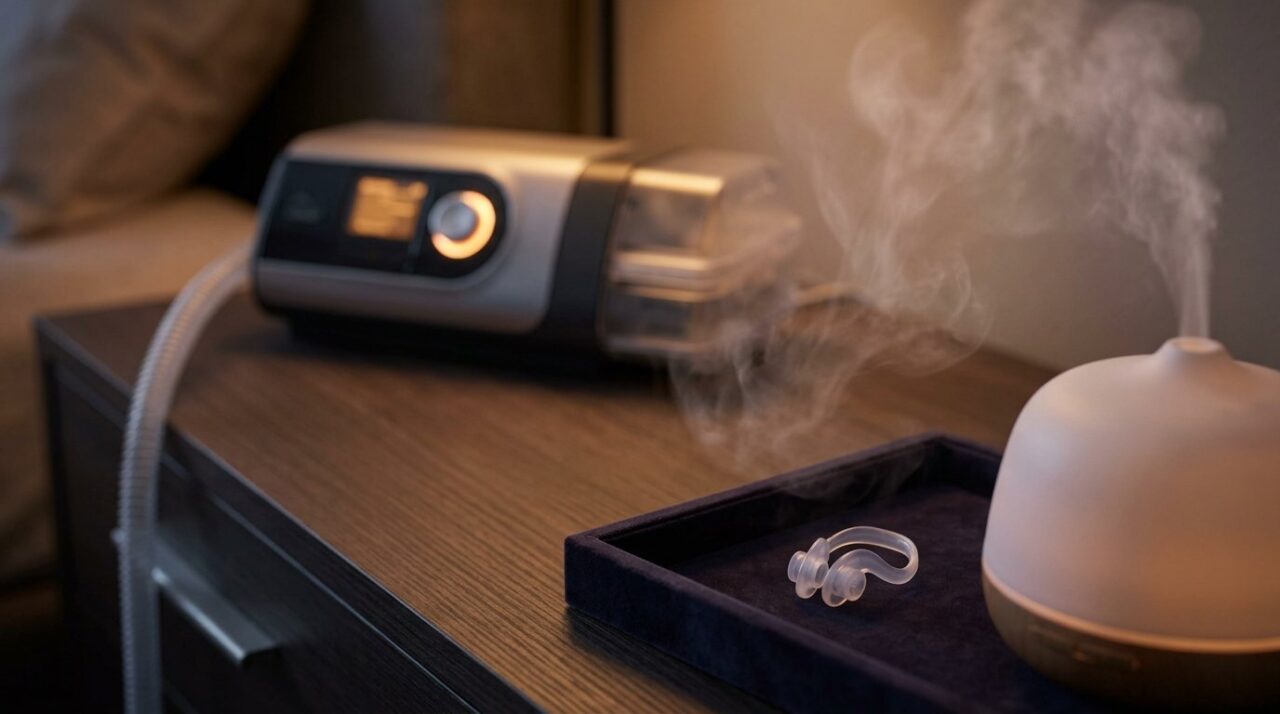
When None of These Will Help
We have to be honest about the limits of plastic and salt. None of these three devices will address throat-based or soft palate snoring. If the noise is coming from the back of your throat, you need a MAD or positional therapy.
They will not fix sleep apnea. Apnea is a medical condition where you stop breathing entirely. It requires a medical diagnosis and serious treatment, like a CPAP machine or a custom oral appliance.
They will not fix severe structural causes that require a surgeon’s hands—things like a severely deviated septum, thick nasal polyps, or turbinate hypertrophy. Those require an ENT evaluation.
There are warning signs that mean you need a doctor, not a device. Pay attention to them:
- Snoring accompanied by gasping, choking, or witnessed pauses in your breathing.
- Excessive, heavy daytime sleepiness even when you thought you slept for eight hours.
- Waking up with persistent morning headaches or a mouth completely devoid of moisture.