

The Best Sleep Position for Lower Back Pain: What Actually Helps
Quick Answer
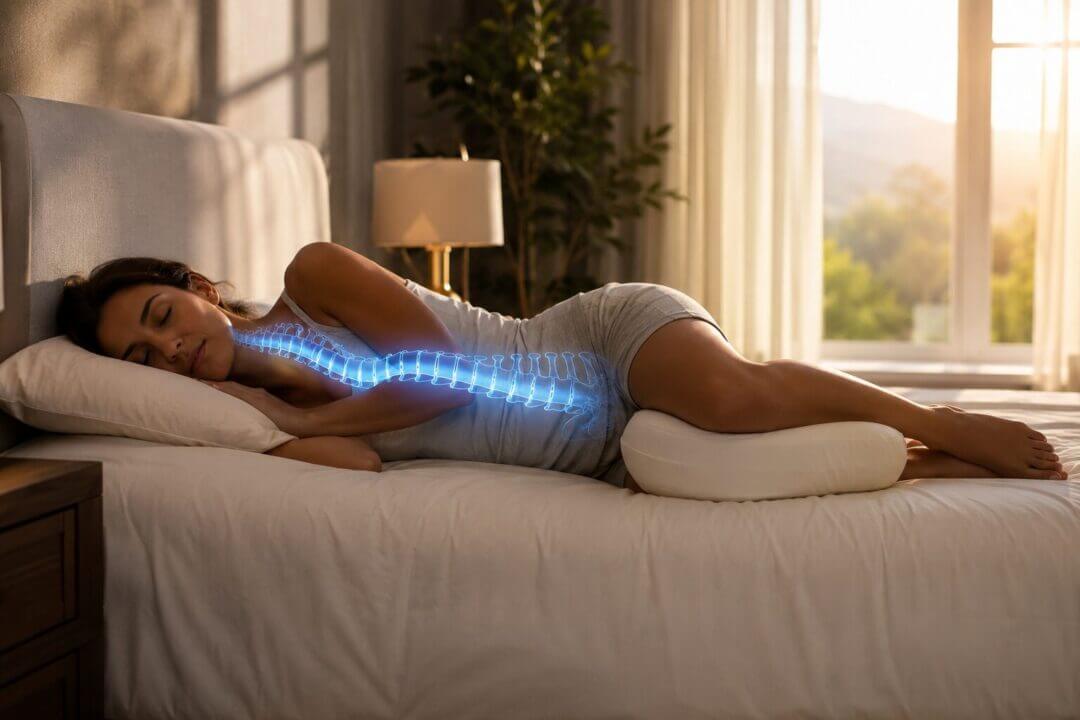
The best sleep position for lower back pain is side sleeping in a gentle fetal position with a pillow between your knees. This position opens the spaces between your vertebrae and keeps your hips aligned, reducing pressure on your lower back. Back sleeping with a pillow under your knees is the second-best option because it maintains your spine’s natural curve while distributing weight evenly.
Last updated: May 29, 2026
Key Takeaways
- Side sleeping with a knee pillow is the most recommended position because it aligns your hips and spine while reducing lower back pressure
- The fetal position actively decompresses your lumbar spine by gently widening the spaces between vertebrae
- Back sleeping works well when you place a pillow under your knees to maintain your spine’s natural inward curve
- Stomach sleeping is the worst position for lower back pain because it forces your spine into an extended arch
- Pillow placement matters more than mattress firmness for immediate relief—proper support prevents your pelvis from twisting
- Medium-firm mattresses generally work best across all sleep positions for lower back pain sufferers
- If you snore and have back pain, side sleeping solves both problems simultaneously
- Allow 1-2 weeks for your body to adapt to a new sleep position before deciding if it works
- See a doctor if your pain radiates down your leg, doesn’t improve in 4-6 weeks, or comes with numbness or weakness
Why Your Sleep Position Matters for Your Lower Back
Your spine curves naturally into an S-shape when you’re standing. Keeping that alignment during seven or eight hours of sleep determines whether you wake up refreshed or hobbling to the bathroom.
The wrong sleep position places uneven pressure on your spinal discs, joints, and muscles. Your facet joints compress on one side, your intervertebral discs bulge where they shouldn’t, and your back muscles never fully relax. The right position does the opposite—it lets your muscles and ligaments release completely so your body can actually heal overnight.
Back pain and poor sleep feed each other in a vicious cycle. Pain disrupts your sleep depth and wakes you up multiple times. Poor sleep then increases your pain sensitivity the next day and slows down tissue healing. Breaking this cycle often starts with something as simple as putting a pillow between your knees.
There’s a difference between temporary sleep-related back pain and structural back problems. If you wake up stiff but feel better as you move through the day, your pain is likely positional. If your pain persists or gets worse regardless of what you do, that warrants a trip to your doctor.
Common Sleep Positions and Their Effect on the Lower Back
Back Sleeping
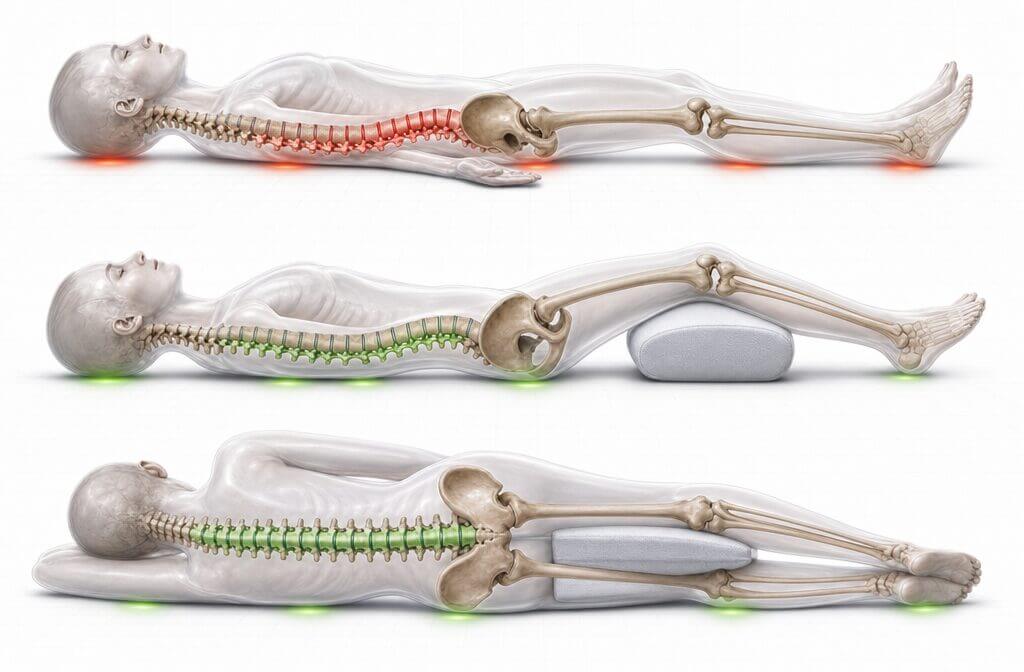
Back sleeping is generally the best position for spinal alignment when you do it correctly. It distributes your body weight evenly across the widest surface area, and your spine rests in its natural neutral position without twisting.
The critical modification: place a pillow under your knees. This maintains your lumbar spine’s natural inward curve, relieves pressure on your facet joints and intervertebral discs, and prevents your lower back from flattening against the mattress. Without the knee pillow, your lumbar curve flattens and strain increases throughout the night.
Who benefits most from back sleeping:
- Most lower back pain sufferers without specific diagnoses
- People with degenerative disc disease
- Anyone who needs even weight distribution
One caution: back sleeping can worsen snoring and isn’t recommended if you’re a positional snorer. Your tongue and soft palate collapse backward when you’re on your back, partially blocking your airway. If you snore and have back pain, you’ll need to choose side sleeping instead. For more on this trade-off, see our guide on how to optimize sleep position to reduce sleep apnea symptoms.
Side Sleeping (with the Fetal Position as a Variation)
Side sleeping is the second-best position for most lower back pain sufferers. It maintains spinal alignment when you do it with proper support.
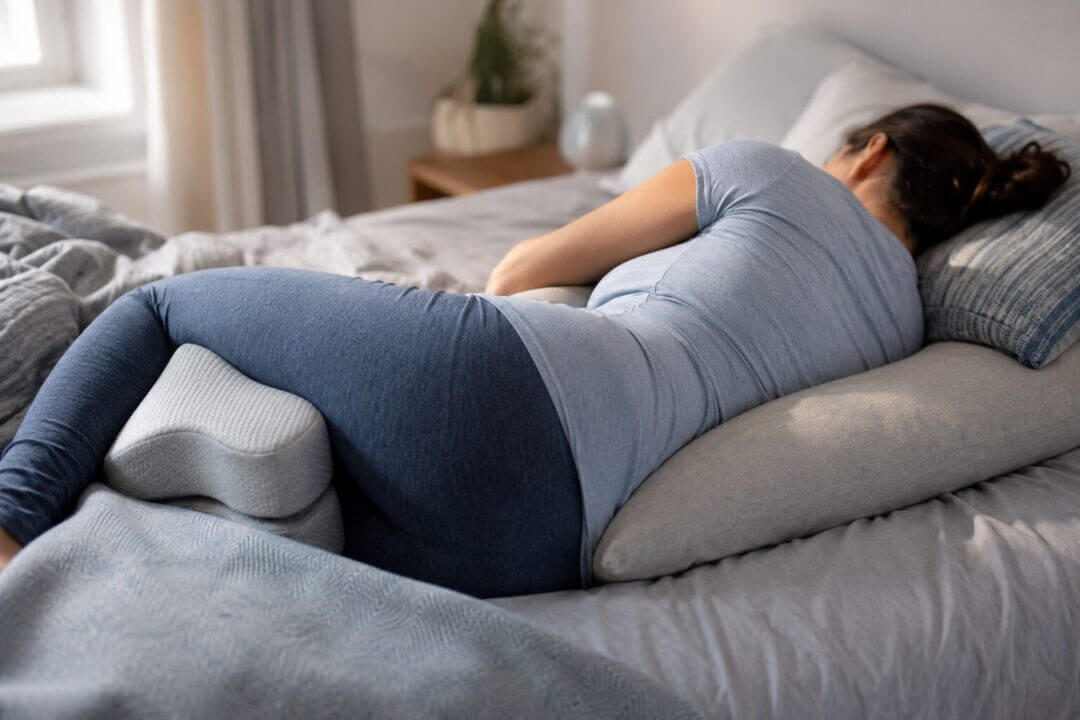
The critical modification: place a pillow between your knees. This prevents your top hip from rotating forward, keeps your pelvis level, and reduces torsional stress on your lumbar spine. Without it, your top leg pulls your pelvis out of alignment all night.
The fetal position—knees drawn gently toward your chest—is recommended by many physical therapists specifically for lower back pain. It opens the spaces between your vertebrae (the facet joints), reducing compression and providing lumbar decompression that back sleeping doesn’t offer. Just don’t curl too tightly; your torso should maintain a gentle curve, not compress into a tight ball.
Left side versus right side doesn’t matter much for back pain. Either works, and alternating prevents asymmetric muscle fatigue. If you have one-sided hip or sciatic pain, sleep with the painful side uppermost to reduce direct pressure.
Who benefits most from side sleeping:
- Herniated disc sufferers
- Sciatica patients
- People with facet joint pain
- Pregnant women (especially left side)
Side sleeping also helps if you snore, making it the ideal position when you’re dealing with both problems. Our article on best sleeping positions to reduce snoring covers this overlap in detail.
Stomach Sleeping
Stomach sleeping is the most problematic position for lower back pain. It forces your lumbar spine into an extended (arched) position, compressing the disc spaces and facet joints all night. You also have to turn your head to one side, placing sustained rotational strain on your cervical spine.
If you absolutely cannot avoid stomach sleeping:
- Place a thin pillow under your pelvis (not your head) to reduce lumbar extension
- Use a very thin pillow for your head, or no pillow at all
- Consider this a temporary compromise while you work on transitioning to side or back sleeping
Long-term, transitioning away from stomach sleeping is strongly recommended for anyone with lower back pain. It’s the one position where the biomechanical disadvantages outweigh any comfort preference.
What Is the Best Sleeping Position for Lower Back Pain Relief?
The fetal position is the best overall choice for lower back pain. It’s the only common sleep position that actively decompresses your lumbar spine instead of just maintaining neutral alignment.
The mechanism is simple: drawing your knees toward your chest gently distracts your facet joints and widens the intervertebral spaces. This creates negative pressure in your spinal canal, reducing compression on nerve roots and allowing fluid to flow back into your intervertebral discs overnight.
Additional benefits of the fetal position:
- Reduces tension in your back and hip muscles
- Feels natural and comfortable for most people
- Associated with a sense of security that can improve sleep onset
- Safe during pregnancy, especially on the left side
How to optimize the fetal position:
Keep the curve relaxed, not tight. Your torso shouldn’t be severely compressed or you’ll restrict your breathing and create new problems. Use a pillow between your knees to maintain hip alignment—this is non-negotiable. Choose a supportive mattress because one that’s too soft allows your hips to sag, misaligning your spine.
Adjusting if the fetal position causes hip or knee discomfort:
Add more padding between your knees with a thicker pillow or folded blanket. Extend your upper knee slightly to reduce torsional stress if hip pain develops. A full-body pillow can support your entire position and prevent you from rolling backward onto your back during the night.
I’ve recommended the fetal position to dozens of people over the years, and the most common mistake is curling too tightly. Your goal is gentle decompression, not becoming a human cannonball.
Side Sleeping vs Back Sleeping for Lower Back Pain
Both side sleeping and back sleeping work well for lower back pain when you use proper pillow support. The choice between them depends on your specific pain pattern and any other health conditions.
Choose side sleeping (fetal position) if:
- You have a herniated disc or sciatica
- You have facet joint arthritis
- You snore or have sleep apnea
- You’re pregnant
- You need active spinal decompression, not just neutral alignment
Choose back sleeping if:
- You have general lower back pain without a specific diagnosis
- You don’t snore
- You find side sleeping uncomfortable even with a knee pillow
- You have shoulder problems that make side sleeping painful
The most important principle is spinal neutrality: keep your ears, shoulders, and hips aligned as much as possible, regardless of which position you choose. A pillow between your knees (side sleeping) or under your knees (back sleeping) is what makes this alignment possible.
For people dealing with middle back pain as well, the positioning principles are similar. Our guide on how to alleviate middle back pain while sleeping on your side covers the upper spine considerations.
How to Sleep with Lower Back Pain and Sciatica
Sciatica—pain that radiates from your lower back down through your buttock and leg—responds especially well to the fetal position. The gentle knee-to-chest curve opens your spinal canal and reduces pressure on the sciatic nerve root.
Sleep with the painful leg on top. This reduces direct pressure on the affected side and allows the nerve more space. Place a thick pillow between your knees to prevent your top leg from pulling your pelvis forward.
If the fetal position alone doesn’t provide enough relief, try these modifications:
- Use a full-body pillow to support your entire top leg
- Place a small rolled towel under your waist to fill the gap between your side and the mattress
- Slightly extend your bottom leg instead of bending both knees equally
Avoid back sleeping if you have active sciatica. Even with a pillow under your knees, back sleeping can increase pressure on the nerve roots in some people. Side sleeping with proper support is almost always better for sciatic pain.
If your sciatica worsens at night regardless of position, or if you develop foot drop or loss of bladder control, see a doctor immediately. These are signs of severe nerve compression that may require urgent intervention.
Does Sleeping on Your Stomach Make Lower Back Pain Worse?
Yes, stomach sleeping makes lower back pain worse for most people. It forces your lumbar spine into extension (an arched position) and compresses the facet joints and disc spaces throughout the night.
The neck rotation required for stomach sleeping adds a second problem. Turning your head 90 degrees to one side for hours places sustained rotational strain on your cervical spine and can cause neck pain that compounds your lower back issues.
If you’re a committed stomach sleeper who can’t change:
Place a thin pillow under your pelvis and lower abdomen to reduce the amount of lumbar extension. Use the thinnest possible pillow for your head, or no pillow at all. Consider this a harm-reduction strategy while you work on transitioning to side sleeping.
How to transition away from stomach sleeping:
Start by using a body pillow to prop yourself into a three-quarter prone position (halfway between stomach and side). Gradually shift more weight onto your side over several weeks. Place a pillow against your back to prevent rolling onto your stomach during the night.
The transition takes time because stomach sleeping is often a deeply ingrained habit. Be patient with yourself, but stay committed—the long-term benefit to your lower back is worth the temporary discomfort of changing positions.
What Kind of Pillow Helps with Lower Back Pain at Night?
The right pillow setup is more important than your mattress for immediate lower back pain relief. Pillows control your alignment at the critical pivot points—your knees, hips, and neck.
For side sleepers:
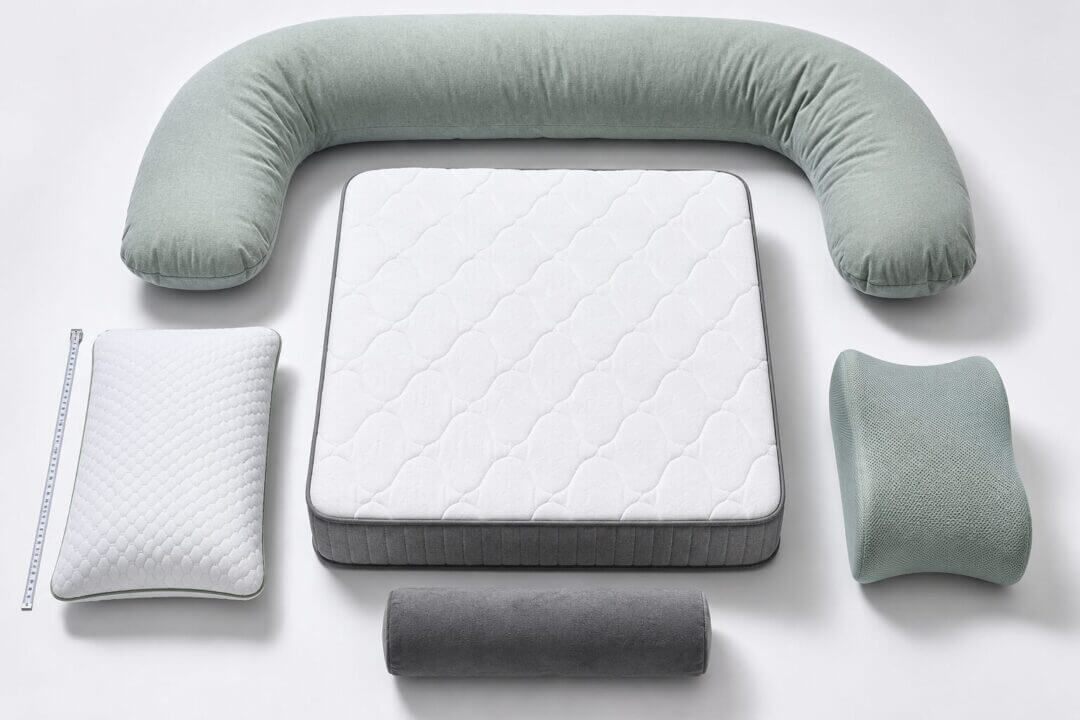
A dedicated orthopedic knee pillow works better than a regular pillow because it stays in place through the night. Look for memory foam or contoured designs that maintain their shape. The pillow should be thick enough to keep your top leg level with your hip, not drooping downward.
A full-body pillow provides even better support by cradling your entire top leg and preventing your pelvis from rotating forward. Pregnant women have used these for decades, but they work just as well for anyone with lower back pain.
For back sleepers:
A firm pillow under your knees should be 4-6 inches thick for most people—enough to create a slight bend in your knees. It needs to be firm enough to maintain that angle through the night without compressing flat.
Some people also benefit from a small rolled towel under their lower back to fill the lumbar gap, but this is supplemental to the knee pillow, not a replacement for it.
Head pillow considerations:
Back sleepers need a thinner, flatter pillow so their head aligns naturally with their spine. Side sleepers need a higher loft (4-6 inches) to fill the space between their ear and outer shoulder. Using the same pillow regardless of sleep position is a common mistake that creates neck and upper back strain.
Why Does My Lower Back Hurt More in the Morning After Sleeping?
Morning lower back pain that improves as you move through the day is usually positional—your sleep setup is placing strain on your spine throughout the night. Your intervertebral discs absorb fluid overnight when you’re lying down, and if your spine is misaligned, that increased disc pressure translates to morning stiffness and pain.
Common causes of morning-specific back pain:
Your mattress is too soft and your hips are sagging into a hammock shape. Your mattress is too firm and you’re compensating by curving your spine to avoid pressure points. You’re not using a knee pillow (side sleepers) or under-knee pillow (back sleepers). Your head pillow is the wrong height for your sleep position.
Less common but important causes:
Inflammatory conditions like ankylosing spondylitis cause morning stiffness that improves with movement. Spinal stenosis can cause positional pain that’s worse after prolonged static positions. Degenerative disc disease often causes morning pain because discs swell overnight.
If your morning back pain is severe, lasts more than 30-60 minutes after waking, or is getting progressively worse, see a doctor. Morning-dominant pain can be a sign of inflammatory or structural problems that need medical evaluation.
Sleeping Positions to Avoid with Herniated Disc
If you have a herniated disc, your sleep position directly affects how much pressure you place on the damaged disc and the nerve roots it may be compressing.
Best position: side sleeping in the fetal position. Drawing your knees gently toward your chest opens the spaces between your vertebrae and reduces pressure on the herniated disc. This is the most consistently recommended position across physical therapy and spine surgery sources.
Second-best: back sleeping with a pillow under your knees. This maintains neutral alignment and distributes weight evenly, though it doesn’t provide the active decompression that the fetal position does.
Positions to avoid:
Stomach sleeping forces your spine into extension and increases pressure on the posterior disc, exactly where most herniations occur. Back sleeping without a knee pillow can flatten your lumbar curve and increase disc pressure. Side sleeping without a knee pillow allows your pelvis to rotate and creates torsional stress on the disc.
Special consideration for different herniation locations:
Central herniations often feel better with the fetal position. Lateral herniations (to one side) often feel better sleeping with the affected side up to open the nerve root foramen. Foraminal herniations may require more experimentation with pillow placement to find the position that reduces leg pain.
If you have a diagnosed herniated disc and your pain is worsening despite proper sleep positioning, or if you develop progressive weakness or numbness, contact your doctor. These can be signs that conservative management isn’t sufficient.
Is a Firm or Soft Mattress Better for Lower Back Pain?
Medium-firm mattresses are generally best for lower back pain across all sleep positions. They provide enough support to prevent your hips from sagging while still contouring to your body’s natural curves.
A mattress that’s too soft creates a hammock effect where your hips sink lower than your shoulders and knees. This flexes your lumbar spine all night and places sustained strain on your back muscles and ligaments. A mattress that’s too firm creates pressure points at your hips and shoulders, forcing you to curve your spine to avoid discomfort.
Body weight matters for mattress firmness:
Heavier individuals typically need a firmer mattress to achieve the same spinal support that a lighter person gets from a medium-firm mattress. A 250-pound person might find a “firm” mattress appropriately supportive, while a 130-pound person might find the same mattress uncomfortably hard.
Sleep position affects ideal firmness:
Side sleepers generally do better with slightly softer mattresses (medium to medium-firm) because they need more contouring at the shoulders and hips. Back sleepers can use slightly firmer mattresses (medium-firm to firm) because their weight is distributed more evenly.
The mattress is secondary to pillow placement. You can improve your lower back pain significantly with proper pillow support even on a less-than-ideal mattress. But if your mattress is more than 7-10 years old, visibly sagging, or causing you to wake up in pain regardless of pillow adjustments, it’s time to replace it.
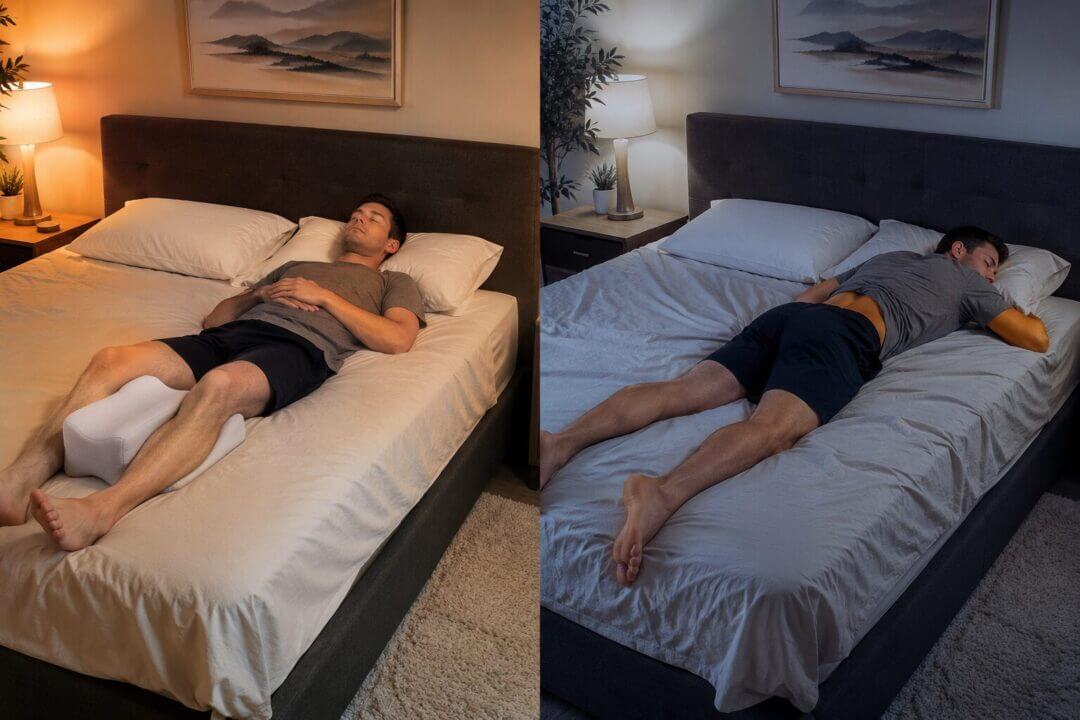
How to Use Pillows to Support Lower Back While Sleeping
Pillow placement is the single most effective immediate intervention for sleep-related lower back pain. Here’s exactly how to set up your pillows for each position.
Side sleeping setup:
- Place a pillow between your knees thick enough to keep your top leg level with your hip
- Use a head pillow with 4-6 inches of loft to fill the space between your ear and shoulder
- Optional: add a full-body pillow to support your entire top leg and prevent backward rolling
- Optional: place a small rolled towel under your waist to fill the gap between your side and the mattress
Back sleeping setup:
- Place a pillow under your knees to create a slight bend (4-6 inches thick)
- Use a thinner head pillow that keeps your head aligned with your spine
- Optional: place a small rolled towel under your lower back to support the lumbar curve
- Optional: place small pillows under your arms to prevent shoulder rotation
Fetal position setup:
- Draw your knees gently toward your chest (not tightly curled)
- Place a thick pillow between your knees
- Use a supportive head pillow with adequate loft
- Consider a full-body pillow to maintain the position through the night
Common pillow mistakes:
Using the same head pillow for side and back sleeping. Not replacing the knee pillow when it compresses flat during the night. Using a pillow that’s too thick under the knees, which can hyperextend the knee joint. Placing a pillow under the lower back without also using a knee pillow (back sleepers).
The goal of all pillow placement is to maintain your spine’s natural S-curve. Your ears, shoulders, and hips should form a straight line when you’re on your side, and your lumbar curve should be gently supported when you’re on your back.
Can Changing Sleep Position Cure Chronic Lower Back Pain?
Changing your sleep position alone won’t cure chronic lower back pain, but it’s an essential part of a comprehensive treatment approach. Sleep position affects how much recovery happens overnight and whether you’re adding to your pain burden or reducing it.
What sleep position can do:
Reduce mechanical strain on your spine during the 7-8 hours you’re in bed. Allow your muscles and ligaments to fully relax and recover. Decrease inflammation by reducing pressure on irritated structures. Improve sleep quality, which reduces pain sensitivity and supports healing.
What sleep position cannot do:
Fix structural problems like herniated discs, spinal stenosis, or spondylolisthesis. Reverse degenerative changes in your spine. Compensate for weak core muscles or poor daytime posture. Replace medical treatment for serious spinal conditions.
Realistic expectations:
Allow 1-2 weeks for your body to adapt to a new sleep position before deciding if it works. Improvement is usually gradual, not immediate. Temporary discomfort in a new position doesn’t mean the position is wrong—your body needs time to adjust.
If you’ve optimized your sleep position and pillow setup but still have significant pain after 4-6 weeks, it’s time to see a doctor or physical therapist. Persistent pain despite conservative measures suggests you need a specific diagnosis and targeted treatment.
Best Sleep Position for Pregnant Women with Lower Back Pain
Pregnancy creates unique lower back challenges because your center of gravity shifts forward and your abdominal weight pulls your lumbar spine into extension. The hormone relaxin also loosens your ligaments, reducing spinal stability.
The best position: left side sleeping in a modified fetal position. Left side sleeping improves circulation to the placenta and reduces pressure on your liver. The gentle knee-to-chest curve reduces lumbar strain.
Essential pillow setup for pregnancy:
- Full-body pregnancy pillow that supports your belly, back, and top leg simultaneously
- Thick pillow between your knees to keep your hips level
- Additional pillow under your belly for support as your pregnancy progresses
- Pillow behind your back to prevent rolling onto your back during sleep
Why back sleeping becomes problematic in later pregnancy:
After about 20 weeks, back sleeping can compress your inferior vena cava (the large vein that returns blood from your lower body to your heart). This reduces blood flow to the placenta and can cause dizziness, shortness of breath, and lower back pain.
If you wake up on your back:
Don’t panic—the discomfort would wake you before any harm occurred. Simply roll back onto your side. Use a wedge pillow or rolled blanket behind your back to make it physically difficult to roll onto your back during sleep.
Pregnancy-related lower back pain usually improves after delivery, but establishing good sleep positioning habits during pregnancy can prevent chronic pain from developing postpartum.
Sleeping on the Floor for Lower Back Pain: Does It Work?
Sleeping on the floor for lower back pain is not recommended. While some people report temporary relief, a hard surface creates pressure points that can worsen pain and doesn’t provide the support your spine needs.
The theory behind floor sleeping:
Proponents claim that a very firm surface prevents the hips from sagging and maintains spinal alignment. Some cultural traditions include floor sleeping with minimal padding.
The reality:
Your body has natural curves that need support, not just a flat surface. Pressure points at your hips and shoulders force you to compensate by curving your spine in unhealthy ways. Most people who try floor sleeping abandon it within a few nights because it’s uncomfortable.
If you’re considering floor sleeping:
Try a firm mattress first—it provides support without the pressure point problems of a hard floor. If you must sleep on the floor, use a yoga mat or thin camping pad for minimal cushioning. Place pillows under your knees (back sleeping) or between your knees (side sleeping) just as you would on a mattress.
When floor sleeping might provide temporary relief:
If your current mattress is extremely old and sagging badly, even a floor might feel better by comparison. But the solution is replacing your mattress, not permanently sleeping on the floor.
The evidence doesn’t support floor sleeping as a treatment for lower back pain. A medium-firm mattress with proper pillow support is far more effective and sustainable.
Common Mistakes People Make When Sleeping with Back Pain
Mistake 1: Using the same sleep position that caused the pain in the first place. If you’ve always been a stomach sleeper and you have chronic lower back pain, the two are probably connected. Change your position.
Mistake 2: Not using a knee pillow. This is the single most common error. Side sleepers need a pillow between their knees, and back sleepers need a pillow under their knees. No exceptions.
Mistake 3: Using the wrong head pillow for your sleep position. Side sleepers need a thick pillow; back sleepers need a thin pillow. Using the same pillow for both positions creates neck and upper back strain that compounds lower back pain.
Mistake 4: Expecting immediate results. Your body needs 1-2 weeks to adapt to a new sleep position. Temporary discomfort doesn’t mean the position is wrong.
Mistake 5: Ignoring your mattress. If your mattress is more than 10 years old or visibly sagging, no amount of pillow adjustment will fully compensate. Replace it.
Mistake 6: Sleeping in a position that helps your back but worsens your snoring. If you snore and have back pain, you need to prioritize side sleeping, which helps both conditions. Back sleeping might feel better for your back but will make your snoring worse. For more on this balance, see our guide on the dangers of sleeping in the wrong position with sleep apnea.
Mistake 7: Not addressing daytime factors. Weak core muscles, poor posture, and excess weight all contribute to lower back pain. Sleep position helps, but it’s not a complete solution.
When Should I See a Doctor for Lower Back Pain That Worsens at Night?
Most lower back pain improves with conservative measures like sleep position changes, proper pillow support, and over-the-counter anti-inflammatory medication. But certain symptoms require medical evaluation.
See a doctor if you have:
Pain that radiates down your leg, especially below the knee (possible nerve involvement). Pain that doesn’t improve within 4-6 weeks of conservative measures. Pain that’s severe and worsening regardless of position. Pain accompanied by weakness, numbness, or tingling in your legs or feet. Loss of bladder or bowel control (this is a medical emergency). Pain that’s worse at night than during the day, especially if it wakes you from sleep. Unexplained weight loss along with back pain. History of cancer and new onset back pain.
Red flags that suggest serious pathology:
Night pain that’s unrelieved by position changes can indicate infection, tumor, or inflammatory conditions. Progressive neurological symptoms (weakness, numbness) suggest nerve compression that may require urgent intervention. Saddle anesthesia (numbness in the groin/inner thigh area) is a surgical emergency.
What to expect at a doctor’s visit:
Your doctor will take a detailed history and perform a physical examination. Imaging (X-ray, MRI, or CT) may be ordered if there are concerning features or if conservative treatment fails. Treatment options range from physical therapy and medications to injections or surgery, depending on the diagnosis.
Don’t let fear of a serious diagnosis keep you from seeking care. Most lower back pain has a benign cause, and early intervention prevents acute pain from becoming chronic.
Lifestyle and Treatment Approaches That Complement Better Sleep Positioning
Sleep position is one piece of a comprehensive approach to lower back pain. These complementary strategies work together with proper positioning to reduce pain and prevent recurrence.
Exercise and Core Strengthening
Weak core muscles place more load on your passive spinal structures during sleep. Your discs, ligaments, and facet joints have to work harder to maintain alignment when your muscles aren’t doing their job.
Targeted exercises that help:
Bird-dog exercises strengthen your deep core stabilizers without loading your spine. Dead bug exercises build anti-rotation strength that protects your back during movement. Glute bridges strengthen your hip extensors and reduce strain on your lower back. Planks build endurance in your core muscles, but avoid them if they cause pain.
Low-impact options:
Swimming provides resistance training without spinal compression. Yoga improves flexibility and reduces muscle tension, especially styles that emphasize gentle stretching. Walking strengthens your core and improves circulation without high impact.
Start slowly and build gradually. Aggressive exercise when you’re in pain can make things worse.
Weight Management
Excess abdominal weight shifts your lumbar spine into extension, worsening lower back strain both during the day and at night. Even modest weight loss—5-10% of your body weight—reduces the mechanical load on your lumbar spine.
Weight loss also reduces systemic inflammation, which contributes to pain sensitivity. The combination of reduced mechanical load and reduced inflammation often produces significant pain improvement.
Medical Treatments When Conservative Approaches Aren’t Enough
Physical therapy provides targeted exercises and manual therapy tailored to your specific diagnosis. A good physical therapist will also evaluate your sleep setup and make specific recommendations.
Chiropractic care offers spinal manipulation for appropriate candidates. Some people respond very well to manipulation, while others don’t—it’s worth trying if you haven’t.
Anti-inflammatory medication (NSAIDs like ibuprofen or naproxen) can reduce pain and inflammation during acute flare-ups. Use the lowest effective dose for the shortest time necessary.
Cortisone injections can provide relief for specific diagnoses like facet arthropathy or epidural injection for radiculopathy. They’re not a cure but can break the pain cycle and allow you to participate in physical therapy.
Surgery is reserved for structural causes (herniation with nerve compression, spinal stenosis, spondylolisthesis) that don’t respond to conservative care. Most lower back pain doesn’t require surgery.
Frequently Asked Questions
Conclusion
Your sleep position directly affects how much lower back pain you experience and how well your spine recovers overnight. Side sleeping in a gentle fetal position with a pillow between your knees is the best choice for most people because it actively decompresses your lumbar spine. Back sleeping with a pillow under your knees is the second-best option, maintaining neutral alignment and distributing weight evenly.
The pillow placement matters more than your mattress for immediate relief. A knee pillow for side sleepers and an under-knee pillow for back sleepers are non-negotiable if you want to reduce lower back strain. Your head pillow height should match your sleep position—thick for side sleeping, thin for back sleeping.
Stomach sleeping makes lower back pain worse for almost everyone. If you’re a committed stomach sleeper, transitioning to side sleeping is one of the most impactful changes you can make.
Allow 1-2 weeks for your body to adapt to a new sleep position before deciding if it works. Temporary discomfort doesn’t mean the position is wrong—your muscles and ligaments need time to adjust.
If you’ve optimized your sleep position and pillow setup but still have significant pain after 4-6 weeks, see a doctor or physical therapist. Persistent pain despite conservative measures suggests you need a specific diagnosis and targeted treatment.
Your next steps:
Tonight, set up your pillows correctly for your chosen sleep position. If you’re a side sleeper, place a pillow between your knees. If you’re a back sleeper, place a pillow under your knees. Give the new setup at least one week before making adjustments. If you snore and have back pain, commit to side sleeping—it helps both conditions simultaneously.
Track your morning pain level for two weeks to see if the changes are working. If you’re not improving, schedule an appointment with a physical therapist who can evaluate your specific situation and provide targeted guidance.
Your lower back pain doesn’t have to be permanent. Small changes to how you sleep can make a significant difference in how you feel every morning.