

How to Tell If You Have Insomnia: Signs, Symptoms, and Self-Assessment
You’ve spent another night watching the ceiling. Your brain won’t stop running through tomorrow’s tasks, last week’s conversations, and every embarrassing thing you’ve ever said.
When you finally drift off around 4am, the alarm screams at 6:30. You drag yourself through the day fueled by coffee and willpower, snapping at your partner over nothing, forgetting why you walked into rooms.
You tell yourself everyone has bad nights, but this has been happening three, four, five times a week for months. The signs of insomnia aren’t always obvious when you’re living inside them, but your body and brain are sending clear signals that something needs to change.
Recognizing the signs of insomnia is the first step toward sustainable recovery. You can’t fix what you can’t name, and you can’t choose the right remedy if you don’t understand your sleep disruptor.
Key Takeaways
- Insomnia requires both nighttime difficulty AND daytime impairment to meet diagnostic criteria, not just trouble sleeping
- Three main patterns exist: difficulty falling asleep (sleep-onset), waking during the night (sleep-maintenance), or waking too early (terminal insomnia)
- Frequency matters: insomnia is diagnosed when symptoms occur 3+ nights per week for at least 3 months (chronic) or under 3 months (acute)
- Validated self-assessment tools like the Insomnia Severity Index and sleep diaries provide objective data about your sleep baseline
- Red flag symptoms like gasping, snoring, or leg sensations suggest other sleep disorders that need different treatment approaches
Do You Have Insomnia or Just a Bad Night’s Sleep?
Everyone has occasional sleep difficulty. You stay up too late binge-watching a series, your neighbor’s dog barks all night, you drink espresso at 8pm without thinking. These are normal disruptions that resolve on their own.
Insomnia is different. It’s a diagnosable condition with specific criteria that separate it from the universal experience of a bad night.
The clinical definition requires two components working together: nighttime difficulty (trouble falling asleep, staying asleep, or waking too early) AND daytime impairment (your functioning suffers because of the sleep loss). You need both halves.
If you sleep poorly but feel fine during the day, that’s not insomnia. If you feel tired during the day but sleep through the night without difficulty, that’s also not insomnia.
This two-part requirement explains why so many people live with undiagnosed insomnia for years. They normalize the daytime symptoms. They tell themselves everyone feels foggy and irritable, that fatigue is just part of adult life, that their declining work performance is about motivation rather than sleep.
They don’t connect the nighttime struggle with the daytime consequences until someone points out the pattern or until the consequences become impossible to ignore.
Understanding the difference between bad sleep and insomnia helps you decide whether you need intervention or just better sleep hygiene for a few nights.
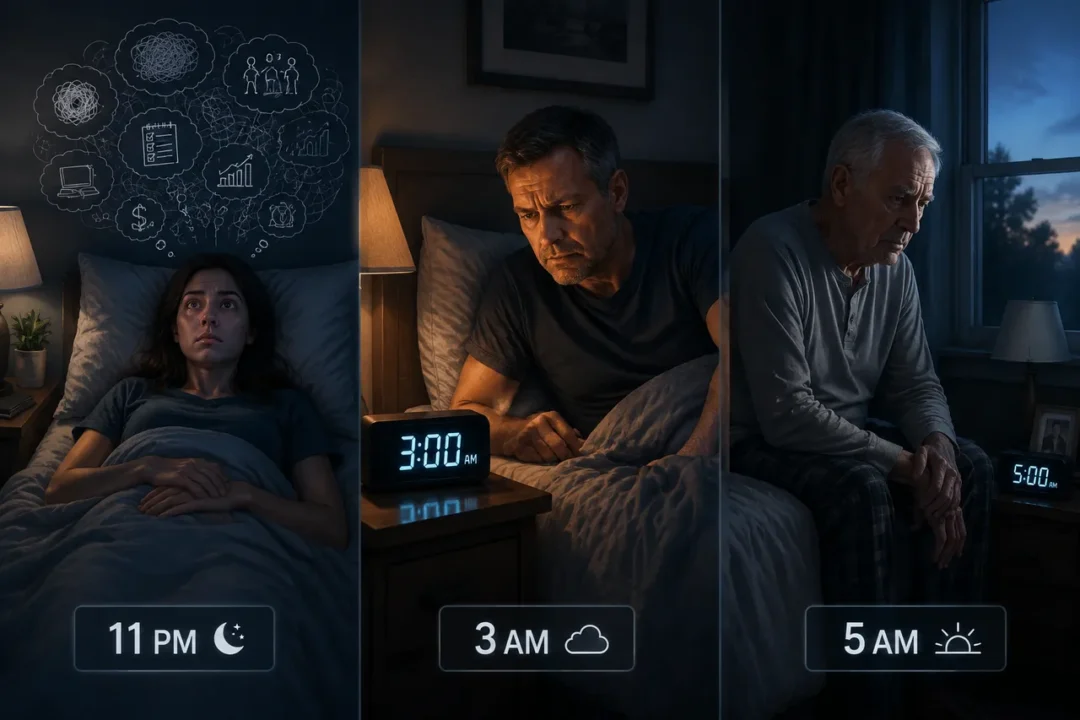
The Three Nighttime Symptom Presentations
Insomnia doesn’t look the same for everyone. Your sleep profile determines which pattern you experience, and understanding your specific presentation helps you match the habit to your pattern rather than trying remedies designed for someone else’s sleep disruptor.
Sleep-Onset Insomnia
You get into bed at a reasonable hour. Your body feels tired. Then your brain switches on like someone flipped a circuit breaker.
Sleep-onset insomnia means lying awake for 30 minutes or more after you intend to fall asleep. Your mind races through worries, plans, random memories, anything except the quiet blankness that leads to sleep. Your body feels wired despite the exhaustion. You shift positions, flip the pillow, check the clock, and watch the minutes pile up.
This pattern typically affects younger adults and people with anxiety disorders. The mechanism involves hyperarousal: your nervous system stays in a heightened state of alertness when it should be winding down.
Your brain produces too much cortisol and adrenaline in the evening hours, and your body temperature doesn’t drop the way it needs to for sleep initiation. The sympathetic nervous system (fight-or-flight) stays dominant when the parasympathetic system (rest-and-digest) should take over.
People with sleep-onset insomnia often describe feeling “tired but wired.” They want to sleep but can’t make it happen through willpower alone.
Sleep-Maintenance Insomnia
You fall asleep without much trouble. Then you wake up at 2am, 3am, 4am, sometimes multiple times per night. Each awakening lasts 20 minutes, 40 minutes, sometimes over an hour.
Sleep-maintenance insomnia involves frequent or prolonged nighttime awakenings. Sleep researchers call the time you spend awake after initially falling asleep “wake after sleep onset” or WASO. High WASO means fragmented sleep architecture, even if your total time in bed looks adequate on paper.
This pattern typically affects middle-aged adults, people with chronic pain conditions, and those with depression. The mechanism often involves disrupted sleep cycles: your brain doesn’t transition smoothly between sleep stages, or external factors (pain signals, temperature changes, bladder pressure) pull you out of deeper sleep stages into lighter ones.
Your cortisol levels may spike in the middle of the night instead of staying low until morning.
People with sleep-maintenance insomnia often get enough total sleep time but wake up feeling unrefreshed because the sleep quality suffers from all the interruptions.
Early-Morning Awakening (Terminal Insomnia)
You fall asleep fine. You sleep through most of the night. Then you wake up at 4am or 5am, one to two hours before you need to, and you can’t get back to sleep no matter what you try.
Terminal insomnia involves waking too early with an inability to return to sleep. The early morning hours often bring a heavy, low mood that lifts somewhat as the day progresses. You lie there in the dark feeling trapped between exhaustion and wakefulness.
This pattern typically affects older adults and people with depression. The mechanism often involves circadian rhythm shifts (your internal clock runs too early) or abnormal cortisol patterns (your cortisol rises too early in the morning, pulling you out of sleep before you’ve had enough). Depression specifically disrupts REM sleep timing, causing early-morning awakenings with rumination.
People with terminal insomnia often describe the early morning hours as the worst part of their day, both physically and emotionally.
Mixed Presentation
Most people with insomnia don’t fit neatly into one category. You might have trouble falling asleep AND wake up too early. You might fall asleep quickly on some nights but wake frequently on others.
Mixed presentation is actually more common than pure types. Your sleep inventory should track all three patterns across multiple nights to identify your dominant disruptor, because that’s what you’ll target first in your sleep protocol.
Daytime Symptoms: The Overlooked Half of the Diagnosis
Insomnia cannot be diagnosed without daytime impairment. This is the part most people miss when they’re trying to figure out if they have a real problem or just annoying nights.
The nighttime symptoms get all the attention because they’re obvious and frustrating. But the daytime consequences are what actually define insomnia as a disorder rather than an inconvenience.
Cognitive Symptoms
Your brain runs on sleep. When you don’t get enough quality sleep, your cognitive function declines in measurable ways.
Concentration suffers first. You read the same paragraph three times without absorbing it. You lose track of conversations mid-sentence. You sit in meetings without retaining what people say.
Memory formation requires sleep, specifically the consolidation that happens during deep sleep and REM sleep. When those stages get disrupted or shortened, your brain can’t properly store new information. You forget appointments, names, where you put your keys, what you were supposed to pick up at the store.
Decision-making becomes harder because your prefrontal cortex (the part that handles executive function) is particularly sensitive to sleep loss. You struggle with choices that would normally feel straightforward. You second-guess yourself constantly.
Emotional Symptoms
Sleep deprivation affects emotional regulation through multiple pathways. Your amygdala (the brain’s emotional center) becomes hyperactive when you’re sleep-deprived, while the prefrontal cortex that normally keeps emotional responses in check becomes less effective.
Irritability shows up first for most people. Small annoyances feel like major provocations. You snap at people you care about over trivial things. Your patience disappears.
Anxiety about sleep itself becomes a secondary symptom. You start worrying about whether you’ll sleep tonight, which creates a self-fulfilling cycle of hyperarousal. The fear of sleeplessness becomes its own sleep disruptor.
Social withdrawal happens gradually. You cancel plans because you’re too tired. You avoid social situations that require energy and engagement. You isolate yourself without fully realizing you’re doing it.
Physical Symptoms
Chronic sleep loss triggers a stress response in your body. Your cortisol levels stay elevated, your inflammatory markers increase, and your nervous system stays in a heightened state.
Fatigue is obvious but worth naming specifically. This isn’t the normal tiredness that comes from a busy day. It’s a bone-deep exhaustion that doesn’t improve with rest, a heaviness that makes every task feel harder than it should.
Tension headaches cluster around the temples and forehead, caused by sustained muscle tension and stress hormone elevation. They’re dull and persistent rather than sharp and throbbing.
Muscle aches appear in the neck, shoulders, and back because your body doesn’t get the full muscle relaxation and repair that happens during deep sleep stages. You wake up feeling stiff and sore.
Performance Symptoms
The impact of insomnia on daily life extends into every area of function. Your work performance declines because you can’t focus, you make more errors, and you take longer to complete tasks. Your productivity drops even though you’re working the same hours.
Relationship strain develops because you’re irritable, withdrawn, and less emotionally available. Your partner or family members notice the changes even if you don’t fully recognize them yourself.
The daytime symptoms are what push most people to finally seek help. The nighttime struggle alone isn’t enough to motivate change, but when your job performance suffers or your relationships start cracking, you realize you need to address the root problem.
The Frequency and Duration Test
Not every bad night counts as insomnia. The diagnostic criteria include specific thresholds for frequency and duration that separate temporary sleep disruption from a persistent disorder.
Frequency threshold: Insomnia requires symptoms occurring three or more nights per week. One or two bad nights per week, even if they’re really bad, doesn’t meet the clinical definition. Your sleep inventory needs to show a consistent pattern across multiple nights, not occasional disruption.
Duration categories: Acute insomnia lasts less than three months. Chronic insomnia persists for three months or longer. The distinction matters because treatment approaches differ slightly, and chronic insomnia often requires more intensive intervention.
These thresholds exist for good reason. They filter out normal sleep variability and temporary stress responses. Everyone has a bad week when life gets chaotic. That’s not insomnia. Insomnia is when the pattern persists despite the absence of obvious external stressors, or when it continues long after the initial trigger has resolved.
Understanding acute insomnia helps you catch problems early before they become chronic. Acute insomnia often responds well to basic sleep hygiene improvements and stress management.
Chronic insomnia typically requires more structured intervention because the sleep disruption has become a learned pattern that persists independently of the original cause.
Validated Self-Assessment Tools
Self-awareness before sleep aids. You need objective data about your sleep baseline before you can choose appropriate interventions or decide whether to seek professional help.
Insomnia Severity Index (ISI)
The ISI is a seven-item questionnaire that measures insomnia severity. It asks about difficulty falling asleep, staying asleep, and waking too early, plus questions about satisfaction with sleep, interference with daily functioning, noticeability of impairment, and degree of worry about sleep.
Each item scores 0-4, giving a total range of 0-28. The interpretation breaks down like this: 0-7 indicates no clinically significant insomnia, 8-14 indicates subthreshold insomnia, 15-21 indicates moderate insomnia, and 22-28 indicates severe insomnia.
You can complete the ISI in about five minutes. It gives you a baseline number to track over time as you implement changes. If your score is 15 or above, that’s a strong signal to seek professional evaluation rather than relying solely on self-help strategies.
Pittsburgh Sleep Quality Index (PSQI)
The PSQI measures sleep quality over the past month using seven component scores: subjective sleep quality, sleep latency (how long it takes to fall asleep), sleep duration, sleep efficiency (percentage of time in bed actually spent asleep), sleep disturbances, use of sleep medication, and daytime dysfunction.
Each component scores 0-3, and the seven components sum to a global score ranging from 0-21. A global score above 5 indicates poor sleep quality. The PSQI is more comprehensive than the ISI and captures different dimensions of sleep problems.
The sleep efficiency calculation is particularly useful: divide your total sleep time by your total time in bed, then multiply by 100. Healthy sleep efficiency is 85% or higher. If you’re in bed for 8 hours but only sleeping 6, your sleep efficiency is 75%, which indicates either insomnia or another sleep disorder.
The Sleep Diary: Your Most Powerful Self-Assessment Tool
Validated questionnaires give you snapshot data. A sleep diary gives you pattern data across multiple nights, which is far more valuable for understanding your specific sleep disruptor.
Track these variables for at least two weeks: bedtime, time you tried to fall asleep, estimated sleep latency (how long it took), number of nighttime awakenings, duration of awakenings, final wake time, time out of bed, total sleep time, sleep quality rating (1-10), daytime naps, caffeine intake (amount and timing), alcohol intake, exercise, and notable stressors or events.
The sleep diary reveals patterns you can’t see from memory alone. You might think you sleep poorly every night, but the diary shows you actually sleep well on weekends when you’re not stressed about work.
You might not realize your sleep latency is consistently shorter on days you exercise. You might discover your nighttime awakenings cluster around nights you drink alcohol, even though you thought alcohol helped you sleep.
Calculate your sleep efficiency from the diary data: total sleep time divided by total time in bed. Track how it changes across the two weeks. Look for correlations between daytime behaviors and nighttime sleep quality.
Insomnia self-assessment tools provide the foundation for informed decision-making. You’re building your sleep profile through data collection, not guessing based on how you feel on any given day.
Symptoms That Suggest Something Other Than Insomnia
Not all sleep problems are insomnia. Several other sleep disorders produce symptoms that overlap with insomnia but require completely different treatment approaches. Recognizing these red flags prevents you from pursuing the right remedy for the wrong sleeper.
Sleep Apnea Red Flags
Sleep apnea involves repeated breathing interruptions during sleep. Your airway partially or completely collapses, oxygen levels drop, and your brain briefly wakes you to restore breathing. This happens dozens or hundreds of times per night, fragmenting your sleep architecture without you fully realizing it.
Red flag symptoms include loud snoring (especially with gasping or choking sounds), witnessed breathing pauses during sleep, excessive daytime sleepiness (falling asleep during passive activities like watching TV or reading), morning headaches, and waking with a dry mouth or sore throat.
You might also experience sleep-maintenance insomnia because the breathing interruptions wake you, but the underlying cause is mechanical rather than psychological.
If you have these symptoms, you need a sleep study, not insomnia treatment. CPAP therapy or other apnea interventions will resolve the sleep disruption. Cognitive behavioral therapy for insomnia won’t help because the problem isn’t in your sleep drive or circadian rhythm.
Restless Legs Syndrome Red Flags
Restless legs syndrome (RLS) causes uncomfortable sensations in your legs (and sometimes arms) that create an irresistible urge to move. The sensations typically worsen in the evening and at night, making it difficult to fall asleep or stay asleep.
Red flag symptoms include crawling, tingling, pulling, or aching sensations deep in the legs, symptoms that worsen with rest and improve with movement, symptoms that follow a circadian pattern (worse in evening/night), and temporary relief from walking or stretching.
You might describe it as feeling like you need to move your legs to get comfortable, but comfort never quite arrives.
RLS often responds to iron supplementation (if ferritin levels are low), magnesium, or specific medications. Standard insomnia treatments won’t address the underlying sensory-motor dysfunction.
Circadian Rhythm Disorder Red Flags
Circadian rhythm disorders involve a mismatch between your internal biological clock and your desired or required sleep schedule. Your sleep drive and timing are normal, but they’re shifted earlier or later than you need them to be.
Red flag symptoms include sleeping well when you follow your natural schedule (sleeping late on weekends or vacations) but struggling when you try to sleep at conventional times, consistent patterns of being a “night owl” or “morning lark” that don’t respond to sleep hygiene changes, and feeling alert and energetic at times when you’re supposed to be sleeping.
If you sleep great from 3am to 11am but can’t fall asleep at 11pm no matter what you try, you likely have delayed sleep phase disorder rather than insomnia. The treatment involves light therapy and chronotherapy (gradually shifting your sleep schedule), not the cognitive and behavioral interventions used for insomnia.
How doctors diagnose insomnia includes ruling out these other sleep disorders through clinical interview, questionnaires, and sometimes sleep studies. Self-assessment can point you in the right direction, but professional evaluation is necessary when red flags appear.
When to See a Doctor
Self-assessment and self-help strategies work well for many people with mild to moderate insomnia. But certain situations require professional evaluation and treatment.
Seek professional help if: Your ISI score is 15 or above (moderate to severe insomnia). Your symptoms have persisted for three months or longer despite consistent sleep hygiene efforts.
You have red flag symptoms suggesting sleep apnea, restless legs syndrome, or another sleep disorder. Your daytime functioning is significantly impaired (you’re making serious errors at work, your relationships are suffering, you’re having accidents or near-misses due to fatigue).
You’re experiencing depression, anxiety, or other mental health symptoms alongside the insomnia. You’re using alcohol or medications to help you sleep. You have chronic pain or medical conditions that might be contributing to sleep disruption.
What to bring to your appointment: Your completed sleep diary covering at least two weeks. Your ISI score and any other self-assessment results. A list of all medications and supplements you’re taking (including over-the-counter sleep aids). Notes about what you’ve already tried and how it worked. Specific questions about treatment options.
Your doctor will likely ask detailed questions about your sleep patterns, daytime symptoms, medical history, psychiatric history, medication use, substance use, and sleep environment.
They may order blood tests to check thyroid function, iron levels, or other factors that can affect sleep. They might refer you for a sleep study if they suspect sleep apnea or another disorder.
Recognizing when to seek professional help is part of building sustainable recovery. Self-awareness includes knowing the limits of self-help and recognizing when you need expert guidance.
Frequently Asked Questions
Your Sleep Inventory Starts Now
You’ve learned the signs of insomnia across nighttime and daytime symptoms. You understand the frequency and duration thresholds that separate normal sleep variability from a diagnosable disorder. You know which self-assessment tools provide objective data about your sleep baseline.
The next step is data collection, not intervention. Spend two weeks tracking your sleep with a detailed diary. Complete the Insomnia Severity Index. Calculate your sleep efficiency. Look for patterns in what disrupts your sleep and what helps.
This is your sleep inventory, the foundation for everything that comes next. You’re building self-awareness before reaching for sleep aids. You’re identifying your specific sleep disruptor so you can match the habit to your pattern rather than trying random remedies designed for someone else’s problem.
The signs of insomnia are clear once you know what to look for. Your body has been sending signals all along. Now you’re learning to read them accurately and respond with precision rather than guesswork.
Start your sleep diary tonight. Track for two weeks. Then you’ll have the data you need to build your sleep protocol from a foundation of deep understanding rather than desperate trial and error.