

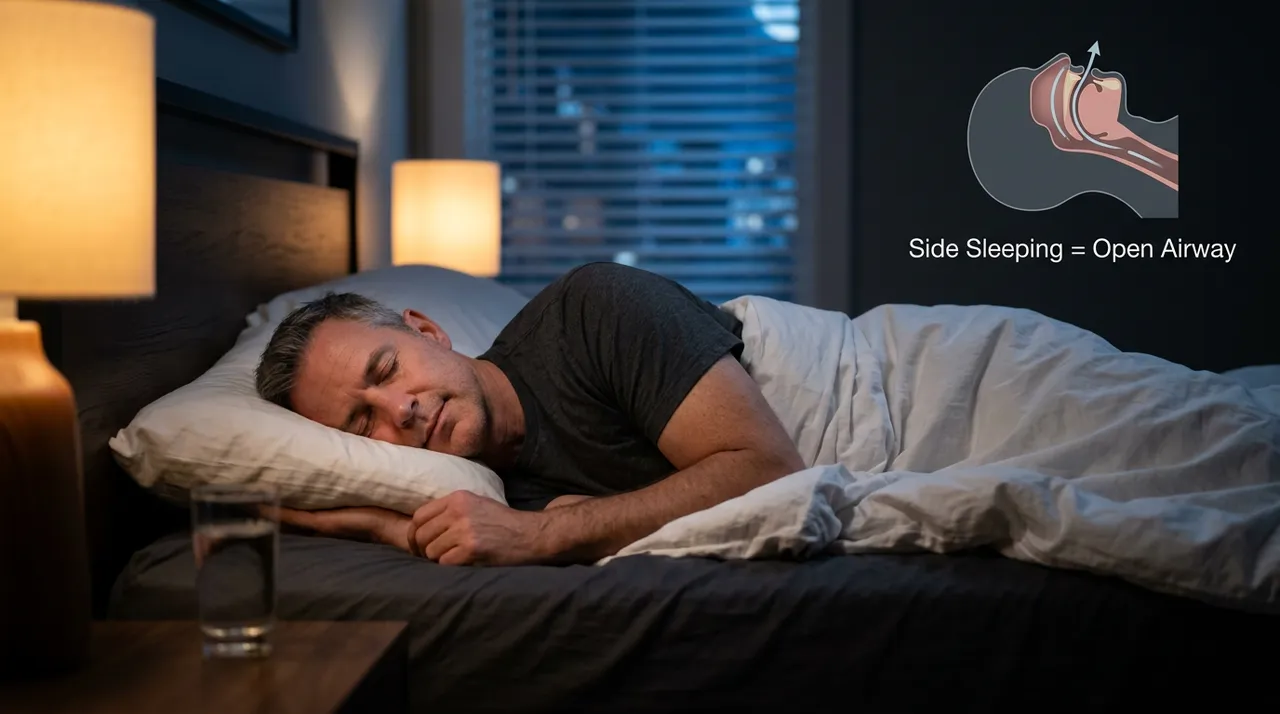
Sleep Position and Sleep Apnea: How to Sleep to Reduce Your AHI
You already know the diagnosis. What you may not know is that how you position yourself in bed each night is actively changing your AHI score, sometimes dramatically, without you touching a single setting on your machine.
Sleep position isn’t just about comfort. It’s a measurable clinical variable in how severe your sleep apnea behaves hour by hour.
Why Sleep Position Is a Clinical Variable in OSA Management
Your apnea-hypopnea index tells you how many breathing events per hour you experience. What your report might not spell out is how much that number shifts depending on whether you’re on your back or your side.
Researchers define “positional OSA” as a condition where your supine (back-sleeping) AHI is at least twice your lateral (side-sleeping) AHI. Studies consistently show that roughly 50 to 60 percent of OSA patients meet that definition.
That’s not a small number. For millions of people with a sleep apnea diagnosis, position is the difference between manageable nights and dangerous ones.
How Back Sleeping Makes OSA Worse
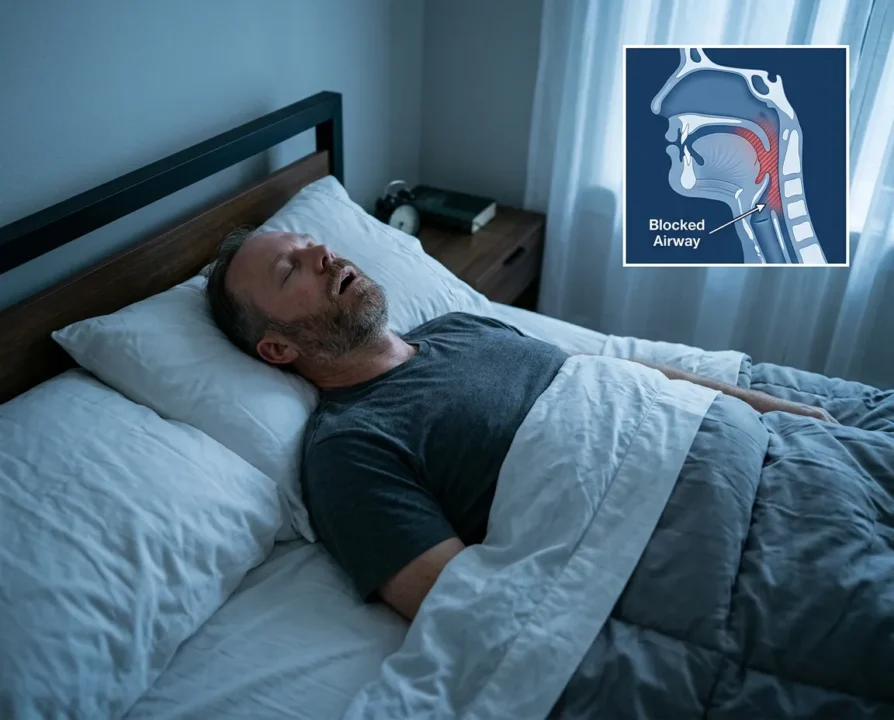
Picture what happens when you roll onto your back. Gravity pulls your tongue, soft palate, and uvula straight backward into the pharyngeal airway.
Your lower jaw drops. Your tongue base falls into the hypopharynx, the deepest part of the throat before the airway splits toward the lungs.
The result is a dramatically narrower airway. In positional OSA patients, the supine AHI is typically two to three times higher than the lateral AHI measured during the same night.
There’s a timing problem, too. OSA events are most frequent and most severe during REM sleep, which is also the stage when muscle atonia is deepest. REM concentrates in the second half of the night, right when most people have quietly migrated from their side onto their back without knowing it.
You can start the night well and still lose the second half entirely because of position.
Side Sleeping: What the Research Actually Shows
The clinical evidence here is consistent. Lateral sleeping significantly reduces AHI in patients with positional OSA, and in some mild-to-moderate cases, it brings AHI below the clinical threshold of five events per hour.
That’s a meaningful result. Some people achieve what looks like a normal AHI simply by staying off their back.
Both the left side and the right side improve outcomes compared to supine. If you also deal with acid reflux, left-side sleeping has an additional advantage: it keeps the stomach-esophagus junction elevated and reduces the nocturnal reflux that independently irritates your throat and compounds apnea events.
Head elevation is worth understanding as a fallback. Raising the head of your bed 30 to 60 degrees using a wedge pillow or adjustable base reduces the gravitational contribution to airway collapse even in back sleepers. Don’t stack regular pillows to accomplish this because it creates a chin-to-chest angle that actually increases airway resistance.
CPAP and Sleep Position: Why Mask Selection Changes Everything
If you’re already on CPAP, position affects more than your airway. It affects how well your mask seals.
The Mask Leak Problem in Side Sleepers
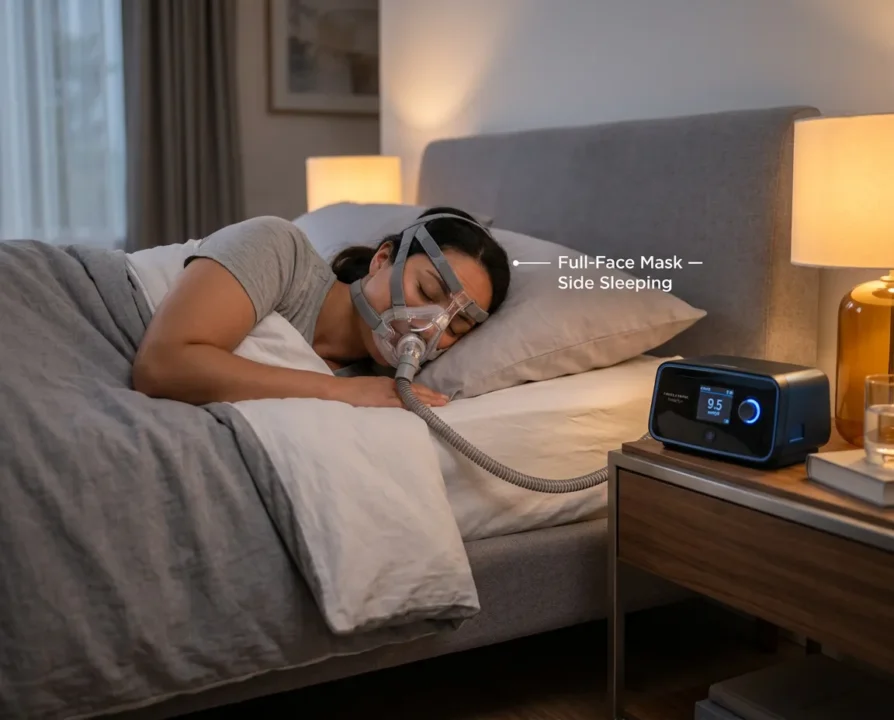
Standard full-face masks and many traditional nasal masks are designed to seal against a face lying relatively flat. Press those frames against a pillow during lateral sleeping and you break the seal.
When the seal breaks, your machine shows elevated leak rate on the same nights your AHI looks elevated. The machine isn’t failing. The mask geometry is wrong for the position.
The Right Mask for Side Sleeping
Nasal pillow masks are the most side-sleep-compatible option available. They use soft nasal tips that seal at the base of each nostril rather than a large frame pressing against the face, so pillow contact is far less likely to compromise the fit.
CPAP-specific pillows are the other piece of the puzzle. They’re designed with carved channels and cutouts that accommodate mask frames during lateral sleeping without mechanical compression. If you’re waking to loud air escapes, a CPAP pillow is frequently the fix, not a new mask.
APAP vs. Fixed CPAP and Position
Fixed CPAP is calibrated to manage your worst expected position, which is typically supine. In lateral sleeping, that pressure may be higher than you actually need, which can cause aerophagia and discomfort.
APAP machines adjust breath by breath. If your data shows clear position-related AHI spikes, switching from fixed CPAP to APAP is worth discussing with your sleep specialist because it delivers what the airway needs moment to moment rather than applying the supine ceiling all night.
Positional Therapy Devices for OSA Patients
For OSA patients, positional therapy isn’t optional lifestyle advice. It’s a clinically validated intervention.
Electronic Position Trainers
These devices use an accelerometer to detect when you’ve rolled supine. They deliver a gentle, escalating vibration designed to prompt a position shift without fully waking you.
Long-term compliance with electronic trainers sits at 60 to 76 percent, far above the 6 to 29 percent typically seen with the tennis ball technique. They also generate objective nightly position data, which you can cross-reference with your CPAP AHI reports to see exactly how position and breathing correlate for you specifically.
The Snorecoach is a well-regarded option in this category, with Bluetooth connectivity and a companion app for tracking your positional data over time. You can read a full breakdown in our Snorecoach Review.
Positional Belts and Bumper Vests
If you need more aggressive supine prevention, bumper belt systems create a physical zone that makes back sleeping mechanically difficult. Clinical studies on the Rematee Anti-Snore Bumper Belt have shown an 80 percent success rate in preventing supine sleeping.
Compliance tends to be lower than with electronic trainers because wearable comfort is the limiting factor. But for patients who need a reliable physical barrier, it works.
Our SlumberBump Review covers the specifics on fit, night-to-night comfort, and what to expect.
Physical Therapy for Sleep Position
This one gets overlooked almost completely, but it matters. If shoulder pain, hip discomfort, or neck strain is the real reason you keep ending up on your back, no device will solve that problem without addressing the underlying physical barrier.
Physical therapists who specialize in sleep posture can assess the specific musculoskeletal issues making lateral sleeping painful or impossible. Targeted stretching, strengthening, and pillow height adjustments frequently make it possible to hold a side-sleeping position through the night when nothing else has worked.
If pain is your obstacle, that’s where the conversation should start.
Using Your CPAP Data to Evaluate Position Changes
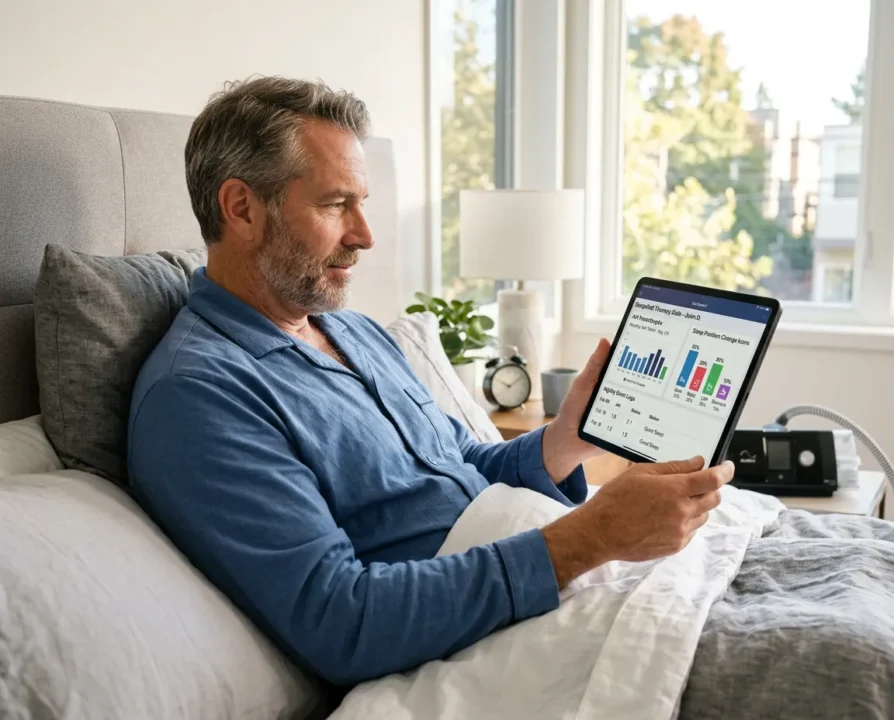
Your CPAP machine is already measuring exactly what you need to evaluate whether a position change is working. Most modern machines record AHI, leak rate, and applied pressure nightly, with apps like MyAir (ResMed) and OSCAR making that data accessible and readable.
The approach is straightforward. Download two weeks of CPAP data before making any position changes and note your average AHI and leak rate as a baseline. Then implement one change, use it consistently for two weeks, and compare.
A working position change typically shows a lower AHI. Watch leak rate too, because an improvement in position sometimes reveals a mask fit issue that wasn’t visible before.
Bring four weeks of before-and-after data to your next appointment. Position-correlated AHI changes give your sleep specialist the information they need to consider pressure adjustments or a switch to APAP.
When Position Changes Aren’t Enough
Position therapy works best for mild positional OSA, as an adjunct to CPAP for residual events, and as a compliance bridge when mask fit in supine is compromising treatment. It isn’t a standalone fix for everyone.
If your AHI stays above five events per hour even in your best lateral position, or if your OSA is moderate to severe regardless of how you sleep, position alone won’t get you where you need to be. Central apnea events aren’t affected by position at all.
The escalation path looks like this. CPAP or APAP therapy remains the clinical gold standard for moderate to severe OSA. Custom oral appliance therapy is the American Academy of Sleep Medicine’s first-line recommendation for mild to moderate OSA and repositions the jaw independently of sleep position. In some cases, combining an oral appliance with positional therapy achieves AHI normalization that neither approach accomplishes alone.
One rule applies regardless of what you change: any shift in your primary treatment approach should be confirmed with a follow-up sleep study. Feeling less tired isn’t the same as a lower AHI, and you deserve the data that proves the change worked.
Frequently Asked Questions
Will sleeping on my side fix my sleep apnea? For positional OSA, lateral sleeping can bring AHI into the normal range for some mild cases. But confirm it with a follow-up sleep study rather than assuming improvement from how you feel.
Can I stop CPAP if I train myself to side sleep? Not without physician guidance and objective verification. Never discontinue CPAP based on subjective improvement alone.
How do I know if I have positional OSA? Your sleep study results should include positional data. Ask your sleep specialist specifically for your supine versus lateral AHI breakdown.
What if I keep waking up on my back? Use a body pillow alongside an electronic position trainer. The physical barrier and the vibration feedback work better together than either does alone.
Can my CPAP mask cause problems in side sleeping? Yes. Mask compression against a standard pillow is one of the most common causes of elevated CPAP leak in side sleepers. Switch to a nasal pillow mask and a CPAP-specific pillow to address it.
Your Next Step: One Night of Better Data
You don’t have to overhaul everything at once. Pick one variable: switch to your side, add a body pillow, or try a CPAP-specific pillow.
Run it for two weeks, pull your CPAP data, and see what the numbers say. That one comparison tells you more than a year of wondering.