

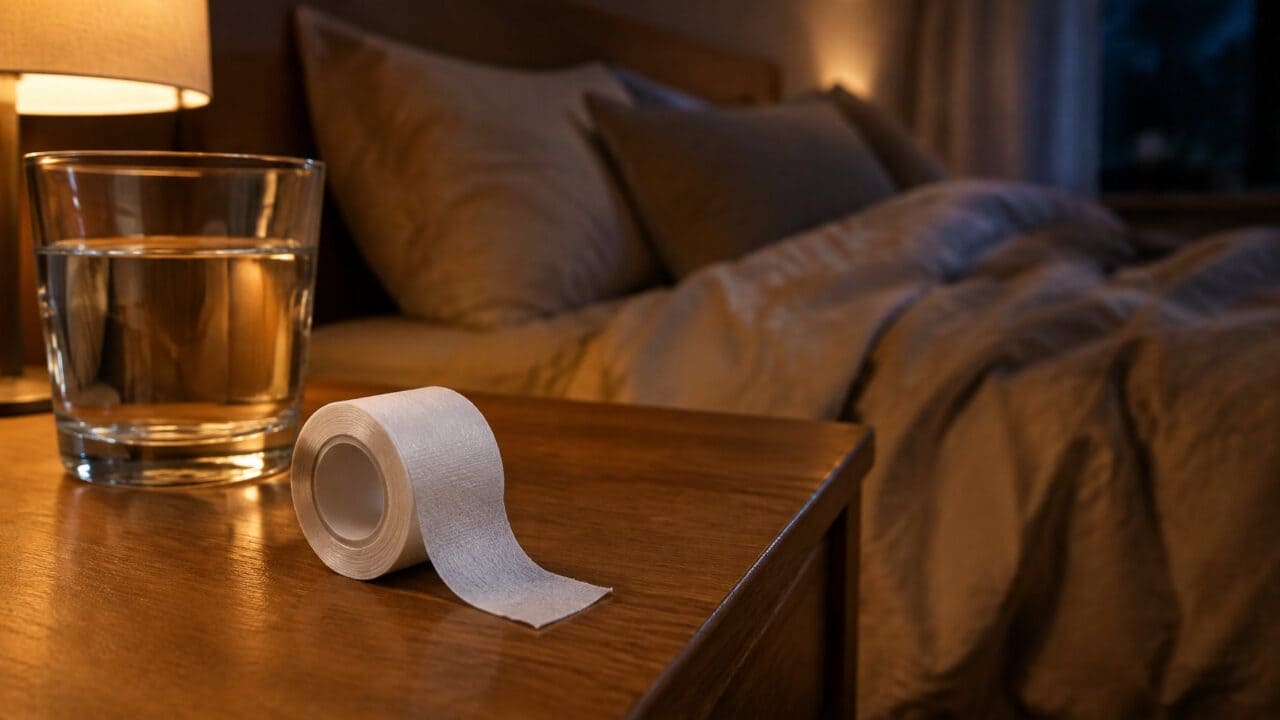
Mouth Taping for Sleep: What the Research Says and Who Should Skip It
You’ve seen the videos. Someone presses a strip of tape across their lips at bedtime, wakes up glowing, and swears the snoring is gone.
Maybe you’re a little skeptical. Maybe you’re a little tempted, and both reactions are fair.
Here’s the short version of what the research says. Tape can help a narrow slice of people, and it can hurt another slice, so the real job is figuring out which slice you’re in before you buy a roll.
Key Takeaways
- Mouth taping has thin and mixed evidence behind it, and the best reviews call for more research before anyone treats it as a standard fix.
- A blocked nose is the biggest red flag, because tape asks every breath to come through your nasal passages.
- Gasping, pauses, or heavy daytime sleepiness point toward a sleep apnea check, not a strip of tape.
Why Do People Tape Their Mouths Shut?
The idea is simple. When your mouth hangs open at night, air takes a shortcut over your tongue and soft palate, and those tissues flutter.

That flutter is the snore. Tape asks your lips to stay closed so air has to travel through your nose, which can steady the airway if your nose is up to the job.
That “if” carries a lot of weight. Our guide to mouth breathing during sleep covers what happens when it isn’t.
What Does the Research Actually Show?
Start with the biggest picture. A 2025 systematic review in PLOS One kept ten studies covering 213 patients in all.
Only two of those ten showed a statistically significant improvement in sleep apnea markers, such as the apnea-hypopnea index or oxygen drops. The rest found no difference, and some warned about a risk of suffocation when the nose is blocked.
A 2024 scoping review in the American Journal of Otolaryngology landed in a similar place. It found 177 studies, and only nine fit the question.
The reviewers also checked fifty popular TikTok videos. The most common promises were better sleep and better oral health, and few of those claims have been tested.
The Study That Looks Best for Tape
A small 2022 study in Healthcare tested 20 adults with mild sleep apnea who breathed through their mouths and could tolerate a sealed mouth. Each person took a baseline home sleep test, then a second one a week later with hypoallergenic silicone tape across their lips.
Thirteen of the twenty cut their snoring index by at least half. The median apnea-hypopnea index fell from 8.3 to 4.7 events per hour, and the lowest oxygen reading rose from 82.5 percent to 87 percent.
Now the fine print: the group was small, there was no separate control group, and everyone had to tolerate the tape to qualify.
Treat it as a hint, not a verdict.
The Study That Cools the Hype
A 2023 study in Nature and Science of Sleep put 71 adults through two home sleep tests. One night they slept normally, and the next night their mouths were taped.
About half the group did not improve on tape. Those who didn’t improve showed more intermittent mouth puffing, and people with more severe apnea tended to have narrower airways.
Tape as One Piece of a Bigger Plan
A 2024 pilot trial in JAMA Otolaryngology enrolled 50 couples, and 42 finished. One group used a mandibular advancement device, which is a mouthpiece that holds the lower jaw forward.
The other group got a bundle: an external nasal dilator, a saline rinse with mometasone, mouth taping, and side-sleeping therapy. Partners rated 21 of 23 mouthpiece users (91 percent) and 11 of 19 bundle users (58 percent) as much or very much improved.
Both approaches reduced snoring. But tape was only one ingredient in that bundle, so the trial can’t tell you what the tape did on its own.
Who Should Skip Mouth Taping?
The 2025 review’s authors pointed to a potentially serious risk of harm when people try the trend without screening. Many of the studies they reviewed excluded anyone with nasal obstruction, so the evidence doesn’t speak for you if your nose is often blocked.
That puts a few groups on the skip list:
- Anyone whose nose is stuffy from a cold, a deviated septum, or allergies.
- Anyone who wakes up gasping or choking, or whose partner has seen them stop breathing.
- Anyone who can’t peel the tape off quickly and easily in the dark.
- Children, unless a pediatric doctor has specifically suggested it.
If any of those fit, talk to your doctor before you try anything on your lips.
A Cautious Way to Test It
If your nose is clear and your doctor is fine with it, here’s a careful approach. It comes from common sense and the studies above, not from a tested protocol.

- Check that you can breathe through your nose comfortably for a full minute, in a quiet room.
- Wear a small strip for ten minutes while you’re awake, reading or watching TV.
- Choose a gentle, skin-safe tape made for the face, never duct tape or packing tape.
- Stop the moment you feel panicky, congested, or short of air.
- Record your snoring with a phone app for a week before and a week after, so you’re judging real numbers and not hopes.
The 2022 study used hypoallergenic silicone tape, which tells you the kind of product researchers reached for.
What Has Stronger Backing for Snoring?
The Australasian Sleep Association’s position statement on primary snoring lists weight loss and less alcohol where appropriate. It also suggests positional therapy for people who snore mostly on their backs.
For people with their own teeth, it recommends a mandibular advancement device as first-line treatment after a dentist and a sleep physician have assessed you. You can browse the anti-snoring mouthpieces and devices we cover.
Gentler tools help too. A chin strap keeps the jaw closed without sealing your lips, and throat and tongue exercises train the muscles behind the noise.
For a wider map of options, start with our guide to how to stop snoring.
When Snoring Means It’s Time for a Sleep Study
Loud snoring plus gasping, pauses in breathing, or exhaustion that sleep never fixes deserves a real test. Tape can’t diagnose sleep apnea, and it can’t replace treatment for it.
A doctor can order a home sleep test or an in-lab study to see what’s happening. Our post on waking up gasping for breath explains the warning signs.
Frequently Asked Questions
Your Next Step: Check Your Nose, Then Decide
Before any tape touches your skin, find out how well you breathe through your nose and whether your snoring has a medical cause. That one check separates the people tape might help from the people it could hurt.
If your nose is clear and the snoring is simple, try the safer tools first and keep the tape as a maybe. If something feels off, call your doctor, and let the tape wait.