

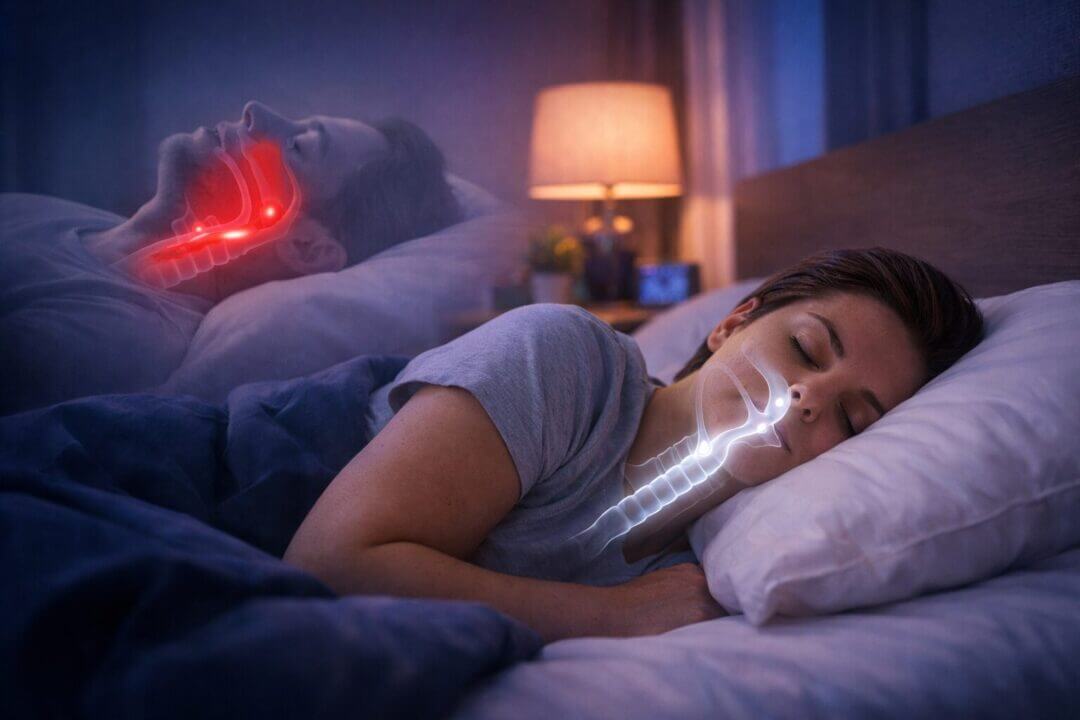
The Best Sleep Positions for Sleep Apnea: What to Do and What to Avoid
Your partner nudges you awake for the third time tonight because you’ve stopped breathing again. You roll over, gasp for air, and wonder if there’s a simpler fix than the CPAP machine gathering dust in your closet.
Turns out, the way you position your body might cut your apnea episodes in half—no equipment required.
The connection between sleep position and sleep apnea isn’t just folk wisdom passed down from exhausted bed partners. It’s backed by research showing that how you lie down directly affects whether your airway stays open or collapses shut.
For many people dealing with obstructive sleep apnea, changing position becomes the first line of defense, sometimes reducing breathing interruptions by up to 50%.
Key Takeaways
Side sleeping reduces apnea episodes by keeping your tongue and soft tissues from blocking your airway, with some studies showing up to 50% fewer breathing interruptions
Back sleeping worsens sleep apnea because gravity pulls your tongue and soft palate backward, narrowing the airway and increasing blockages
Left side sleeping offers extra benefits beyond airway management, including better circulation and reduced acid reflux symptoms
Position therapy works best for positional OSA, where breathing problems occur primarily when sleeping on your back
Combining position changes with other treatments like CPAP or oral appliances often produces the best results for moderate to severe cases
Why Sleep Position Matters for Sleep Apnea
Gravity never takes a night off. While you sleep, it’s constantly tugging at your tongue, soft palate, and the loose tissues lining your throat. Where those tissues end up determines whether air flows freely into your lungs or gets stuck at a roadblock.
When you have obstructive sleep apnea, your airway already runs narrow or your throat muscles relax too much during sleep. Add gravity to the mix, and you’ve got a recipe for breathing interruptions that can happen dozens or even hundreds of times per night.
The position you choose either fights against gravity or surrenders to it.
The Science Behind Positional Sleep Apnea
Research distinguishes between two types of OSA patients: those with positional sleep apnea and those with non-positional. If you’re in the positional camp, your apnea-hypopnea index (AHI)—the number of breathing interruptions per hour—shoots up dramatically when you sleep on your back but improves significantly in other positions.
Studies suggest about 60% of adults naturally sleep on their side anyway, which means many people instinctively avoid their worst position.
For non-positional OSA, your airways collapse regardless of how you’re lying down. Position changes still help these folks, just not as dramatically.
But even a modest reduction in breathing interruptions translates to better oxygen levels, less fragmented sleep, and mornings where you actually feel rested instead of like you’ve been hit by a truck.
The National Institutes of Health backs up what sleep specialists have observed for decades: side sleeping opens airway space without the spinal misalignment that comes with stomach sleeping or the airway collapse that plagues back sleepers.
Your body already knows this—it’s why you probably shift positions multiple times during the night without realizing it.
The Worst Position: Sleeping on Your Back
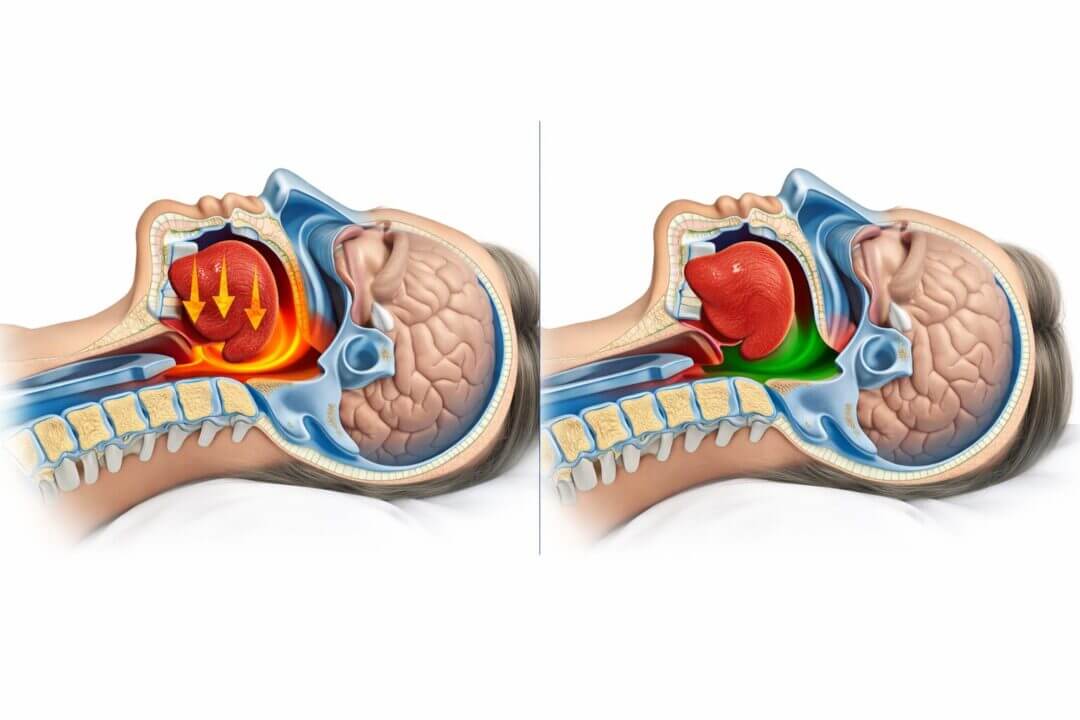
Sleeping supine—flat on your back—turns your throat into a collapsing tunnel. Gravity pulls your tongue toward the back of your throat, your soft palate droops downward, and your jaw relaxes backward.
All these tissues crowd into the space where air needs to flow, creating a bottleneck that forces your brain to wake you up just enough to breathe.
The numbers tell a stark story. Back sleepers with OSA experience more frequent apnea episodes per hour compared to any other position. Their snoring gets louder because air has to squeeze through a narrower opening, creating that chainsaw sound that sends partners fleeing to the guest room.
Health Consequences Beyond Poor Sleep
The cascade of problems doesn’t stop at snoring. When your airway repeatedly collapses throughout the night, your blood oxygen levels drop. Your heart works harder to compensate. Your blood pressure spikes with each breathing interruption. Over months and years, this nightly stress contributes to hypertension, irregular heart rhythms, and increased risk of stroke.
Sleep quality tanks too. You might spend eight hours in bed but wake up feeling like you barely slept at all.
That’s because your brain keeps pulling you out of deep, restorative sleep stages to restart your breathing. You’re stuck in the shallow end of sleep, never diving deep enough to let your body and mind truly recover.
I’ve talked to dozens of people who thought they were just “bad sleepers” until a sleep study revealed they were having 30, 40, even 60 apnea episodes per hour—almost all while sleeping on their backs.
The moment they switched positions, their AHI dropped by half or more. One guy told me it felt like someone had given him a new brain.
If you’re a dedicated back sleeper, the dangers of sleeping in the wrong position with sleep apnea extend beyond just feeling tired. Your cardiovascular system takes a beating night after night.
The Best Position: Sleeping on Your Side
Side sleeping—what doctors call lateral sleeping—works with gravity instead of against it. Your tongue naturally falls to the side of your mouth rather than backward into your throat. Your soft palate stays put. The airway remains open, allowing air to flow freely with each breath.
This isn’t just theory. Research consistently shows that side sleeping reduces both the frequency and severity of apnea episodes in most OSA patients. Some people see their AHI cut in half just by making this one change. Others find their snoring drops from window-rattling to barely noticeable.
Why Lateral Sleeping Works
The mechanics are straightforward. When you lie on your side, gravity pulls your tongue and soft tissues toward your cheek instead of your throat. Your jaw doesn’t sag backward. The space behind your tongue—the oropharynx, where most obstructions happen—stays open and unobstructed.
About 60% of adults already sleep on their side at least part of the night, which makes this position change more achievable than you might think. Your body may already be trying to protect your airway by naturally rolling you onto your side when breathing gets difficult.
The trick is staying there all night instead of rolling back onto your back during deep sleep.
Side sleeping also aligns your spine better than stomach sleeping, reducing neck and back pain. It’s the Goldilocks position—not too hard on your airways, not too hard on your joints, just right for most people dealing with sleep apnea.
Left Side vs. Right Side
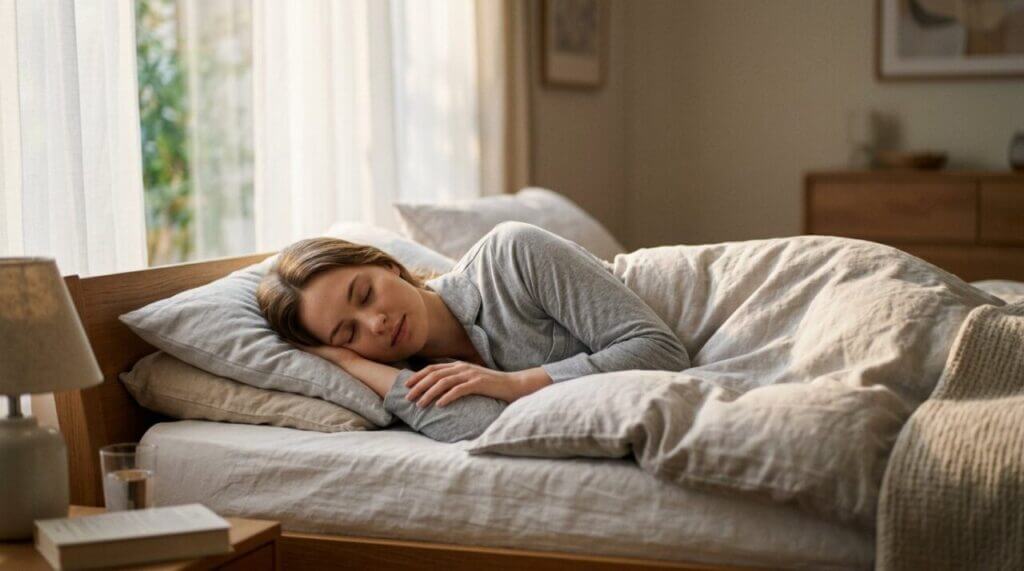
Both sides beat back sleeping by a mile, but research suggests the left side might have a slight edge. Left-side sleeping optimizes blood flow and circulation, particularly beneficial if you have heart concerns alongside your sleep apnea.
It also helps with acid reflux because your stomach sits lower than your esophagus in this position, making it harder for stomach acid to creep upward.
One study found right-side sleeping to be the best for reducing OSA, likely due to how blood flows to the heart in that position. The truth is, both sides work well for most people.
If you’re pregnant or dealing with GERD, left side gets the nod. Otherwise, pick whichever side feels more comfortable and doesn’t aggravate any shoulder or hip issues you might have.
The real enemy is your back. Left or right, just stay off your back and you’re already winning.
How to Stay on Your Side All Night
Knowing you should sleep on your side and actually doing it all night are two different challenges. Your body has muscle memory from years or decades of sleeping a certain way. You’ll drift back to old habits without some guardrails in place.
Body pillows become your best friend. Hug one in front of you and wedge another behind your back. You’ve created a pillow sandwich that makes rolling onto your back physically difficult. A knee pillow between your legs keeps your hips aligned and makes side sleeping more comfortable for the long haul.
Positional therapy devices range from simple to high-tech. The classic tennis ball trick works surprisingly well: sew a tennis ball or foam roller into the back of an old t-shirt.
When you try to roll onto your back, the discomfort immediately wakes you enough to shift back to your side. It sounds medieval, but it’s effective and costs almost nothing.
More sophisticated options include devices like the SlumberBump or Snorecoach—wearable gadgets that vibrate when you roll onto your back, training your body over time to avoid that position.
Some people swear by anti-roll straps that physically prevent back sleeping without being uncomfortable.
Wedge pillows offer another approach. These foam triangles elevate your upper body slightly while you sleep on your side, combining the benefits of lateral sleeping with mild head elevation. The angle helps even more with keeping airways open.
For detailed strategies on maintaining side sleeping throughout the night, check out our guide on how to optimize sleep position to reduce sleep apnea symptoms.
Stomach Sleeping: Pros and Cons
Sleeping on your stomach—prone position—pulls your tongue and throat tissues forward through gravity, which theoretically keeps them from blocking your airway. Some people with positional sleep apnea find that face-down sleeping reduces their apnea episodes.
But here’s the catch: stomach sleeping wrecks your neck and spine. Your head has to turn 90 degrees to one side or the other to breathe, putting enormous strain on your cervical spine. Your lower back arches unnaturally. After a few hours, you wake up feeling like you’ve been in a wrestling match.
Who It Might Work For
If you have mild, positional-only sleep apnea and you’ve tried everything else without success, stomach sleeping might be worth experimenting with. Use the thinnest pillow possible—or no pillow at all—to minimize neck strain. Some people place a pillow under their pelvis to reduce lower back arching.
This position isn’t a long-term solution for most people. The musculoskeletal problems it creates often outweigh the breathing benefits. But for someone who absolutely cannot tolerate side sleeping and refuses CPAP therapy, it’s better than sleeping on your back.
I knew a guy who slept on his stomach for years to manage his snoring. His sleep apnea improved, but by age 50 he had chronic neck pain that required physical therapy. He eventually switched to side sleeping with proper pillow support and wished he’d made the change a decade earlier.
For more on various sleeping positions and their effects, see our article on the best sleeping positions to reduce snoring.
Head Elevation
Elevating your head and upper body by 30 to 60 degrees counteracts gravity’s pull on your airway even when you’re sleeping on your back. This semi-Fowler position reduces the apnea-hypopnea index in people with mild to moderate OSA by keeping throat tissues from collapsing as severely.
Wedge pillows are the simplest solution. These foam triangles slide under your regular pillow and mattress, creating a gentle incline. You can find them in various heights and firmness levels. Start with a modest elevation and adjust upward if needed.
Adjustable bed bases offer more flexibility. You can fine-tune the exact angle, raise just your head or both your head and feet, and change positions with a remote control. They’re pricier than wedge pillows but worth considering if you have severe sleep apnea or other conditions like GERD that benefit from elevation.
Some people use hospital-style bed risers to elevate the entire head of their bed frame. This creates a consistent slope without the need for special pillows or bases. It’s a budget-friendly option that works surprisingly well.
Combining Elevation with Side Sleeping
The real magic happens when you combine head elevation with side sleeping. You’re stacking two effective strategies, giving gravity even less opportunity to collapse your airway. Many sleep specialists recommend this combination for patients who can’t tolerate CPAP or are waiting for oral appliance therapy to begin.
Elevated side sleeping takes some getting used to. Your body needs time to adjust to the new angle. Start with modest elevation—maybe 20 to 30 degrees—and gradually increase over several weeks. Use extra pillows to support your arms and prevent shoulder strain.
How Position Interacts with Your Treatment Devices
Sleep position doesn’t exist in a vacuum. If you’re using CPAP, an oral appliance, or other sleep apnea treatments, your position affects how well those devices work.
CPAP and Sleep Position
CPAP machines deliver pressurized air through a mask to keep your airway open. Side sleeping can affect mask seal, especially with full-face masks. You might experience air leaks when your face presses into the pillow, reducing treatment effectiveness and creating annoying whistling sounds.
CPAP-friendly pillows solve this problem. They have cutouts or contours that accommodate your mask, allowing you to sleep on your side without compromising the seal. Some designs work with nasal masks, others with full-face masks. It’s worth investing in one if you’re committed to both CPAP therapy and side sleeping.
Nasal pillow masks often work better for side sleepers than full-face masks because they’re smaller and less likely to shift or leak. If you’re struggling with mask seal issues, talk to your sleep doctor about trying a different mask style.
For more information on CPAP therapy, explore our article on benefits of therapy for obstructive sleep apnea.
Oral Appliances and Sleep Position
Oral appliances—also called mandibular advancement devices—hold your jaw forward to keep your airway open. The beauty of these devices is that they work regardless of your sleep position. You can sleep on your back, side, or stomach, and the appliance continues doing its job.
This position-independence makes oral appliances attractive for people who can’t maintain side sleeping all night or who have non-positional sleep apnea. The device provides consistent airway support no matter how much you toss and turn.
That said, combining an oral appliance with side sleeping often produces better results than either strategy alone. You’re addressing the problem from multiple angles, maximizing your chances of reducing apnea episodes and improving sleep quality.
Learn more about these devices in our guide on choosing the best sleep apnea oral appliance.
Physical Therapy and Posture Training
Sometimes the barrier to side sleeping isn’t habit—it’s pain. Shoulder problems, hip arthritis, or spinal issues can make side sleeping uncomfortable or impossible. Physical therapy addresses these musculoskeletal factors, making position changes feasible.
A physical therapist can assess your hip and shoulder alignment, identify muscle imbalances, and prescribe exercises to improve your tolerance for side sleeping. Strengthening your core and hip stabilizers often reduces the discomfort that drives people back to their backs at night.
Proper Pillow Support
Pillow selection matters more than most people realize. Your pillow needs to fill the space between your shoulder and head, keeping your neck in neutral alignment. Too high and your neck bends upward; too low and it droops downward. Either extreme leads to pain and poor sleep.
A knee pillow prevents your top leg from pulling your spine out of alignment. This simple addition can transform side sleeping from uncomfortable to sustainable. Memory foam versions contour to your leg shape and stay in place better than regular pillows.
Some people need a small pillow or rolled towel under their waist to support the natural curve of their spine. Experiment with different support configurations until you find what works for your body.
Gradual Position Training
Don’t expect to switch from back sleeping to side sleeping overnight. Your body needs time to adapt. Start by spending the first hour of the night on your side, then allow yourself to shift to your preferred position once you’re deeply asleep. Gradually extend the time you spend on your side over several weeks.
Consistency matters more than perfection. If you spend 60% of the night on your side instead of 10%, you’ve made significant progress even if you’re not hitting 100%. Your apnea episodes will decrease proportionally to the time you spend in better positions.

When Position Change Alone Isn’t Enough
Position therapy works brilliantly for some people and barely makes a dent for others. If you have non-positional OSA—where your airway collapses regardless of position—you’ll need more than a new sleeping angle to solve the problem.
Signs you need to escalate treatment include:
Still feeling exhausted despite consistent side sleeping
Partner reports you’re still snoring loudly or gasping for air
Morning headaches persist
Blood pressure remains elevated
Daytime sleepiness interferes with work or driving
A follow-up sleep study can measure whether position changes have actually reduced your AHI. If your numbers are still high, it’s time to discuss CPAP, oral appliances, or other interventions with your sleep doctor.
Combining Position Therapy with Other Treatments
The good news is that position therapy complements other treatments beautifully. Using CPAP while sleeping on your side often allows you to use lower pressure settings, making the therapy more comfortable. Combining an oral appliance with side sleeping can produce better results than either approach alone.
Some people use position therapy as a bridge while waiting for their oral appliance to be fabricated or while adjusting to CPAP. Others use it as their primary treatment for mild positional OSA, reserving devices for travel or nights when they can’t maintain good position.
Lifestyle changes amplify the benefits of position therapy. Losing weight reduces the amount of tissue crowding your airway. Avoiding alcohol before bed prevents excessive muscle relaxation. Treating nasal congestion improves airflow. These changes work synergistically with better sleep positions.
For comprehensive strategies beyond position, read about lifestyle changes to improve sleep apnea symptoms.
The goal isn’t perfection—it’s progress. Every night you spend in a better position is a night your body gets more oxygen, your brain gets better sleep, and your cardiovascular system gets a break from the stress of repeated breathing interruptions.
Position or Imposition?
Your sleep position might be the simplest, cheapest, and most effective tool you have for managing sleep apnea. Side sleeping keeps your airway open by working with gravity instead of against it, potentially cutting your apnea episodes in half.
Back sleeping does the opposite, turning your throat into a collapsing tunnel that blocks airflow dozens or hundreds of times per night.
Start tonight. Grab a couple of pillows, create a barrier behind your back, and commit to side sleeping for at least the first few hours.
Try the tennis ball trick if you keep rolling onto your back. Experiment with wedge pillows or adjustable bases if elevation helps. Give your body a few weeks to adapt to the new position before deciding whether it’s working.
Track your progress through how you feel—energy levels, morning headaches, daytime alertness—and through feedback from your partner about snoring and breathing pauses. If you’re seeing improvement, you’ve found a sustainable strategy that costs almost nothing and requires no prescriptions or medical devices.
If position changes alone aren’t enough, they still form a valuable part of your treatment plan. Combine them with CPAP, oral appliances, or other therapies your sleep doctor recommends.
Every tool you add to your arsenal increases your chances of finally getting the restorative sleep your body desperately needs.
The best sleep position for sleep apnea is the one you can maintain all night while keeping your airway open. For most people, that’s side sleeping—preferably on the left, with proper pillow support, and maybe a slight elevation. Your body will thank you with better sleep, more energy, and years added back to your life.