

Oral Appliances for Sleep Apnea: How They Work, Types, and How to Choose the Right One
Twenty-two million Americans stop breathing in their sleep. Most of them don’t know it until their partner threatens to move to the guest room or their doctor spots the warning signs during a routine checkup.
If you’re hunting for the best oral appliance for sleep apnea, you’ve probably already tried the CPAP machine and hated every minute of it. Or maybe you’re looking for something that doesn’t make you feel like a fighter pilot every night. Either way, you’re in the right place.
I spent years watching my dad struggle with his CPAP machine before he finally switched to an oral appliance. The difference was night and day—literally.
Key Takeaways
Oral appliances work by repositioning your jaw forward 5-10 millimeters to keep your airway open during sleep
Custom-fitted mandibular advancement devices achieve 70-80% patient compliance compared to CPAP’s lower rates
They’re FDA-approved for mild to moderate sleep apnea (5-30 events per hour) and work best when fitted by a dentist
Recent 2026 studies show patients can see improvement with as little as 1-2 mm of jaw advancement
While CPAP may be more effective for severe cases, oral appliances often deliver comparable health outcomes due to consistent nightly use
What Is an Oral Appliance for Sleep Apnea?
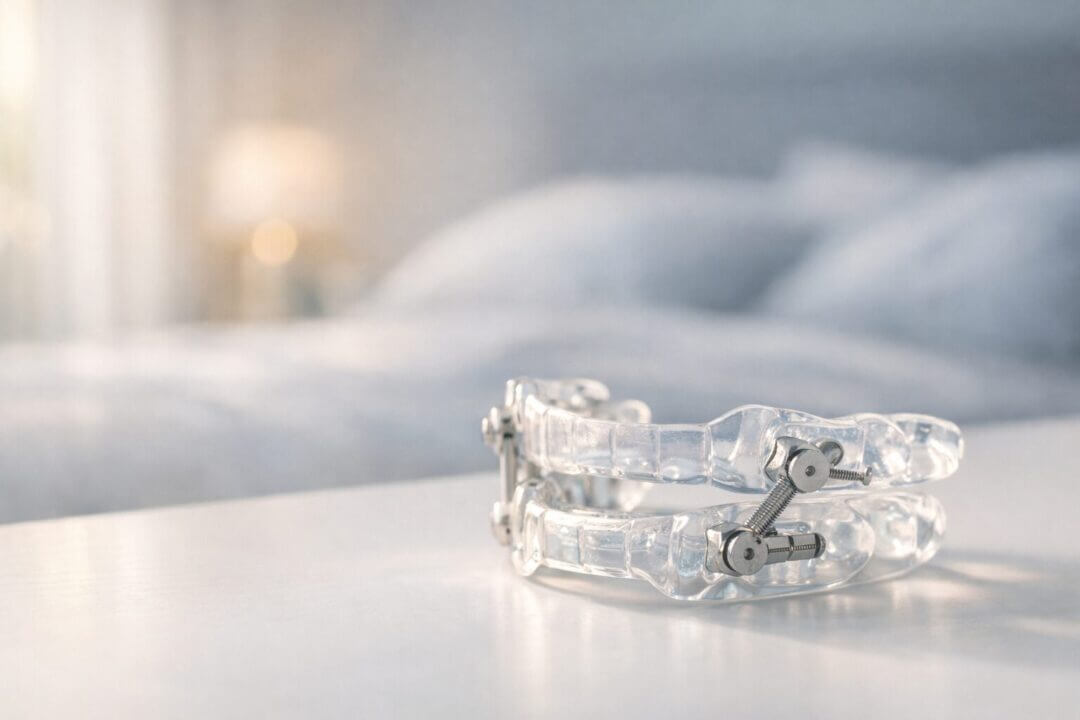
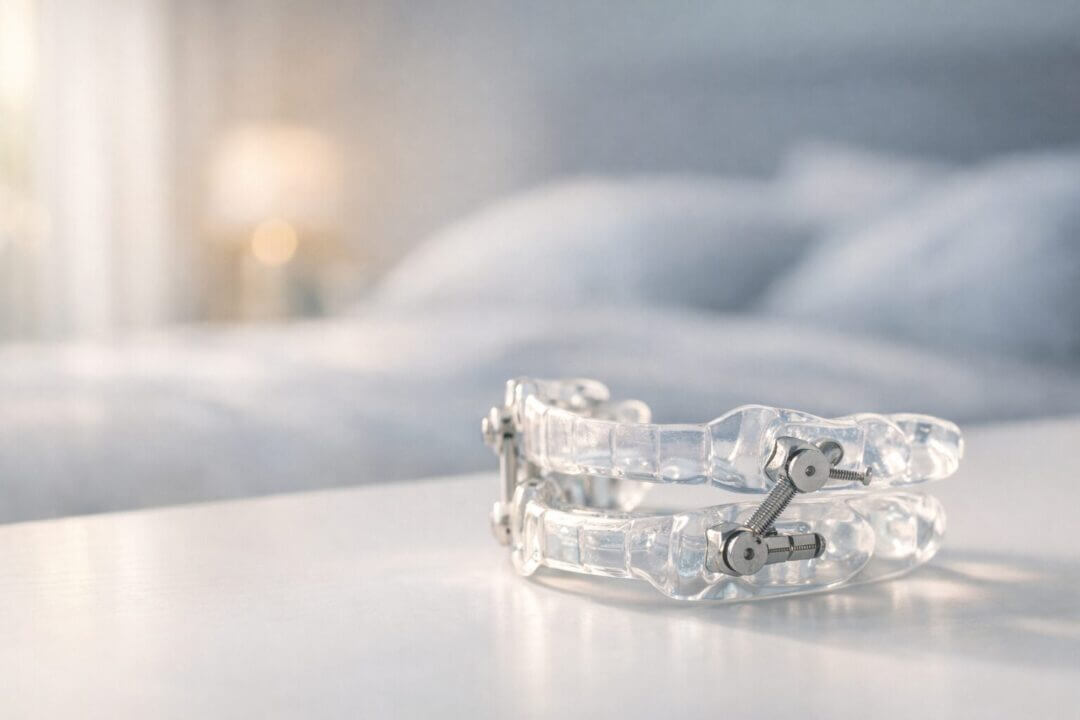
Think of an oral appliance as a retainer that does more than straighten your teeth. It’s a custom-fitted device you wear during sleep that keeps your airway open by repositioning your jaw or tongue.
The FDA approved these devices as legitimate treatments for obstructive sleep apnea, not just snoring aids you buy off late-night TV. They’re medical devices that require proper fitting and follow-up care.
Most doctors prescribe them as a CPAP alternative for people with mild to moderate sleep apnea. Some patients even use them alongside CPAP therapy to reduce the pressure settings and make the whole experience more tolerable.
Custom-Fitted Device Worn During Sleep
Your dentist or sleep specialist takes impressions of your teeth to create a device that fits your mouth exactly. No two mouths are the same, which is why the boil-and-bite versions from the drugstore rarely work as well as the custom jobs.
The device sits in your mouth like a sports mouthguard but with a specific purpose. It holds your jaw in a forward position all night long, creating space in the back of your throat where the collapse happens.
FDA-Approved Treatment for Mild-to-Moderate OSA
The FDA doesn’t hand out approvals like candy. These devices went through rigorous testing to prove they actually work for people with an Apnea-Hypopnea Index between 5 and 30 events per hour.
That’s the sweet spot where oral appliances shine. Severe cases usually need the heavy artillery—CPAP machines or even surgery—but for most people dealing with sleep apnea, an oral appliance gets the job done.
Often Prescribed as a CPAP Alternative or Complement
Doctors love having options. When patients can’t tolerate CPAP (and many can’t), oral appliances become the go-to solution.
Some creative practitioners even combine the two treatments. Studies show that using both together can cut CPAP pressure requirements in half, making the mask more comfortable and easier to stick with long-term.
How Oral Appliances Work
Your airway collapses during sleep because the muscles in your throat relax too much. Gravity pulls everything backward, and suddenly you’re trying to breathe through a straw.
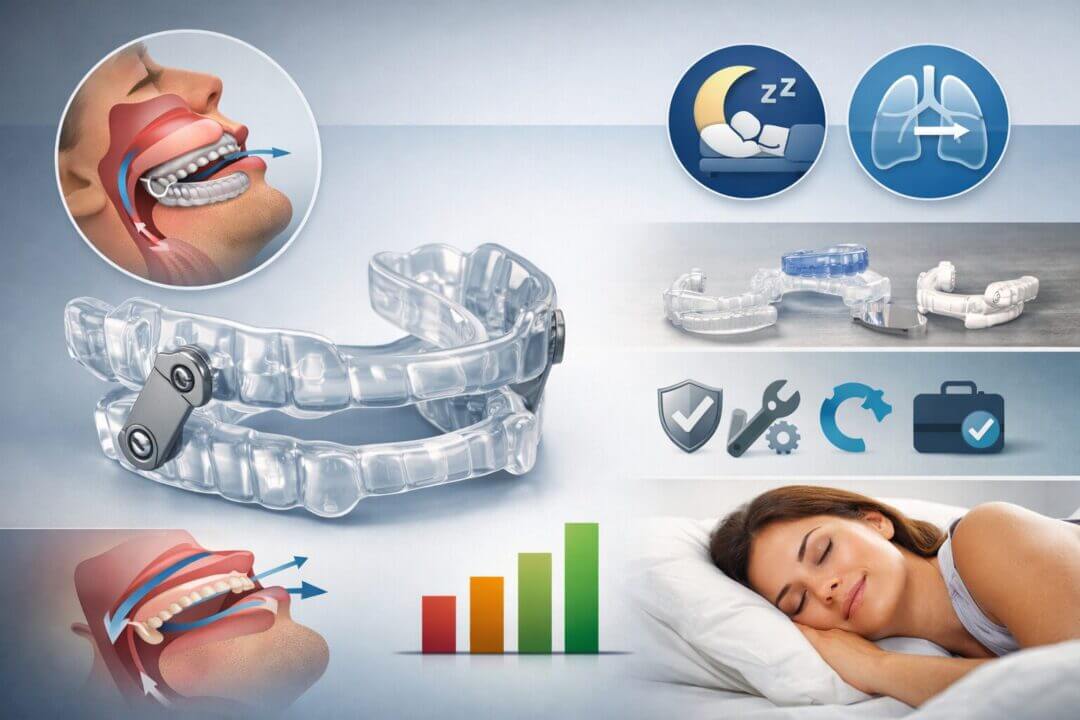
Oral appliances fight physics with physics. They reposition your lower jaw forward, typically by 5-10 millimeters, which pulls the tongue and soft tissues away from the back of your throat.
Repositioning the Jaw or Tongue to Prevent Airway Collapse
The mandibular advancement device (the most common type) works like a gentle tow truck for your jaw. It holds your lower jaw in a forward position all night, which automatically pulls your tongue forward too since they’re connected by muscles and tissue.
This forward positioning creates more space in your upper airway. More space means less chance of collapse, which means you keep breathing steadily instead of stopping and starting all night.
Recent research from Cedars-Sinai in January 2026 showed something surprising: patients achieved improvement with as little as 1-2 mm of advancement. That’s way less than the 5 mm most previous studies required, which means better tolerance and fewer side effects.
Creating More Space in the Upper Airway
Picture your throat as a flexible tube. When you lie down, that tube wants to collapse on itself, especially if you’re overweight, have a large tongue, or just won the genetic lottery for a narrow airway.
By moving your jaw forward, you’re essentially pulling the walls of that tube apart. The physics are simple, but the results are powerful—you go from gasping for air to breathing smoothly.
The best oral appliance for sleep apnea creates this space without causing jaw pain or tooth movement. That’s why proper fitting matters so much.
Reducing Snoring by Limiting Tissue Vibration
Snoring happens when air rushes through a narrowed airway, causing the soft tissues to vibrate like a flag in the wind. Open up that airway, and the vibration stops.
Your partner will notice this benefit before you do. Patients consistently report that their bed partners sleep better once they start using an oral appliance, which sometimes matters more than the health benefits.
One guy I know said his wife stopped threatening divorce after he got fitted for his device. That’s not in the clinical studies, but it’s real-world data that counts.
The Two Main Types
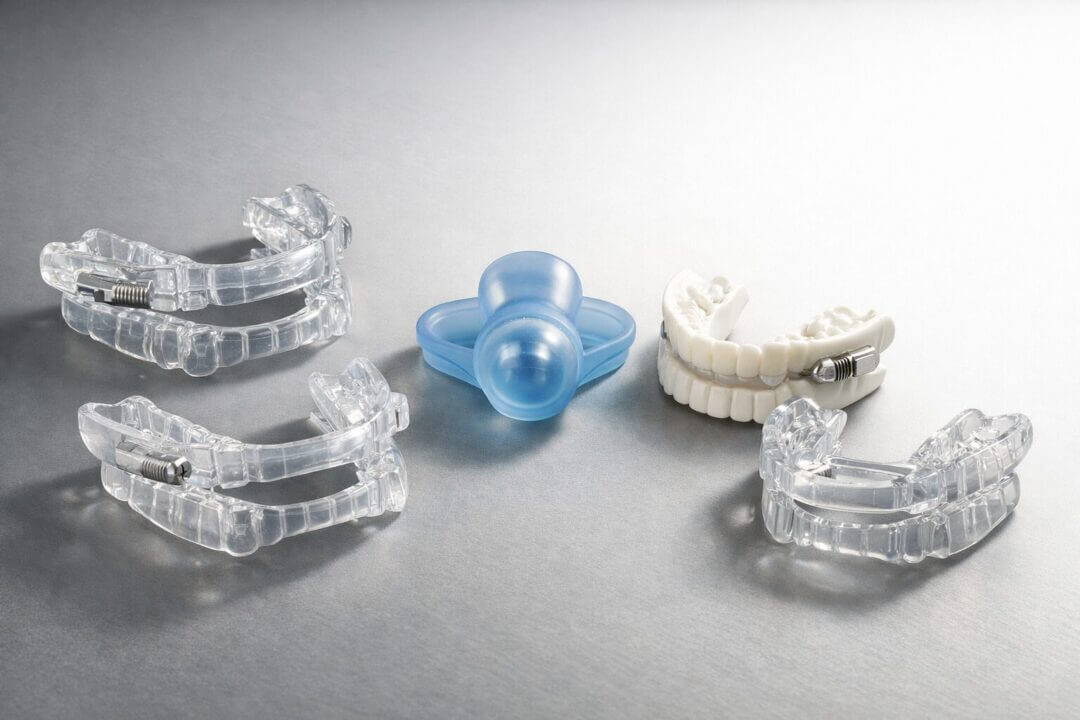
The oral appliance world splits into two main camps: devices that move your jaw and devices that hold your tongue. Both work, but they work differently and suit different people.
Understanding which type fits your situation saves you time, money, and frustration. Let’s break down the differences.
Mandibular Advancement Devices (MADs)
These are the workhorses of oral appliance therapy. MADs look like two mouthguards connected by hinges or bands that hold your lower jaw forward while you sleep.
The beauty of MADs is their adjustability. Most modern versions let you fine-tune the amount of advancement in tiny increments until you find the sweet spot where your apnea improves without causing jaw discomfort.
How They Work: Advance the Lower Jaw Forward
Your lower jaw (mandible) connects to your skull at the temporomandibular joint, which allows it to move forward and backward. MADs take advantage of this natural movement by holding your jaw in a forward position.
When your jaw moves forward, your tongue comes along for the ride since it’s attached to your jaw. This dual action—jaw and tongue moving forward together—creates maximum space in your airway.
The device uses gentle, constant pressure throughout the night. You’re not forcing anything; you’re just maintaining a position that keeps your airway open.
Adjustable vs. Fixed Designs
Fixed designs hold your jaw at one predetermined position. They’re simpler and often cheaper, but they don’t give you room to experiment with different advancement levels.
Adjustable designs let you dial in the exact amount of advancement you need. Most use small screws or bands that you can adjust in 1mm increments, which means you can start conservative and increase advancement gradually.
I always recommend adjustable designs for first-time users. You need flexibility to find what works for your unique anatomy without committing to a fixed position that might not be optimal.
Best For: Most OSA Patients, Especially Jaw-Related Cases
If your sleep apnea stems from jaw position or tongue collapse, MADs are your best bet. They work for the vast majority of mild to moderate cases.
People with TMJ issues need to proceed carefully with MADs since they put pressure on the jaw joint. But for most patients, the benefits far outweigh the temporary adjustment period.
Examples: SnoreRx, ZQuiet, VitalSleep, SomnoGuard
The market offers dozens of MAD options. SnoreRx features micro-adjustment technology that lets you fine-tune in 1mm increments. VitalSleep offers different sizes for men and women, recognizing that one size definitely doesn’t fit all.
ZQuiet uses a hinged design that allows some jaw movement during sleep, which some people find more comfortable. SomnoGuard takes the custom-fit approach with dental impressions for maximum precision.
Each has its strengths, and choosing the right oral appliance depends on your specific needs and budget.
Tongue-Retaining Devices (TRDs)
TRDs take a completely different approach. Instead of moving your jaw, they grab your tongue and hold it forward using gentle suction.
These devices look weird—there’s no getting around it. They feature a bulb at the front that you squeeze, insert your tongue into, then release to create suction that holds your tongue in place.
How They Work: Hold the Tongue Forward via Suction
You squeeze the bulb, stick your tongue into it, and release. The suction created holds your tongue forward and prevents it from falling back into your throat during sleep.
The mechanism is simple but effective. By keeping your tongue forward, you maintain an open airway without needing to reposition your jaw at all.
Best For: Tongue-Based Apnea, Those Who Can’t Use MADs
If you have dental issues that prevent you from using a MAD—missing teeth, loose teeth, dentures, or severe TMJ problems—TRDs offer a viable alternative. They don’t attach to your teeth or put pressure on your jaw joint.
People whose apnea stems primarily from tongue collapse rather than jaw position also do well with TRDs. Your sleep study results can help determine if you’re a good candidate.
Examples: AVEOtsd, Good Morning Snore Solution
The AVEOtsd pioneered the tongue-retaining category and remains the gold standard. Good Morning Snore Solution offers a similar design at a lower price point, making TRDs more accessible to people who want to try this approach.
Both devices work on the same principle, though the materials and durability differ. The learning curve is steeper with TRDs—it takes most people a week or two to get used to sleeping with their tongue held forward—but the results can be just as effective as MADs for the right candidates.
Oral Appliances vs. CPAP
The CPAP versus oral appliance debate rages in sleep medicine circles. Both camps have passionate advocates, and honestly, both treatments work—just for different people and different situations.
Let’s cut through the noise and look at the real differences that matter to you.
Effectiveness Comparison by OSA Severity
CPAP machines win on pure effectiveness. They normalize the Apnea-Hypopnea Index better than oral appliances in head-to-head studies, especially for severe cases.
But here’s the catch: effectiveness only matters if you actually use the device. A CPAP machine sitting in your closet because you can’t stand wearing it helps exactly nobody.
For mild to moderate sleep apnea, oral appliances deliver comparable health outcomes to CPAP. The key phrase is “health outcomes”—not just AHI numbers, but actual improvements in blood pressure, daytime sleepiness, and quality of life.
Compliance Rates (Oral Appliances Often Win for Mild-Moderate)
Custom-fitted oral appliances achieve 70-80% patient compliance. CPAP compliance rates vary widely depending on who’s measuring, but they’re consistently lower than oral appliances for mild to moderate cases.
Why? Because oral appliances are simpler. No mask, no hose, no electricity, no noise. You pop it in your mouth and go to sleep.
I’ve talked to dozens of people who abandoned their CPAP machines within months but still use their oral appliances years later. Consistency beats perfection when it comes to treating sleep apnea.
Travel and Portability Advantages
Try packing a CPAP machine for a weekend trip. You need the machine, the mask, the hose, the power cord, distilled water for the humidifier, and a power outlet wherever you’re sleeping.
An oral appliance fits in a case the size of a soap dish. You can throw it in your pocket and forget about it until bedtime.
For people who travel frequently for work or pleasure, this difference alone makes oral appliances the clear winner. You’re more likely to treat your sleep apnea consistently if the treatment doesn’t require a separate suitcase.
When CPAP Is Still the Better Choice (Severe OSA)
If your Apnea-Hypopnea Index exceeds 30 events per hour, you have severe sleep apnea. At that level, CPAP therapy becomes the gold standard because oral appliances might not provide enough improvement.
Some people with severe OSA do use oral appliances successfully, but they need close monitoring and follow-up sleep studies to confirm effectiveness. Don’t make this decision on your own—work with your sleep specialist to determine the right treatment for your severity level.
CPAP therapy also works better if you have central sleep apnea (where your brain fails to signal breathing) rather than obstructive sleep apnea. Oral appliances only address obstructions, not neurological breathing issues.
Benefits of Oral Appliance Therapy
The benefits go way beyond just treating sleep apnea. People who switch to oral appliances report improvements in areas they didn’t even realize were connected to their breathing problems.
Let me walk you through what you can actually expect.
Non-Invasive and Portable
No surgery required. No permanent changes to your anatomy. You wear the device at night and take it out in the morning.
The portability factor changes lives for frequent travelers. Business trips, vacations, camping—you can treat your sleep apnea anywhere without worrying about power outlets or TSA questions about medical equipment.
No Electricity, Hose, or Mask Required
Freedom from cords and machines feels liberating. You’re not tethered to your nightstand, you can sleep in any position, and you don’t wake up with mask marks on your face.
Your bedroom stays quiet too. CPAP machines make noise—some more than others—but oral appliances are completely silent. Your partner will appreciate this almost as much as the reduction in snoring.
High Comfort and Compliance vs. CPAP
Comfort drives compliance, and compliance drives results. The best oral appliance for sleep apnea is the one you’ll actually wear every night.
Most people adapt to oral appliances within a week or two. There’s an adjustment period where your jaw might feel sore in the morning, but that typically resolves as your muscles adapt to the new position.
Compare that to CPAP, where some people never adapt to having a mask strapped to their face all night. The claustrophobia, the air pressure, the dry mouth—these issues drive many people to abandon CPAP therapy entirely.
Reduces Snoring Significantly
Your snoring will drop dramatically or disappear completely. Patients report that their bed partners notice this benefit immediately—often before the patient notices improvements in their own energy levels.
One woman told me her husband cried the first morning after she used her oral appliance because he’d finally slept through the night for the first time in years. That’s the kind of relationship-saving benefit that doesn’t show up in clinical studies but matters enormously in real life.
If you’re dealing with snoring and related issues, an oral appliance addresses both the health risks and the social consequences simultaneously.
How to Choose the Right Oral Appliance
Choosing the best oral appliance for sleep apnea isn’t about finding the most expensive option or the one with the fanciest features. It’s about matching the device to your specific anatomy, sleep patterns, and lifestyle needs.
Let’s break down the key factors that actually matter.
Comfort and Fit
Comfort determines whether you’ll still be using your device six months from now. An uncomfortable appliance ends up in your bathroom drawer, not your mouth.
The fit needs to be snug enough to hold your jaw in position all night but not so tight that it causes pain or prevents you from breathing through your mouth if needed.
Custom-Fitted vs. Boil-and-Bite vs. OTC
Custom-fitted devices made from dental impressions offer the best fit and longest lifespan. Your dentist takes molds of your teeth, and a lab creates a device specifically for your mouth. These typically cost $1,800-$3,000 but last several years with proper care.
Boil-and-bite devices offer a middle ground. You heat them in water, bite down to create an impression, and they mold to your teeth. They’re less expensive ($50-$200) but less precise than custom devices. Many quality options fall into this category.
Over-the-counter devices require no fitting at all—you use them straight out of the package. They’re the cheapest option ($30-$100) but also the least likely to work effectively since they can’t account for your unique dental anatomy.
Importance of Dental Fitting for Long-Term Use
A proper dental fitting isn’t just about comfort—it’s about protecting your teeth and jaw joint from long-term damage. Dentists trained in sleep medicine understand how to position the device to maximize airway opening while minimizing stress on your temporomandibular joint.
They also check for dental issues that might contraindicate oral appliance use: loose teeth, active gum disease, insufficient teeth to anchor the device. Skipping this step can lead to tooth movement, bite changes, or jaw problems down the road.
Adjustability
Your ideal jaw position isn’t something you can guess. It requires experimentation and fine-tuning over several weeks or months.
Adjustable devices let you start with minimal advancement and gradually increase until you find the sweet spot where your symptoms improve without causing excessive jaw discomfort.
Why Fine-Tuning Jaw Position Matters for Efficacy
That 2026 Cedars-Sinai study I mentioned earlier found that some patients achieved improvement with just 1-2 mm of advancement. Others needed the full 10 mm to see results.
Without adjustability, you’re stuck with whatever position the device provides. With adjustability, you can optimize for your unique anatomy and gradually increase advancement as your muscles adapt.
Most adjustable devices use small screws or bands that you turn to advance the lower jaw in 1mm increments. Your dentist or sleep specialist guides this titration process, often requiring follow-up sleep studies to confirm you’ve found the optimal position.
Durability and Maintenance
Oral appliances don’t last forever. Most need replacement every 2-5 years depending on the material, your bite force, and how well you maintain them.
Hard acrylic devices last longer but feel less comfortable initially. Softer materials feel better but wear out faster. The best devices use a combination—hard outer shell for durability, softer inner lining for comfort.
Expected Lifespan, Cleaning Routine
Plan on replacing your device every 3-5 years for custom-fitted appliances, 1-2 years for boil-and-bite versions. Signs you need a replacement include cracks, loose fit, or visible wear on the adjustment mechanisms.
Daily cleaning is non-negotiable. Rinse your device every morning with cool water, brush it gently with a soft toothbrush and mild soap, and let it air dry. Once a week, soak it in denture cleaner or a specialized oral appliance cleaning solution.
Ultrasonic Cleaners (e.g., iSonic)
Ultrasonic cleaners use high-frequency sound waves to remove bacteria and debris from hard-to-reach areas. They’re not essential, but they do a better job than manual cleaning alone.
The iSonic and similar devices cost $30-$50 and last for years. You fill the tank with water and cleaning solution, drop in your appliance, and run a 5-minute cycle. It’s the same technology dentists use to clean dental instruments.
Cost and Insurance Coverage
Money matters. Let’s talk real numbers.
Custom-fitted devices from a dentist typically run $1,800-$3,000 including the fitting appointments and follow-up adjustments. Boil-and-bite devices cost $50-$200. Basic OTC devices start around $30.
Typical Price Ranges (OTC vs. Dentist-Fitted)
The price difference reflects more than just the device itself. When you pay for a dentist-fitted appliance, you’re paying for:
Initial consultation and examination
Dental impressions or digital scans
Custom fabrication by a dental lab
Fitting appointment and adjustments
Follow-up visits to optimize positioning
Professional oversight of your treatment
OTC and boil-and-bite devices save money upfront but require you to manage the entire process yourself. For some people, that’s fine. For others, especially those with moderate sleep apnea or complex dental situations, professional oversight is worth the investment.
How to Check Coverage with Your Insurer
Many insurance plans cover oral appliances for sleep apnea, but coverage varies wildly. Some plans cover 50-80% of the cost, others cover nothing.
Call your insurance company before starting treatment and ask specifically about:
Coverage for oral appliance therapy for sleep apnea
Whether they require a sleep study first
If they cover only certain device types or brands
What your out-of-pocket costs will be
Whether they require a dentist with specific training
Get the answers in writing. Insurance representatives sometimes provide incorrect information over the phone, and you want documentation if there’s a dispute later.
Potential Side Effects and How to Manage Them
Every medical treatment comes with potential side effects. Oral appliances are generally well-tolerated, but you should know what to expect during the adjustment period and what warning signs indicate a problem.
Most side effects are minor and temporary. A few require attention from your dentist or sleep specialist.
Jaw Soreness, Especially Early On
Your jaw will probably feel sore for the first week or two, especially in the morning. You’re holding your jaw in an unnatural position all night, and your muscles need time to adapt.
This soreness typically peaks around day 3-5, then gradually improves over the next week. By week three, most people report minimal or no jaw discomfort.
If soreness persists beyond a month or gets worse instead of better, the device might be advancing your jaw too far. Contact your dentist to adjust the positioning.
Tooth Sensitivity
Some people experience temporary tooth sensitivity, especially to cold foods and drinks. This happens because the device puts gentle pressure on your teeth throughout the night.
The sensitivity usually resolves within a few weeks as your teeth adapt. If it doesn’t, your dentist might need to adjust the fit or check for underlying dental issues like cavities or gum recession.
Temporary Bite Changes in the Morning
Many users notice that their bite feels “off” when they first remove the device in the morning. Your teeth don’t quite fit together the way they normally do.
This is normal and temporary. Your bite returns to normal within 15-30 minutes as your jaw muscles relax back to their usual position. The effect is similar to how your face feels after dental work—weird at first, then normal again.
If the bite changes last longer than an hour or become permanent, that’s a red flag. Stop using the device and see your dentist immediately. Permanent bite changes can occur with prolonged use, though they’re rare with properly fitted devices.
When Side Effects Signal a Poor Fit
Some side effects indicate the device doesn’t fit properly and needs adjustment:
Severe pain that doesn’t improve after the first week
Loose teeth or teeth that feel like they’re moving
Cuts or sores on your gums or cheeks
Inability to close your mouth with the device in place
Difficulty breathing through your mouth while wearing it
Don’t tough it out if you’re experiencing these issues. A poorly fitted device can cause permanent dental damage. Your dentist can usually fix fit problems with adjustments or, if necessary, by remaking the device.
Working with a Dentist or Sleep Specialist
Self-diagnosis and self-treatment work fine for minor issues like occasional snoring. Sleep apnea isn’t a minor issue—it’s a serious medical condition that increases your risk of heart disease, stroke, and early death.
You need professional guidance to diagnose your condition accurately and choose the right treatment.
Why Self-Diagnosis Isn’t Enough
You can’t diagnose sleep apnea by counting how many times your partner says you stop breathing. You need objective data from a sleep study that measures your breathing patterns, oxygen levels, and sleep stages throughout the night.
The severity of your sleep apnea determines which treatments are appropriate. Mild cases respond well to oral appliances. Severe cases might need CPAP or even surgery. You can’t make that determination without professional testing.
Understanding your diagnosis helps you appreciate why treatment matters so much.
What to Expect at a Consultation
Your first consultation typically involves a comprehensive examination of your teeth, jaw, and airway. The dentist or sleep specialist will:
Review your sleep study results
Examine your dental health and bite alignment
Check for TMJ issues or other contraindications
Discuss your treatment preferences and lifestyle factors
Recommend specific device types based on your anatomy
Explain the fitting process and timeline
This appointment usually takes 45-60 minutes. Come prepared with questions and a list of any medications you’re taking.
Follow-Up and Adjustment Schedule
Getting fitted for an oral appliance isn’t a one-and-done process. You’ll need several follow-up appointments to optimize the device positioning and monitor your progress.
A typical schedule looks like:
Week 1: Initial fitting and device delivery
Week 2-4: First adjustment based on comfort and initial results
Month 2-3: Follow-up sleep study to measure effectiveness
Month 3-6: Additional adjustments as needed
Year 1+: Annual check-ups to monitor device condition and treatment effectiveness
The exact schedule varies based on your response to treatment and your provider’s protocols. Some dentists now offer virtual follow-ups using telehealth platforms, which the 2026 Cedars-Sinai study showed can be just as effective as in-person visits.
Questions to Ask Your Provider
Don’t leave your consultation without getting clear answers to these questions:
What type of device do you recommend for my specific case, and why?
How much experience do you have fitting oral appliances for sleep apnea?
What’s the total cost including all follow-up appointments?
Does my insurance cover this treatment?
How will we measure whether the device is working?
What side effects should I watch for?
How often will I need follow-up appointments?
What’s the expected lifespan of this device?
What happens if the device doesn’t work for me?
A good provider welcomes these questions and answers them thoroughly. If you feel rushed or dismissed, find a different provider. This is your health, and you deserve a practitioner who takes your concerns seriously.
For more detailed guidance, check out our comprehensive article on how a dental appliance can help manage sleep apnea.
Whew! Let’s Recap
The best oral appliance for sleep apnea is the one you’ll actually wear every night. Custom-fitted mandibular advancement devices work for most people with mild to moderate sleep apnea, offering a comfortable alternative to CPAP machines without sacrificing effectiveness.
The technology keeps improving. That 2026 Cedars-Sinai study showed that virtual care models can deliver results comparable to traditional in-person treatment, making oral appliances more accessible than ever.
Modern devices use 3D scanning and precision printing to create better fits with fewer side effects.
But technology only matters if you take action. If you’re struggling with sleep apnea—or if your partner is losing sleep because of your snoring—schedule a consultation with a dentist trained in sleep medicine. Get a proper sleep study if you haven’t already. Explore your options with professional guidance.
Your next steps:
Get tested if you haven’t had a sleep study yet
Consult with a sleep dentist to discuss whether you’re a good candidate for oral appliance therapy
Consider your lifestyle and which treatment option you’ll actually use consistently
Check your insurance coverage before committing to a specific device
Commit to follow-up care to optimize your results
Sleep apnea won’t fix itself. But with the right oral appliance and professional support, you can breathe easier, sleep better, and wake up feeling like yourself again. Your partner will thank you, your heart will thank you, and you’ll wonder why you didn’t do this years ago.
For additional support, explore lifestyle changes that can improve your sleep apnea symptoms and learn about optimizing your sleep position to maximize your treatment results.