

Snoring vs. Sleep Apnea: Understanding the Difference and What to Do About It
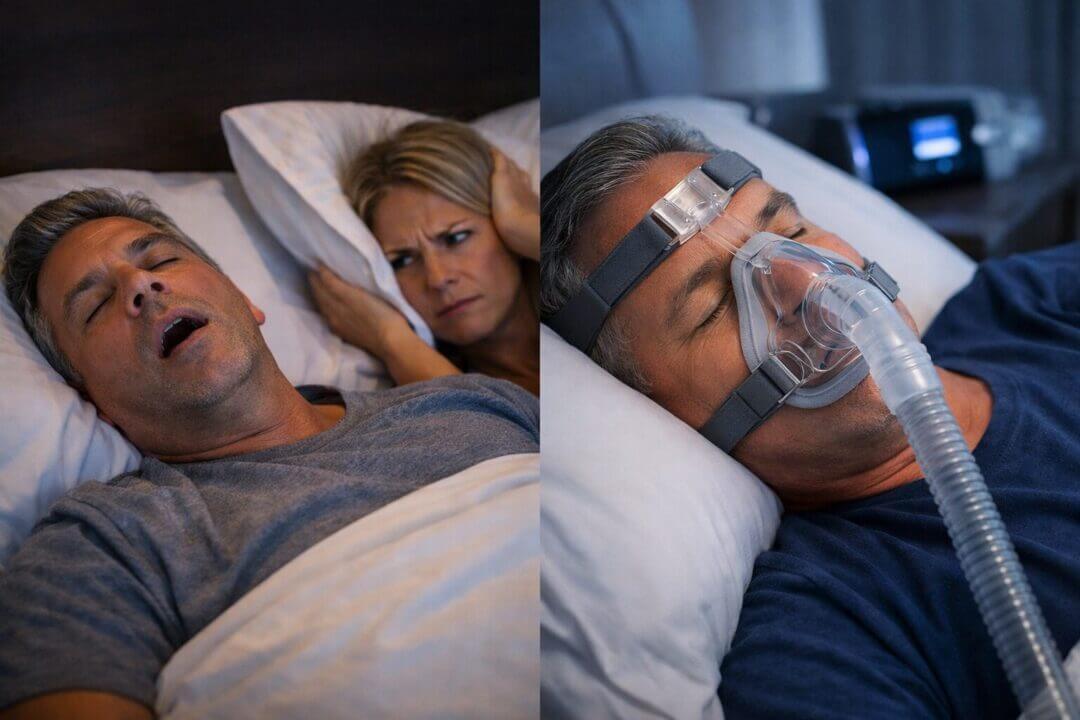
Your partner elbows you awake for the third time tonight. You’re snoring again—or maybe it’s something worse.
Nearly 90 million Americans snore regularly, but roughly 22 million of them are actually suffocating dozens of times per hour without knowing it. That’s the brutal truth about snoring vs sleep apnea: one is annoying, the other is slowly killing you.
I spent years dismissing my own nighttime noise as just another quirk. My wife didn’t find it charming. She’d describe how I’d go silent mid-snore, then gasp like I was drowning.
Turns out, I was drowning—in my own collapsed airway. Understanding the difference between simple snoring and sleep apnea literally saved my life, and it might save yours too.
Key Takeaways
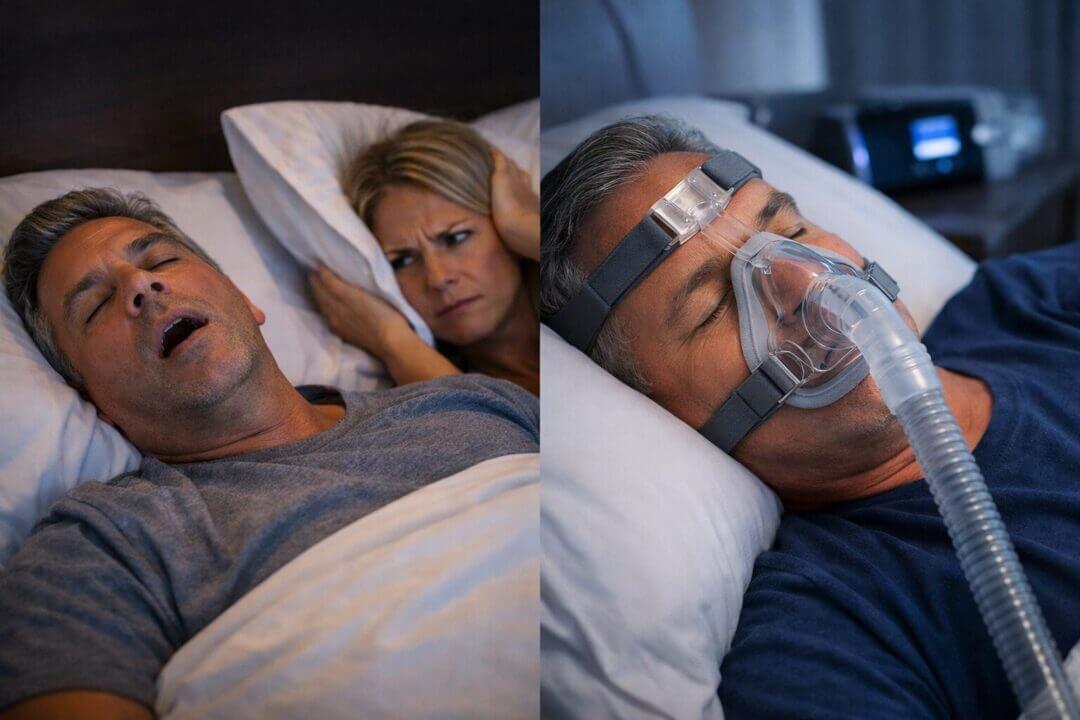
Snoring is noise from vibrating throat tissue; sleep apnea involves repeated breathing pauses that starve your body of oxygen
Not all snorers have sleep apnea, but most sleep apnea patients snore—the key difference is whether breathing actually stops
Daytime exhaustion, gasping awake, and witnessed breathing pauses signal apnea, not just snoring
Sleep studies are the only way to diagnose sleep apnea—self-treatment of apnea as simple snoring is dangerous
Treatment differs dramatically: snoring responds to lifestyle changes and simple devices, while sleep apnea requires medical intervention like CPAP or oral appliances
What Snoring Actually Is
Snoring happens when air squeezes through a partially blocked airway, making the soft tissues in your throat vibrate like a flag in the wind. The sound can range from a gentle purr to a freight train rumble that rattles windows. It’s mechanical, predictable, and usually harmless on its own.
But here’s where it gets tricky: snoring is the most common warning sign that something’s wrong with your airway. Your throat muscles relax during sleep, and if your airway narrows enough to create noise, it might narrow enough to close completely.
That’s when snoring crosses into dangerous territory.
Occasional snoring—when you’ve got a cold or you’ve had a few drinks—is different from chronic nightly sawing. If you snore every night or most nights, your airway is telling you it’s struggling. The question becomes whether it’s just struggling or actually failing.
The Three Types of Snoring
Nasal Snoring
Your nose acts as your primary air highway during sleep. When allergies, a deviated septum, or a simple cold blocks that highway, your body switches to mouth breathing. The turbulent airflow through your mouth creates the classic snoring sound.
Nasal snorers often wake with dry mouth and sore throat. Nasal strips and dilators can work wonders here because they address the root cause—getting air through your nose again.
Mouth / Palate Snoring
This is the most common type. Your soft palate—that fleshy part at the back of your roof—relaxes and vibrates when you breathe through your mouth. Back sleeping makes it worse because gravity pulls everything backward.
The sound is usually louder and more consistent than nasal snoring. Changing your sleep position can dramatically reduce palate snoring, sometimes eliminating it entirely.
Tongue Snoring
When your tongue relaxes too much, it falls backward and partially blocks your airway. Alcohol, antihistamines, and sleep aids all make this worse by over-relaxing your muscles. This type often sounds deeper and more irregular.
Tongue snoring is the type most likely to progress into obstructive sleep apnea. The same mechanism that creates the noise can create complete blockages.
What Sleep Apnea Is
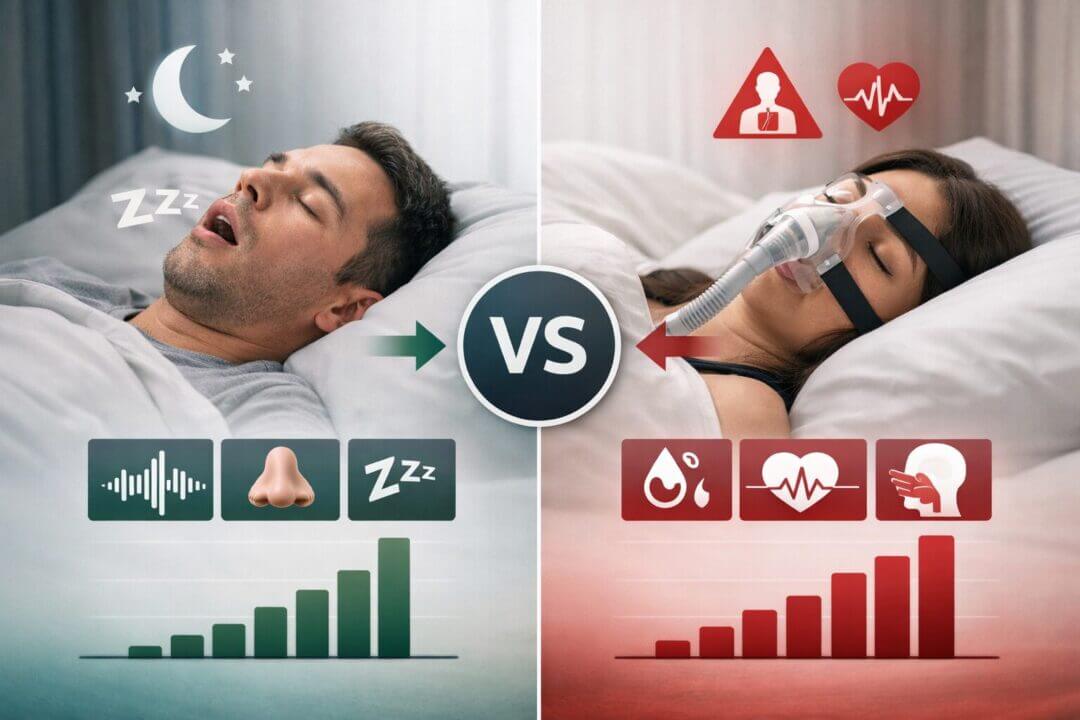
Sleep apnea isn’t just loud snoring. It’s a medical condition where your breathing repeatedly stops and starts throughout the night. Each pause—called an apnea—can last from a few seconds to over a minute.
Your brain has to wake you up (usually without you knowing it) to restart breathing.
The 2025 Clinical Practice Guidelines emphasize that sleep apnea commonly occurs alongside insomnia, creating a vicious cycle. You can’t sleep well because you can’t breathe, and the fragmented sleep makes everything worse.
This isn’t just about being tired—untreated sleep apnea carries serious health risks.
Obstructive Sleep Apnea (OSA)
OSA accounts for about 84% of sleep apnea cases. Your airway physically collapses during sleep, blocking airflow completely. The obstruction triggers a desperate cycle: you stop breathing, oxygen drops, your brain panics and wakes you just enough to gasp and resume breathing, then you fall back asleep and the cycle repeats.
Most OSA patients don’t remember these awakenings. You might experience them 5 times per hour (mild), 15-30 times per hour (moderate), or over 30 times per hour (severe). Imagine trying to sleep while someone shakes you awake every two minutes all night long.
Excess weight around the neck increases collapse risk, which is why weight loss can sometimes reduce OSA severity. But thin people get it too—anatomy matters as much as weight.
Central Sleep Apnea (CSA)
CSA is neurological, not mechanical. Your brain simply fails to signal your breathing muscles. There’s no obstruction—your airway stays open, but you stop breathing anyway. It’s associated with heart failure, stroke, and certain medications.
The eerie thing about CSA is that it often happens without snoring. Your partner might notice you just stop breathing, with no sound at all. Then you suddenly gasp and resume.
Complex (Mixed) Sleep Apnea
Some unlucky people have both OSA and CSA. Even more confusing, some people develop CSA after starting CPAP treatment for OSA. The machine fixes the obstruction, but then the brain’s breathing signals get confused.
Complex sleep apnea requires specialized treatment approaches. Standard CPAP might not be enough.
How to Tell the Difference Between Snoring vs Sleep Apnea
Here’s the critical distinction: snoring is noise, sleep apnea is silence followed by gasping. If you just snore steadily all night without pauses, you probably don’t have apnea. If your snoring includes gaps where breathing stops, then desperate gasps, you likely do.
The overlap confuses people. Many OSA patients snore loudly between apneas. But not all snorers have apnea—you can snore like a chainsaw and breathe perfectly fine all night.
Partner observations are gold. Ask your bed partner these questions:
Do I stop breathing during sleep?
Do I gasp or choke?
Does my snoring sound interrupted or steady?
If they’ve witnessed breathing pauses, that’s a major red flag. Daytime symptoms matter too. Excessive sleepiness despite “sleeping” 8 hours suggests your sleep is fragmented by apneas. Simple snorers usually feel reasonably rested.
Other apnea warning signs include:
Morning headaches
Difficulty concentrating
Irritability and mood changes
Night sweats
Frequent nighttime urination
I had all of these. I blamed stress, age, bad luck. Never connected the dots until my wife recorded me on her phone—watching myself stop breathing for 40 seconds was terrifying.
Diagnosing Sleep Apnea vs. Snoring
Diagnosing simple snoring is straightforward. Your doctor asks about symptoms, examines your throat and nose, and rules out apnea. If you snore but don’t have breathing pauses or daytime symptoms, you’re probably dealing with primary snoring.
Sleep apnea requires a sleep study—there’s no way around it. You can’t diagnose it by symptoms alone. The gold standard is an in-lab polysomnography where you sleep overnight while connected to monitors tracking brain waves, breathing, oxygen levels, and body movements.
Home sleep tests are increasingly common for straightforward cases. You wear a device that monitors breathing and oxygen overnight in your own bed. They’re less comprehensive but more convenient and cheaper.
The study generates an AHI score—Apnea-Hypopnea Index. This counts how many times per hour your breathing stops (apnea) or becomes too shallow (hypopnea):
AHI under 5: Normal
AHI 5-15: Mild OSA
AHI 15-30: Moderate OSA
AHI over 30: Severe OSA
My AHI came back at 42. Severe. I was stopping breathing 42 times every hour, over 300 times per night. No wonder I felt like death.
Treatment Paths by Diagnosis
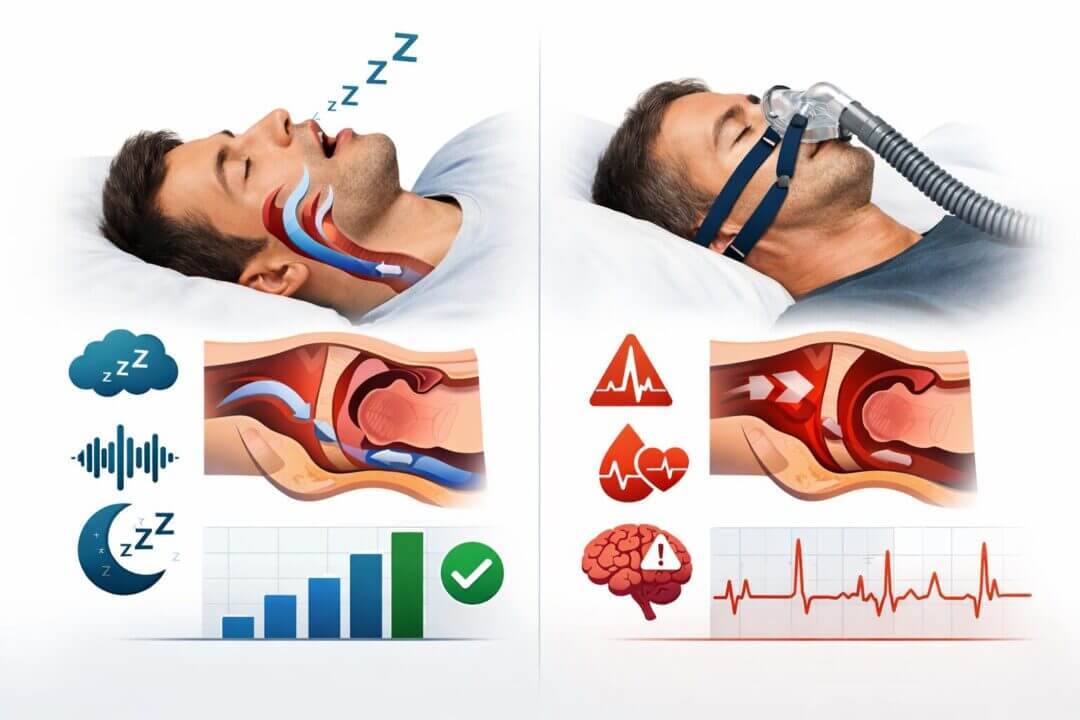
Treatment depends entirely on what you’re dealing with. Treating snoring won’t fix apnea, and apnea treatments might be overkill for simple snoring.
For Snoring (Without Apnea)
The American Academy of Sleep Medicine recommends oral appliances over no treatment for primary snoring. Mandibular advancement devices gently push your jaw forward, opening your airway. They work well for many snorers.
Other effective approaches:
Nasal strips or dilators to improve nasal breathing
Positional therapy (sleeping on your side instead of your back)
Weight loss if you’re overweight
Avoiding alcohol before bed
Staying hydrated to keep throat tissues from getting sticky
Lifestyle changes can dramatically reduce or eliminate snoring. I’ve seen people completely stop snoring just by losing 20 pounds and switching to side sleeping.
For OSA
The 2025 Clinical Practice Guidelines identify first-line therapies for mild to moderate OSA as PAP machines and mandibular advancement devices. CPAP (Continuous Positive Airway Pressure) remains the gold standard—it blows air through a mask to keep your airway open all night.
CPAP works incredibly well when you can tolerate it. The challenge is adherence.
Many people struggle with the mask, the noise, or feeling claustrophobic. The guidelines now emphasize educational, behavioral, and supportive interventions (including telehealth) to improve CPAP adherence.
Oral appliances for sleep apnea are an alternative for mild to moderate cases or when CPAP fails. They work similarly to snoring mouthpieces but are custom-fitted by a dentist and adjusted more precisely.
Surgery is an option when anatomy is the problem—enlarged tonsils, severe deviated septum, or excess throat tissue. Lifestyle changes matter here too, especially weight management.
Veterans dealing with sleep apnea should know that VA disability ratings are changing in 2026. The proposed rules shift ratings from treatment type to treatment effectiveness.
Most veterans getting relief from CPAP will drop from 50% to 10% disability rating. Those unable to tolerate CPAP due to PTSD or claustrophobia may still qualify for 50%, but need documented medical evidence.
For CSA
Central sleep apnea requires treating the underlying condition first—heart failure, medication adjustments, or stroke recovery. If CSA persists, adaptive servo-ventilation (ASV) machines can help by adjusting pressure breath-by-breath based on your breathing patterns.
CSA is complex and needs specialist management. Don’t try to self-treat this one.
Why It Matters to Know Which One You Have
The difference between snoring and sleep apnea isn’t academic—it’s life or death. Untreated OSA dramatically increases your risk of:
Heart attack and stroke (your heart works overtime compensating for oxygen drops)
High blood pressure (the constant stress response elevates BP)
Type 2 diabetes (sleep disruption messes with insulin regulation)
Memory problems and cognitive decline (your brain needs oxygen)
Depression and anxiety (chronic sleep deprivation destroys mental health)
Sudden death during sleep (in severe cases, your brain might not wake you)
Snoring might annoy your partner and disrupt your sleep quality, but it won’t kill you. Sleep apnea will.
That’s why self-diagnosing and self-treating is dangerous. You might think you’re addressing snoring with a simple mouthpiece when you actually have moderate OSA that needs CPAP.
When should you stop self-treating and see a doctor? If you have any of these:
Witnessed breathing pauses during sleep
Gasping or choking awake
Severe daytime sleepiness despite adequate sleep time
Morning headaches
Difficulty concentrating or memory problems
High blood pressure that’s hard to control
Don’t mess around with this. A sleep study is simple, usually covered by insurance, and might save your life.
Well? Which Is It?
The snoring vs sleep apnea question isn’t just about noise levels or annoyance—it’s about whether you’re breathing properly all night or slowly suffocating.
Snoring means your airway is narrowed and vibrating. Sleep apnea means your airway is collapsing completely, over and over, starving your body of oxygen.
Most sleep apnea patients snore, but most snorers don’t have sleep apnea. The telltale signs are breathing pauses, gasping, and severe daytime exhaustion despite spending enough time in bed.
If your partner has witnessed you stop breathing, or if you’re exhausted no matter how long you sleep, get a sleep study.
Treatment paths diverge completely. Simple snoring responds to lifestyle changes, positional therapy, and over-the-counter devices. Sleep apnea requires medical intervention—CPAP, oral appliances, or surgery.
Treating one as if it’s the other wastes time and, in the case of untreated apnea, risks your life.
I wish I’d understood this distinction years earlier. The damage from untreated sleep apnea accumulates silently—heart strain, cognitive decline, metabolic dysfunction
By the time I got diagnosed, I’d spent years operating at half capacity, thinking I was just a bad sleeper.
Your next steps:
Ask your partner to observe your sleep and report any breathing pauses or gasping
Track your symptoms—daytime sleepiness, morning headaches, concentration problems
See your doctor if you have any red flags for sleep apnea
Get a sleep study if recommended—don’t skip this step
Follow through with treatment once diagnosed, whether it’s lifestyle changes for snoring or CPAP for apnea
The difference between snoring and sleep apnea is the difference between an annoyance and a medical emergency. Know which one you’re dealing with.
Your life might depend on it.
Related reading: normal oxygen levels during sleep and breathing rate during sleep.