

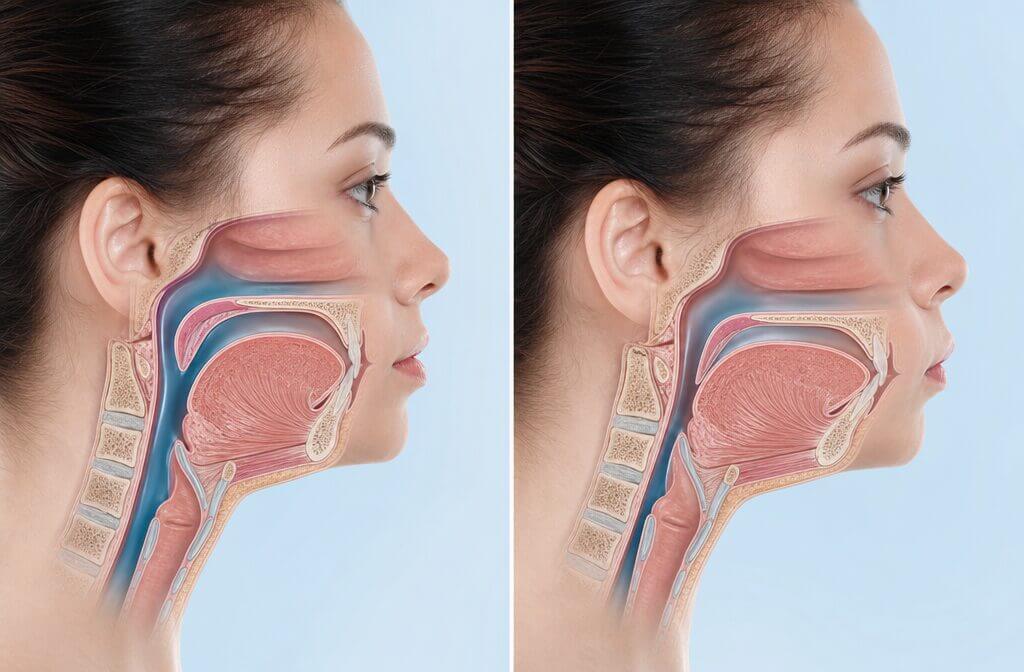
Snoring and Overbite: How Your Jaw Alignment Affects Sleep Quality
Quick Answer: An overbite can cause or worsen snoring by pushing your lower jaw backward, which narrows your airway and forces air through a restricted passage. When your upper teeth overlap your lower teeth by more than 2-3mm (an excessive overbite or malocclusion), the recessed jaw position creates an obstruction that makes throat tissues vibrate during sleep. Mandibular advancement devices can reposition your jaw forward during sleep to open the airway and reduce snoring, even if they don’t correct the overbite itself.
Last updated: May 20, 2026
Key Takeaways
- Excessive overbites (upper teeth overlapping lower teeth by 2.5mm or more) commonly cause snoring by narrowing the airway
- Two types of overbites exist: skeletal (jaw bone positioning) and dental (tooth misalignment), both can contribute to breathing issues
- A recessed lower jaw from an overbite pushes your tongue backward, reducing airway space during sleep
- Overbite-related snoring often occurs alongside mouth breathing and can progress to obstructive sleep apnea
- Mandibular advancement devices hold your jaw forward during sleep to open the airway without requiring surgery
- Braces correct overbites in children and teens, but adults with snoring may need alternative solutions
- Surgical jaw correction exists but remains a last-resort option due to pain, recovery time, and cost
What Is an Overbite and How Common Is It?
An overbite occurs when your upper front teeth extend over your lower front teeth when your mouth is closed. Nearly everyone has some degree of overbite—a 1-2mm overlap is considered normal and healthy. The problem starts when that overlap exceeds 2-3mm, creating what dentists call an excessive overbite or malocclusion.
Overbites rank among the most common orthodontic issues, affecting roughly 70% of children to some degree. Most cases are mild and don’t cause functional problems. However, moderate to severe overbites can impact:
- Breathing patterns (especially during sleep)
- Jaw joint function and pain
- Speech clarity
- Tooth wear and dental health
- Facial appearance and profile
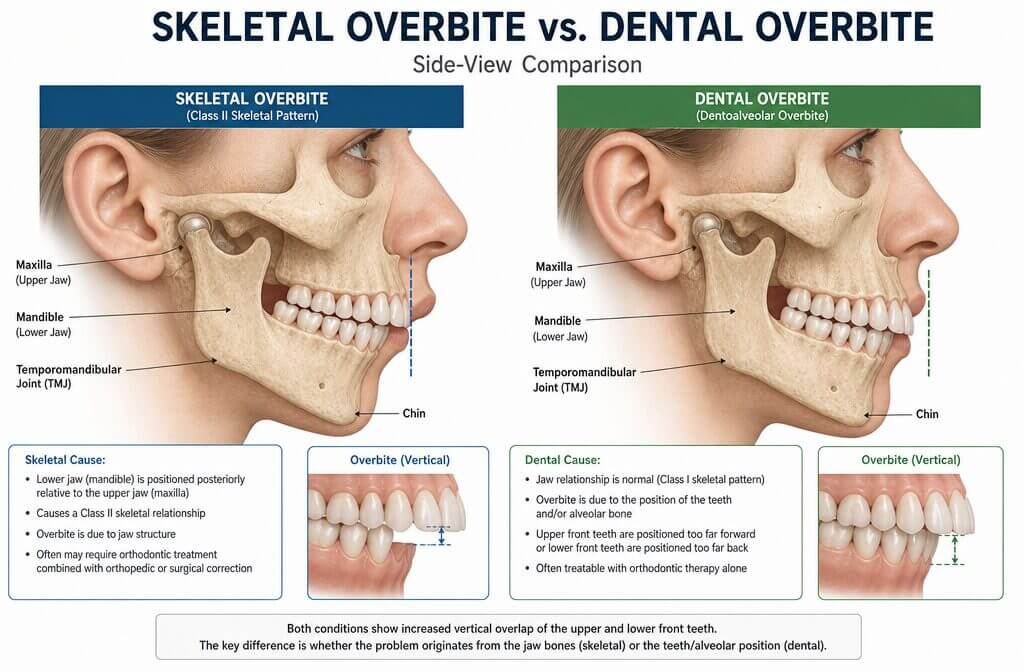
The Two Types of Overbites
Skeletal overbite: Your jaw bones themselves are misaligned. The maxilla (upper jaw) sits too far forward, or the mandible (lower jaw) sits too far back. This structural issue often runs in families and typically requires orthodontic intervention or, in severe cases, surgical correction.
Dental overbite: Your jaw bones align correctly, but your teeth have grown or shifted into misaligned positions. Childhood habits like thumb-sucking, prolonged pacifier use, or tongue thrusting can cause dental overbites. These respond well to braces or clear aligners.
Many people have a combination of both skeletal and dental components contributing to their overbite.
How Does an Overbite Cause Snoring?
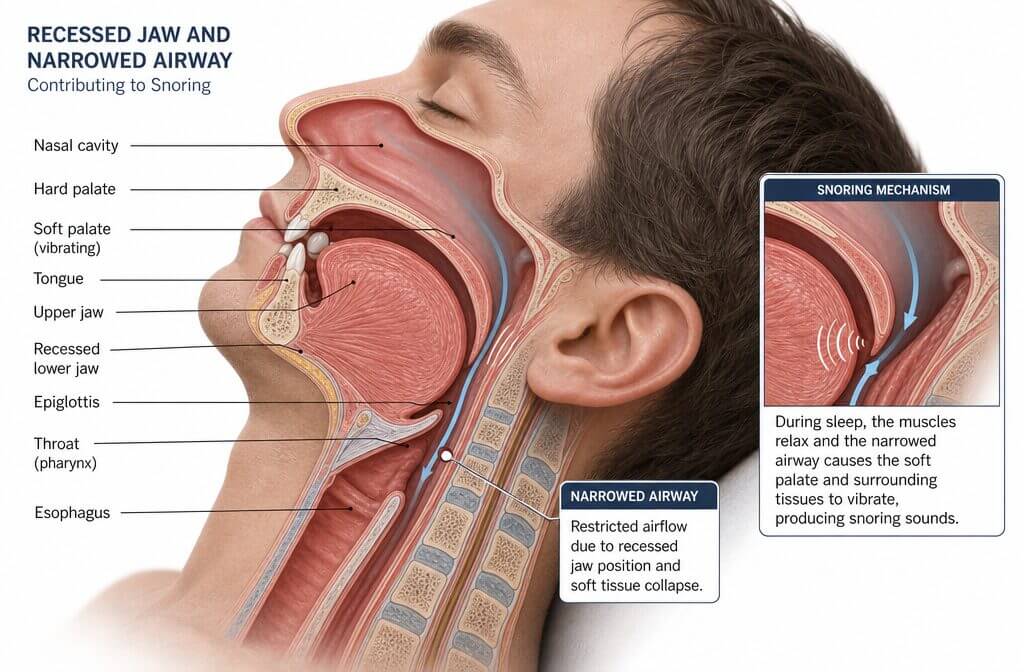
When your upper jaw extends significantly over your lower jaw, your lower jaw often sits in a recessed (pulled-back) position. This backward positioning creates a chain reaction that affects your airway:
The airway narrowing process:
- Your recessed lower jaw pushes your tongue further back in your mouth
- The tongue takes up more space in your throat, especially when you lie down
- Your soft palate and throat tissues have less room
- Air must squeeze through a narrower passage
- The restricted airflow causes soft tissues to vibrate, creating snoring sounds
People with excessive overbites frequently develop mouth breathing habits because nasal breathing doesn’t provide enough airflow through their restricted passages. Mouth breathing during sleep makes snoring worse and dries out throat tissues, creating more vibration.
The Sleep Apnea Connection
Severe overbites don’t just cause snoring—they increase your risk of obstructive sleep apnea (OSA). With OSA, your airway doesn’t just narrow; it completely collapses repeatedly throughout the night, cutting off oxygen. Each collapse triggers a brief awakening (often so brief you don’t remember it) as your brain panics and forces you to breathe.
Research shows that jaw position significantly affects sleep-disordered breathing. A narrow lower jaw and recessed jaw position—both common with overbites—are recognized risk factors for OSA. If your snoring includes gasping, choking sounds, or your partner notices you stop breathing during sleep, talk to a doctor about a sleep study.
Who Is Most Affected by Overbite-Related Snoring?
Overbite-related snoring doesn’t affect everyone with an overbite equally. You’re more likely to experience breathing issues during sleep if you have:
- An overbite measuring 4mm or greater (moderate to severe)
- A narrow lower jaw or small chin (retrognathia)
- A history of mouth breathing, especially at night
- Extra weight, which adds tissue bulk around the airway
- Nasal congestion or obstruction that forces mouth breathing
- A family history of sleep apnea
Children with overbites may snore, breathe through their mouths, or experience restless sleep. Parents sometimes dismiss these signs, but childhood sleep-disordered breathing can affect growth, behavior, and school performance. If your child snores regularly or breathes through their mouth at night, mention it to their dentist or pediatrician.
Can Braces or Orthodontics Stop Snoring?
Braces and orthodontic treatment can correct overbites, especially in children and teenagers whose jaws are still growing. By gradually moving teeth and guiding jaw development, orthodontics can improve jaw alignment and potentially reduce snoring.
What orthodontic treatment can do:
- Align teeth to reduce dental overbite
- Expand the upper jaw to create more space
- Guide lower jaw growth forward in growing children
- Improve overall facial structure and airway space
Important limitations:
- Treatment takes 18-36 months on average
- Works best before jaw growth is complete (typically by late teens)
- May not fully resolve skeletal overbites in adults
- Doesn’t guarantee snoring will stop, especially if other factors contribute
Adults with overbites have fewer orthodontic options because their jaw bones have stopped growing. Braces can still move teeth, but they can’t change the underlying jaw bone position without surgery.
If you’re considering orthodontics primarily to address snoring, discuss this goal specifically with your orthodontist. They can assess whether treatment is likely to improve your airway and breathing, or whether you’ll need additional interventions.
What About Jaw Surgery for Overbites?
Orthognathic surgery (jaw surgery) can correct severe skeletal overbites by physically repositioning the jaw bones. During the procedure, an oral surgeon cuts the lower jaw bone, moves it forward, and secures it with titanium plates and screws.
When surgery might be recommended:
- Severe skeletal overbite that orthodontics alone can’t fix
- Significant breathing problems or diagnosed sleep apnea
- Jaw pain or temporomandibular joint (TMJ) dysfunction
- Difficulty chewing or speaking
- After orthodontic options have been exhausted
Why surgery is typically a last resort:
- Pain and recovery: Expect significant swelling, bruising, and discomfort for weeks. Full recovery takes 3-6 months.
- Diet restrictions: You’ll need a liquid or soft food diet for 6-8 weeks while bones heal.
- Cost: The procedure typically costs $20,000-$40,000, though insurance may cover part of it if deemed medically necessary.
- Risks: Like any surgery, complications can include infection, nerve damage, or relapse where the jaw shifts back.
Most people with overbite-related snoring don’t need surgery. Less invasive options work well for the majority of cases.
How Do Anti-Snoring Mouthpieces Work for Overbites?
Mandibular advancement devices (MADs) are custom-fitted or adjustable oral appliances that hold your lower jaw in a forward position while you sleep. This forward positioning opens your airway, similar to what jaw surgery accomplishes, but temporarily and non-invasively.
How MADs address overbite-related snoring:
- Pull your lower jaw forward, counteracting the recessed position from your overbite
- Create more space behind your tongue
- Reduce airway collapse and tissue vibration
- Allow better airflow without obstruction
These devices work particularly well for people with overbites because they directly address the root cause: the backward jaw position that narrows the airway.
Choosing the Right Mouthpiece
Not all anti-snoring mouthpieces work the same way. For overbite-related snoring, you’ll want a mandibular advancement device specifically, not a tongue-retaining device. Understanding the differences between device types helps you choose the right solution.
Features to look for:
- Adjustability: Your jaw position may need fine-tuning for optimal results
- Custom or boil-and-bite fit: Better fit means more comfort and effectiveness
- Dental clearance: Ensure your teeth and gums are healthy enough for a MAD
- Breathing holes: Allow mouth breathing if needed (common with overbites)
Popular options include devices with incremental adjustment mechanisms that let you gradually advance your jaw forward until you find the position that stops your snoring without causing jaw discomfort.
Before using any oral appliance, check with your dentist. Some dental conditions (severe gum disease, loose teeth, or TMJ disorders) may make MADs unsuitable or require modifications.
What If a Mouthpiece Doesn’t Work?
Mandibular advancement devices work for many people with overbite-related snoring, but they’re not universal solutions. If you’ve tried a properly fitted MAD and still snore, consider these possibilities:
Other contributing factors:
- Nasal obstruction: Deviated septum, allergies, or chronic congestion can cause snoring independent of jaw position
- Excess weight: Fat deposits around the neck and throat narrow the airway
- Alcohol or sedatives: These relax throat muscles excessively
- Sleep position: Back sleeping makes snoring worse for most people
- Enlarged tonsils or adenoids: Physical obstructions in the throat
Next steps if MADs don’t help:
- Sleep study: Rule out or diagnose obstructive sleep apnea, which may require CPAP therapy
- ENT evaluation: Check for structural issues like enlarged tonsils or nasal problems
- Positional therapy: Try devices that keep you sleeping on your side
- Weight management: Even modest weight loss can significantly reduce snoring
- Combination approach: Address multiple factors simultaneously
Some people need layered solutions. For example, treating nasal congestion while using a MAD, or combining a supportive mattress that promotes side sleeping with an oral appliance.
Can Children With Overbites and Snoring Use Mouthpieces?
Most anti-snoring mouthpieces are designed for adults and aren’t appropriate for children whose teeth and jaws are still developing. However, children with overbites who snore shouldn’t be ignored.
Better approaches for children:
- Orthodontic evaluation: Early intervention (ages 7-10) can guide jaw growth and prevent worsening
- Palatal expanders: Widen the upper jaw to create more airway space
- Myofunctional therapy: Exercises that strengthen tongue and facial muscles, improve breathing patterns
- Adenoid/tonsil evaluation: Enlarged tissues are common snoring causes in children
- Allergy management: Reduce nasal congestion that forces mouth breathing
If your child snores regularly, breathes through their mouth, or has an obvious overbite, schedule evaluations with both their dentist and pediatrician. Addressing these issues early prevents more serious problems later and may eliminate the need for extensive treatment in adulthood.
Lifestyle Changes That Help Overbite-Related Snoring
While you can’t change your jaw structure without orthodontics or surgery, several lifestyle modifications can reduce snoring severity:
Sleep position adjustments:
- Sleep on your side instead of your back
- Elevate your head 4-6 inches with a wedge pillow or bed risers
- Avoid sleeping flat, which lets your jaw and tongue fall backward
Evening habits:
- Avoid alcohol 3-4 hours before bed (it relaxes throat muscles)
- Don’t eat large meals right before sleep
- Stay hydrated, but don’t overdo fluids right before bed
Nasal breathing support:
- Use saline rinses to clear nasal passages
- Try nasal strips to open nasal airways
- Run a humidifier to prevent dryness
- Address allergies with appropriate medications
Weight management:
- Even 5-10% body weight loss can reduce snoring
- Focus on reducing neck circumference specifically
- Combine diet changes with regular exercise
Mouth and throat exercises:
- Practice keeping your mouth closed and breathing through your nose during the day
- Tongue exercises (pressing tongue to roof of mouth, sliding it backward) strengthen muscles
- Singing or playing wind instruments can tone throat tissues
These changes won’t correct your overbite, but they reduce additional factors that make snoring worse.
When to See a Doctor About Snoring and Overbite
Not all snoring requires medical intervention, but certain warning signs indicate you should talk to a healthcare provider:
See a doctor if you experience:
- Loud snoring that disrupts your partner’s sleep regularly
- Gasping, choking, or silent pauses in breathing during sleep
- Excessive daytime sleepiness despite spending enough time in bed
- Morning headaches or waking with a dry mouth/sore throat
- Difficulty concentrating or memory problems
- High blood pressure that’s hard to control
- Witnessed breathing pauses (your partner sees you stop breathing)
These symptoms may indicate obstructive sleep apnea, which requires diagnosis and treatment beyond simple snoring solutions. Untreated sleep apnea increases risks of heart disease, stroke, diabetes, and accidents due to daytime sleepiness.
Which specialist to see:
- Dentist: For overbite assessment and oral appliance fitting
- Orthodontist: For braces or jaw alignment treatment options
- Sleep medicine physician: For sleep study and apnea diagnosis
- ENT (ear, nose, throat) specialist: For structural airway issues
- Oral surgeon: If jaw surgery is being considered
Many cases benefit from a team approach where multiple specialists coordinate your care.
Comparing Your Options: Quick Decision Guide
Choose orthodontic treatment (braces) if:
- You’re under 18 with a developing jaw
- You want to permanently correct your overbite
- You can commit to 18-36 months of treatment
- Your snoring is mild to moderate
Choose a mandibular advancement device if:
- You’re an adult with an established overbite
- You want immediate snoring relief
- You’re not ready for or don’t need surgery
- Your teeth and gums are healthy
Consider jaw surgery if:
- You have a severe skeletal overbite
- You’ve been diagnosed with moderate to severe sleep apnea
- Other treatments haven’t worked
- You have additional jaw problems (pain, difficulty chewing)
Try lifestyle changes first if:
- Your snoring is occasional or mild
- You have other risk factors (weight, alcohol use, back sleeping)
- You want to enhance other treatments
- You’re not ready for devices or procedures
Most people start with the least invasive options and progress to more intensive treatments only if needed. A properly selected anti-snoring mouthpiece combined with lifestyle changes resolves snoring for many people with overbites.
Frequently Asked Questions
Related Reading
If you’re exploring solutions for snoring related to jaw position, these resources may help:
- 14 Important Facts About Anti-Snoring Mouthpieces
- MAD vs TRD: Understanding Different Mouthpiece Types
- Feature Comparison: Mandibular Advancement Devices
Understanding the connection between your jaw structure and sleep quality empowers you to find solutions that actually work. Whether you choose an oral appliance, pursue orthodontic treatment, or combine multiple approaches, addressing overbite-related snoring can dramatically improve your sleep and your partner’s rest.