

Best Anti-Snoring Sprays to Suppress Snoring
Anti-snoring sprays promise a quick fix at bedtime, but the evidence is thin and mostly negative. Most of the sprays this page once covered could not be confirmed as sold today, so we cut it down to what you can still buy.
Here is what the trials found, what the one spray we could confirm in stock costs, and what to try if a spray does nothing for you.
Key Takeaways
- The trial evidence is weak: a randomized trial of 40 snorers found no objective or subjective benefit from an oral spray, a nasal strip or a head-positioning pillow
- One spray is confirmed in stock: SnoreStop Oral Spray, $59.99 for a 2 fl oz bottle as of November 21, 2026
- It is homeopathic: the company says its ingredients have not been reviewed by the FDA, so it is not FDA approved
- Sprays do not treat sleep apnea: gasping, choking or pauses in breathing call for a sleep study
Do Anti-Snoring Sprays Work?
Mostly no, in the controlled trials we found. A 2004 randomized trial of 40 snorers tested an oral spray lubricant, a nasal strip and a head-positioning pillow, and it found neither objective nor subjective benefit from any of them.
A double-blind crossover trial of an oil-based oral spray in 69 chronic snorers reached the same verdict. Compared with a water-based placebo spray, the authors reported a lack of efficacy, and of the 20 snorers analyzed for percent of time snoring, 55% got worse while 30% improved.
Results for plant oils are mixed. A 2001 trial of 72 heavy snorers who gargled a volatile oil found no statistically significant drop in snoring as graded by bed partners, while one double-blind study of essential-oil sprays and gargles reported less snoring.
The American Academy of Sleep Medicine reviewed nonprescription snoring products in 2003 and concluded that the scientific evidence for many of them is limited.
How Snoring Sprays Are Meant to Work
Most sprays try to coat or lubricate the soft palate and throat so the tissue vibrates less. Some, like the one below, are sold as homeopathic products instead.
Neither idea has strong support, and a spray cannot widen a narrow airway. If your snoring comes from a blocked nose, your tongue falling back or your jaw position, a spray may do little.
SnoreStop Oral Spray: The One We Can Confirm
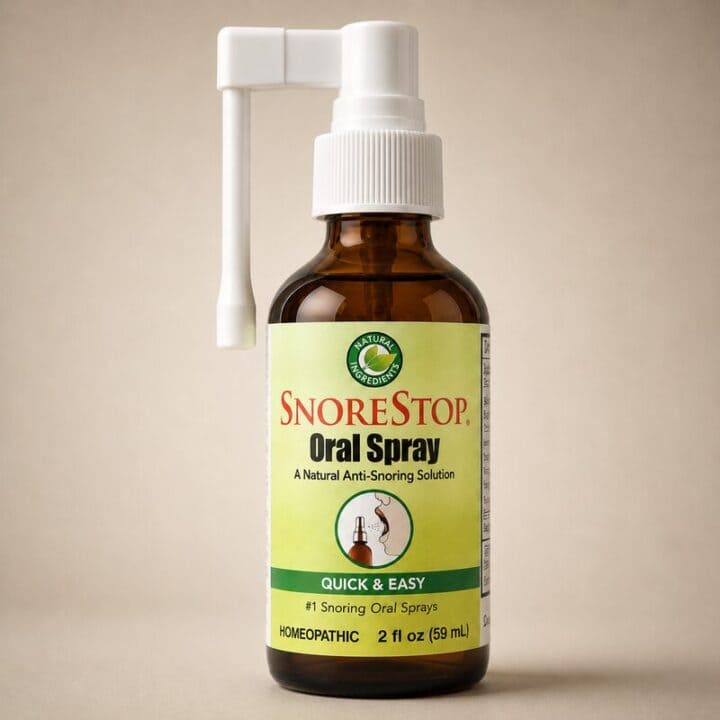
SnoreStop Oral Spray is sold on the maker’s own site at $59.99 for a 2 fl oz bottle, as of November 21, 2026, or $50.99 with Subscribe & Save. The company says a bottle holds about 400 sprays, roughly 100 nights, and it lists a 30-day money-back guarantee.
The company’s directions are to shake it well and, at bedtime, spray twice under the tongue and twice at the back of the throat, without water. The current formula lists nine homeopathic ingredients, including Belladonna, Nux Vomica and Hydrastis canadensis, in 4X, 6X and 12X potencies.
Our old version of this page called it FDA approved. The company’s own site says its ingredients have not been reviewed by the FDA, so we dropped that claim.
The company also says its spray is backed by a double-blind, placebo-controlled study. That study, by Lipman and colleagues in 1999, tested SnoreStop tablets and not the spray.
In it, 35 of 44 treated snorers (79.5%) improved on a global rating versus 21 of 46 on placebo (45.6%), with a partner-scored snoring measure also favoring treatment. It was a 10-night trial from 1999, and we found no published trial of the spray itself.
SnoreStop’s own site says a former SnoreStop nasal spray lot was recalled in 2024 and that the product was discontinued. It says the current oral spray and tablets were not part of that recall.
Why Other Sprays Are Not Listed Anymore
This page used to review seven sprays. We checked each one against its maker’s site and the big retailers.
Several are discontinued, sold out, sold only outside the United States, or not marketed for snoring at all, and one we could not find anywhere. Under our rule, a product you cannot buy online does not belong in a roundup, so we removed them.
What to Try if a Spray Does Not Help
If sprays do nothing, match the fix to the cause. A blocked nose points toward nasal strips or dilators, and our guide on whether nasal strips work for snoring covers who they suit.
If your jaw or tongue is the problem, a mouthpiece addresses it directly. Our guide to the best anti-snoring mouthpieces compares the ones in stock today.
Habits matter too, so try the changes in our natural remedies for snoring guide alongside any product.
When to See a Doctor
Loud snoring with gasping, choking or pauses in breathing is a reason for a sleep study, not a spray. Our guide to snoring versus sleep apnea explains the warning signs.
Talk to your doctor before using any homeopathic product if you are pregnant, take prescription medicine or have a chronic condition.
Frequently Asked Questions
Your Next Step if a Spray Falls Short
Give any spray one honest week with a partner or a recording app as your judge. If the snoring does not drop, move on to a fix that targets your cause instead of buying another bottle.