

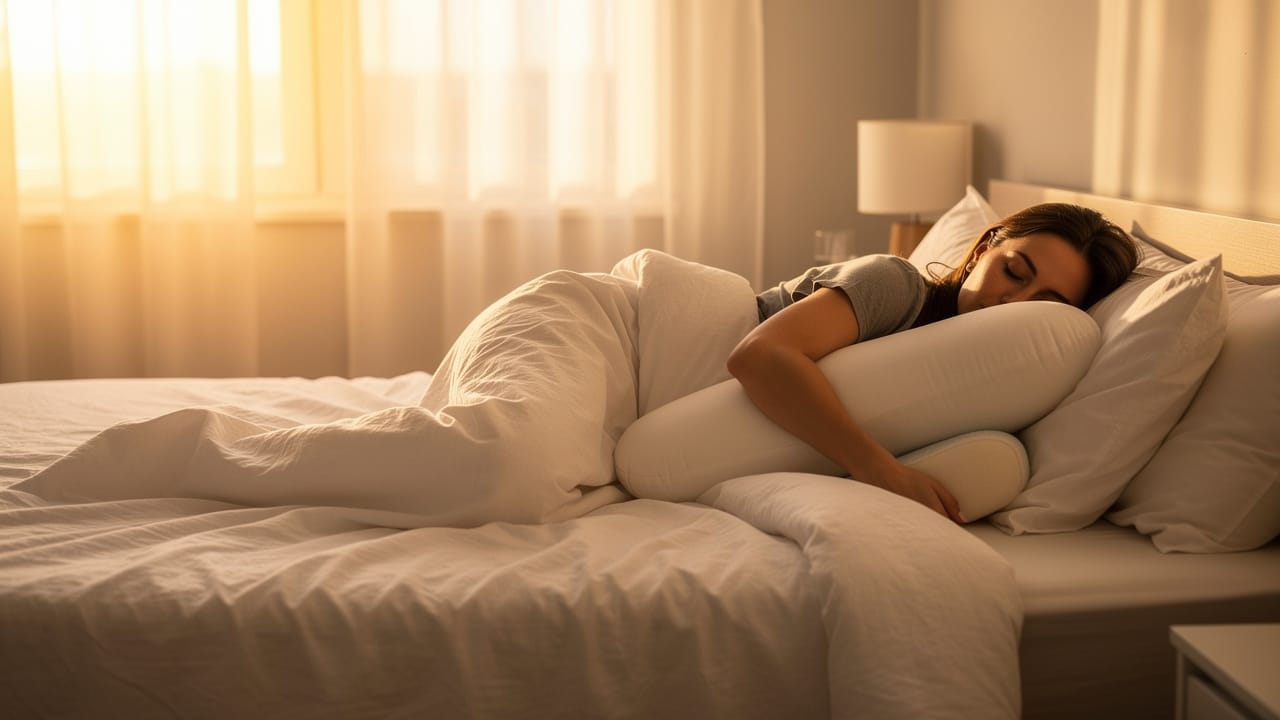
How to Train Yourself to Sleep on Your Side
You know that feeling when your partner elbows you at 3 AM—again—because your snoring sounds like a freight train? You’re exhausted despite sleeping eight hours, and the embarrassment when guests stay over makes you want to hide.
You’ve tried those fancy nasal strips, bought three different pillows, and even Googled “snoring surgery cost” at 2 AM in desperation. But here’s the truth: the answer might be simpler than you think.
Your body position is the problem. You’re not imagining it. When you sleep on your back, gravity becomes your enemy—pulling your tongue and soft tissues backward, narrowing your airway, and creating those vibrations that wake everyone except you.
Meanwhile, 60% of adults already sleep on their side because it works. It keeps airways open. It stops the gravitational collapse that turns your throat into a wind tunnel.
Here’s the promise: training yourself to sleep on your side can reduce or eliminate your snoring in just a few weeks. This isn’t about willpower or suffering through uncomfortable positions. It’s about strategic positioning, the right support tools, and understanding why your body fights the change.
You’re about to learn practical techniques that work with your body’s natural resistance, not against it. By the time you finish reading, you’ll have a roadmap that doesn’t require expensive equipment or medical intervention—just smart adjustments that retrain decades of muscle memory.
Key Takeaways
Side sleeping prevents your tongue and soft tissues from collapsing backward, keeping your airway open and dramatically reducing snoring
The tennis ball technique creates gentle aversive conditioning that retrains your body to avoid back sleeping within 7-10 nights
Strategic pillow placement—especially a knee pillow and body pillow—maintains spinal alignment and prevents the discomfort that makes people abandon side sleeping
Most people successfully adapt to side sleeping within 4-6 weeks of consistent practice using physical barriers and support tools
Specialized devices like inclined pillows and positional trainers can accelerate the transition and provide clinical-grade support for persistent snorers

Why Side Sleeping Stops Snoring (And Why Your Body Resists It)
When you sleep on your back, physics works against you. Gravity pulls your tongue and the soft tissues in your throat backward, narrowing the space where air flows.
As you breathe, air squeezes through this restricted passage, causing the surrounding tissues to vibrate.
That vibration?
That’s the sound your partner hears as snoring. It’s not a character flaw or a mystery condition—it’s basic anatomy meeting gravity.
Side sleeping solves this problem by repositioning your airway. When you lie on your side, gravity pulls your tongue and soft tissues toward the mattress instead of toward your throat.
Your airway stays open. Air flows freely. The vibrations stop.
Research shows that 25-56% of people with obstructive sleep apnea have positional sleep apnea, meaning their condition is triggered or significantly worsened specifically by back sleeping. For these people, changing position isn’t just helpful—it’s life-changing.
But here’s why you can’t just decide to sleep on your side tonight and expect it to stick: your body has spent years, maybe decades, developing muscle memory for your current position. You’ve trained yourself to find comfort in a specific posture, and your subconscious guards that habit fiercely.
During sleep, you unconsciously roll onto your back without any awareness. You wake up in the exact position you were trying to avoid, frustrated and convinced you lack discipline.
You don’t lack discipline. You lack the right strategy.
Changing sleep position isn’t about willpower—it’s about creating physical barriers that work with your unconscious mind, not against it. The transition typically takes four to six weeks of consistent practice, but the payoff is significant:
Reduced snoring intensity
Fewer nighttime awakenings
Better oxygen flow throughout the night
Improved morning alertness
Your partner notices the difference first, but you’ll feel it in your energy levels and morning alertness.
“The position you sleep in can be as important as the number of hours you sleep. Side sleeping is one of the most effective non-invasive interventions for positional snoring.” — Sleep Medicine Research

The Tennis Ball Technique: Your First Line of Defense
The tennis ball technique sounds absurd until you understand the psychology behind it. You sew a pocket into the back of a tight-fitting pajama shirt and insert a tennis ball.
Some people pin a bundle of socks instead if they want something slightly softer. Either way, you’re creating a physical deterrent that makes back sleeping uncomfortable enough to trigger a response without causing real pain or fully waking you.
When you unconsciously try to roll onto your back during sleep, the discomfort from the tennis ball sends a signal to your brain. Your subconscious registers the unpleasant sensation and prompts you to return to your side—all without pulling you out of sleep.
This is gentle aversive conditioning, and it works because it targets the automatic behaviors that happen below your conscious awareness. You’re not fighting your willpower. You’re reprogramming your muscle memory.
How to implement the tennis ball technique:
Position the tennis ball between your shoulder blades for maximum effect
Use a firm tennis ball, not a soft stress ball—you need enough discomfort to trigger the response
Wear the shirt every night for at least two weeks before evaluating effectiveness
Expect some initial disruption to your sleep during the first few nights
Most people adapt within seven to ten nights, and by the second week, the technique starts feeling less intrusive. The first few nights feel awkward, and you might wake up more frequently as your body adjusts. This is normal.
The limitation is real, though: some people find it too uncomfortable to tolerate long enough for the retraining to take hold. If you’re one of them, don’t abandon the goal.
Move on to the pillow strategies below, or combine the tennis ball method with other techniques for a gentler transition. The key is consistency—wear the shirt every night for at least two weeks before deciding whether it’s working for you.

Strategic Pillow Placement: Building Your Side-Sleep Fortress
The knee pillow is your most critical tool. Place a firm orthopedic or memory foam pillow between your knees when you lie on your side. This single adjustment aligns your hips and prevents your upper leg from sliding forward and resting on the mattress.
When your top leg falls forward, it rotates your pelvis and twists your lower spine, creating the exact kind of discomfort that makes people abandon side sleeping in the middle of the night. The knee pillow keeps your spine straight and your hips stacked, eliminating the strain.
A full-length body pillow provides both physical and psychological support. A C-, U-, or J-shaped body pillow gives you something to hug, which satisfies the instinct to curl around something during sleep. More importantly, it creates a physical wall that makes rolling onto your back difficult.
You’d have to consciously move the pillow out of the way, which means you’re far less likely to shift positions unconsciously. Body pillows are especially effective for people transitioning from stomach sleeping, as they provide a resting place for your top arm and prevent shoulder collapse.
Tuck a rolled towel or small pillow against your lower back as a sensory reminder. This doesn’t prevent rolling as effectively as a body pillow, but it adds another layer of feedback.
When you start to shift backward, you feel the pressure against your spine, and your brain registers the signal to stay put. It’s subtle reinforcement that works alongside your other positioning tools.
Choosing the Right Head Pillow
Your head pillow needs to be higher than what back sleepers use. The pillow should fill the entire gap between your ear and the outer edge of your shoulder, keeping your neck in a neutral, straight line with your spine.
What happens with incorrect pillow height:
Too thin: Your head tilts downward, straining your neck
Too thick: It pushes your head upward, creating tension in your upper spine
Memory foam and latex pillows maintain their shape throughout the night, providing consistent support without flattening. Test the height by lying down and having someone check whether your head, neck, and spine form a straight line.
Adopt a modified fetal position: slightly lift your knees toward your chest, but keep your torso relatively straight. Curling too tightly restricts your diaphragm and limits deep breathing, which defeats the purpose of opening your airway.
The goal is a relaxed curve, not a tight ball. Your lungs need room to expand fully, and your spine needs to maintain its natural alignment.

Snoring HQ’s Recommended Solutions for Side Sleepers
Snoring HQ reviews specialized pillows designed specifically to facilitate side sleeping and maintain open airways. The HPP (Head Position Pillow) and SONA Pillow elevate your head and upper body at a 10-15° incline, combining the benefits of side sleeping with the airway advantages of elevation.
Both pillows incorporate arm slots that encourage side sleeping by providing a comfortable place for your lower arm, preventing the numbness and tingling that often drives people back to their backs.
The clinical evidence is compelling. The SONA Pillow achieved 60% snoring elimination in users and reduced the Respiratory Disturbance Index from 17 to less than 5 events per hour in people with mild to moderate obstructive sleep apnea.
The HPP reduced snoring index from 218 to 115 events per hour in positional OSA patients. These aren’t marginal improvements—they’re the kind of reductions that change lives and save relationships.
Smart anti-snore pillows like the Nitetronic goodnite™ and Smart Sensor Anti-Snore Pillow take a different approach. They use embedded sensors to detect snoring in real time, then gently inflate air chambers to reposition your head automatically.
You don’t wake up, but your airway opens. It’s gentle, automatic feedback that works while you sleep, requiring no conscious effort or willpower.
Positional Trainers and Complementary Devices
For people who need more aggressive intervention, positional trainers like the Rematee Bumper Belt create an 80° exclusion zone that physically prevents back sleeping. The belt uses foam bumpers or vibrations to deter supine sleep, and it’s remarkably effective—studies show 80% success rates in preventing back sleeping.
Chin straps complement these devices by keeping your mouth closed and your jaw positioned forward, preventing your tongue from sliding backward even when you’re on your side.
Compliance rates by device type:
| Device Type | Short-Term Compliance Rate |
|---|---|
| Specialized Pillows | 80-90% |
| Positional Belts | 50-70% |
| Tennis Ball Technique | 60-75% |
Compliance rates matter, and pillows consistently outperform other positional aids. Comfort drives adherence, and adherence drives results.
When you’re choosing a solution, prioritize what you’ll actually use every night for months, not just what sounds most effective on paper.

Get Off Your Back!
You now have a proven roadmap. Start with the tennis ball technique for aversive training—it’s free, it’s simple, and it works for most people within two weeks.
Add strategic pillow placement for comfort and support: a knee pillow to align your hips, a body pillow to create a physical barrier, and a high-loft head pillow to keep your neck straight.
If you need more support, consider specialized devices like the SONA Pillow or HPP, which combine clinical effectiveness with high compliance rates.
The transition takes four to six weeks. Expect to wake up on your back occasionally during the first week—that’s normal, not failure. Your partner will notice the difference before you do, but you’ll feel it in your energy levels and morning alertness.
Start tonight with what you have: a tennis ball and extra pillows. Then upgrade to specialized support if you need it. The investment in better sleep position pays dividends in reduced snoring, improved oxygen intake, and deeper, more restorative sleep.
Your body will thank you, and so will everyone within earshot.
FAQs
How Long Does It Take to Train Yourself to Sleep on Your Side?
Most people successfully adapt within four to six weeks of consistent practice. The first seven to ten nights are the hardest as your body fights the change and your muscle memory pulls you back to familiar positions.
You’ll likely wake up on your back occasionally during the first week—this is completely normal and expected, not a sign of failure. By week three, side sleeping should start feeling more natural than forced.
The key is consistency: use your positioning tools every single night, even when you’re tired or tempted to skip them. Your unconscious mind learns through repetition, and skipping nights resets your progress.
Which Side Is Better—Left or Right?
For snoring reduction specifically, either side works equally well. The goal is simply avoiding your back, where gravity collapses your airway. However, if you have other health conditions, the side you choose matters:
Choose the left side if you have:
GERD or acid reflux—this position keeps the junction between your stomach and esophagus elevated, preventing acid from flowing backward into your throat
Pregnancy—left-side sleeping improves blood flow to the placenta
Choose the right side if you have:
Certain heart conditions, particularly heart failure—this position reduces pressure on the heart and can improve breathing comfort
If you have no specific medical conditions, alternate sides occasionally to prevent muscular imbalances and uneven wear on your shoulders and hips.
What If I Still Wake Up on My Back Despite Using These Techniques?
This is common in the first two weeks, and it doesn’t mean you’re failing. Strengthen your barriers:
Use a firmer tennis ball
Add a second body pillow along your back
Try the couch method—sleep on a narrow sofa for a few nights to force your body into the lateral position through physical constraint
Consider upgrading to a positional trainer belt like the Rematee Bumper Belt, which has an 80% success rate in preventing supine sleep through foam bumpers or gentle vibrations
Track your progress with a partner or a sleep tracking app that monitors position changes. You’re looking for trends, not perfection. If you’re waking up on your back less frequently in week two than in week one, you’re making progress. Keep going.