

Travel CPAP Machine: Mini, Portable & Hoseless Options 2026
If you’ve ever canceled a trip because you couldn’t face hauling your CPAP machine through security, you’re not alone. That bulky bedside unit has probably kept you tethered to home more times than you’d like to admit.
You need consistent therapy to protect your heart and brain, but the logistics of traveling with a standard CPAP feel like planning a military operation.
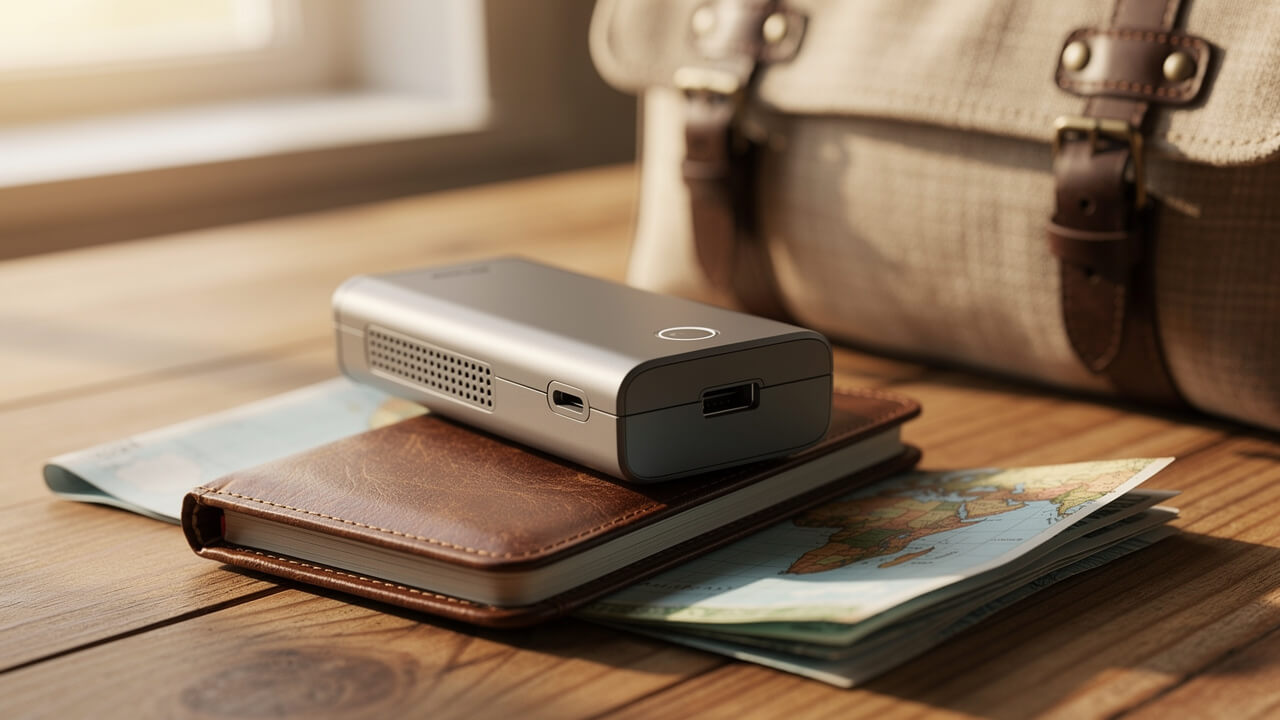
Here’s the truth: modern travel CPAP technology has eliminated that excuse. Today’s portable machines weigh less than a water bottle, fit in your carry-on, and deliver the same therapeutic pressure as your home unit.
Whether you’re eyeing mini CPAPs that slip into a jacket pocket, hoseless systems that eliminate tube tangling, or battery-powered options for off-grid adventures, you have choices that actually work.
This comparison cuts through the marketing noise to show you exactly what these three categories deliver—and what they don’t.
Key Takeaways
Mini travel CPAPs weigh under 1 lb compared to 3+ lbs for home units, making them genuinely portable without sacrificing therapeutic effectiveness
Hoseless systems eliminate hose tangling and simplify hotel room setup by integrating the motor directly into or adjacent to the mask interface
FAA-approved models allow you to continue therapy during flights, and most units feature universal voltage (100-240V) for international travel
Battery options enable 1-2 nights of off-grid camping per charge, with solar charging compatibility for extended wilderness trips
Trade-offs include limited humidification in most travel models, higher upfront costs ($400-900), and the reality that insurance rarely covers a second “travel” unit
What Makes a CPAP Machine “Travel-Ready”?
A travel CPAP isn’t just a smaller version of your bedside machine. It’s engineered from the ground up to prioritize portability without compromising the therapeutic pressure that keeps your airway open.
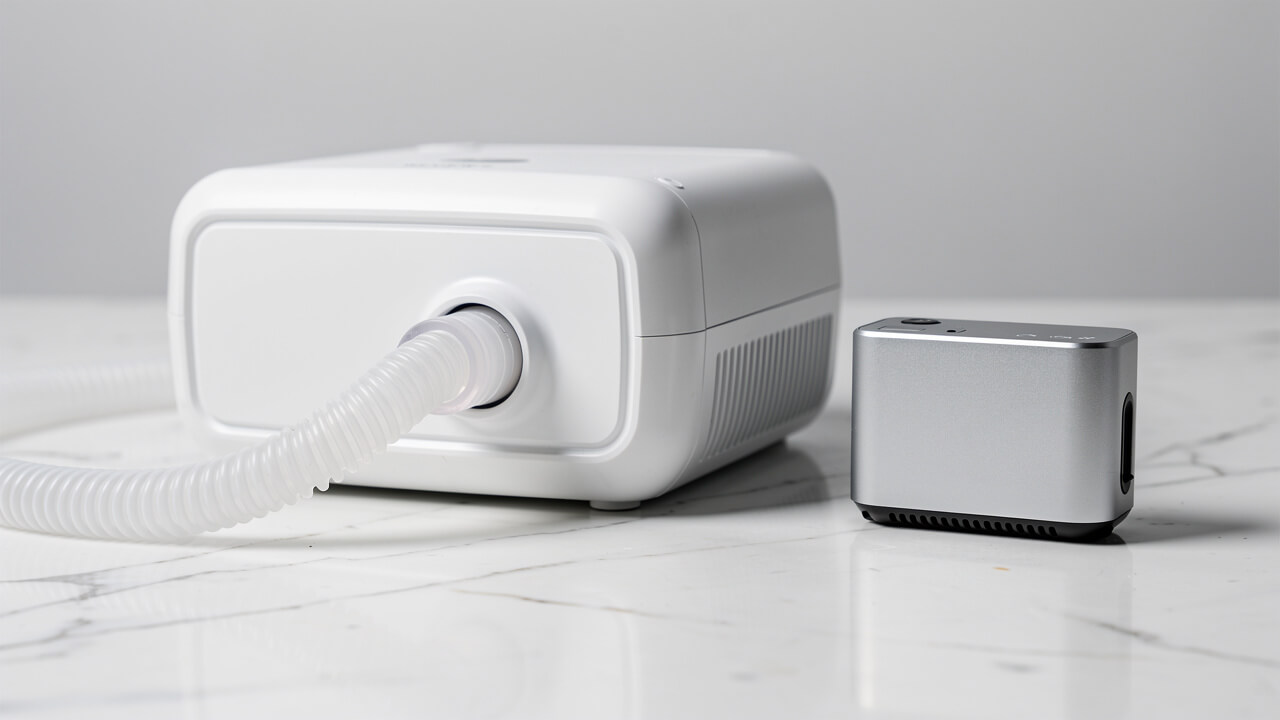
The core difference lies in motor design: manufacturers use compact, high-efficiency motors that generate the same pressure ranges (typically 4-20 cm H2O) as full-sized units while fitting in a package the size of a soda can.
Weight matters more than you’d think. Standard home CPAPs weigh 3-5 pounds; travel units clock in under 1 pound. That difference determines whether you can slip the machine into your personal item or need to dedicate half your carry-on to sleep equipment.
Dimensions matter too—most travel CPAPs measure roughly 6 x 4 x 3 inches, genuinely palm-sized.
FAA approval isn’t automatic. For a CPAP to be flight-safe, it must meet specific electromagnetic interference standards and operate safely in pressurized cabins.
Every model mentioned in this guide carries FAA approval, meaning you can use it during takeoff, landing, and throughout your flight. But keep the compliance letter (usually in your manual) with you at security checkpoints… just in case.
Here’s what trips up many buyers: they assume smaller means weaker therapy. It doesn’t. Modern travel CPAPs offer Auto-CPAP (APAP) functionality, meaning they automatically adjust pressure breath-by-breath based on your needs.
This adaptability actually makes them better for travel than fixed-pressure machines, since your pressure needs may change in hotel beds, different altitudes, or unfamiliar unfamiliar sleeping positions.
Power flexibility separates travel-ready machines from home units. Look for universal voltage (100-240V) so you only need plug adapters abroad, not bulky voltage converters.
DC compatibility lets you power the machine from your car’s cigarette lighter during road trips. Battery integration—either built-in or via external packs—enables camping and provides backup during power outages.
| Feature | Standard Home CPAP | Travel CPAP |
|---|---|---|
| Weight | 3-5 lbs | 0.5-1 lb |
| Dimensions | ~10 x 8 x 5 inches | ~6 x 4 x 3 inches |
| Noise Level | 25-30 dBA | 25-30 dBA |
| Humidification | Heated water chamber | Waterless HME or none |
| Power Options | AC only | AC/DC/Battery |
| TSA Screening | Bulky, awkward | Fits in clear pouch |
The myth that smaller means less effective dies here. Travel CPAPs deliver identical therapeutic outcomes to home units.
What you sacrifice isn’t pressure or effectiveness—it’s luxury features like large heated humidifiers, front-facing displays, and extensive comfort menus. For most travelers, that’s a trade worth making.
“The best CPAP machine is the one you’ll actually use consistently. For many patients, that means having a travel option that removes barriers to compliance.” — Dr. Michael Breus, Clinical Psychologist and Sleep Specialist
Mini Travel CPAP Machines: Top Models Compared
Four machines dominate the mini CPAP market, each excelling in specific travel scenarios. Understanding their strengths and limitations helps you match the right machine to your actual travel patterns rather than buying based on specs alone.
ResMed AirMini AutoSet
The ResMed AirMini AutoSet holds the reputation as the quietest travel CPAP available. At 10.6 ounces and 25 dBA, it’s whisper-quiet even in shared hotel rooms.
The waterless HumidX system uses heat moisture exchange (HME) technology—small cartridges that capture moisture from your exhaled breath and return it during inhalation. This eliminates the need to carry distilled water, a genuine advantage for international travel.
The AirMini connects to your smartphone via Bluetooth, letting you track sleep data, adjust comfort settings, and share compliance reports with your doctor.
The catch? It requires specific ResMed masks (P10, N20, N30, F20, F30) due to proprietary connectors. If you’re attached to a different mask brand, you’ll need to switch.
Expect to pay premium pricing ($800-900) for this level of refinement.
Transcend Micro 510 Auto
The Transcend Micro 510 Auto claims the title of lightest travel CPAP at under 0.5 pounds. For ultralight backpackers or minimalist business travelers, this weight advantage matters.
Unlike the AirMini, it uses a standard 22mm connection, meaning it works with virtually any CPAP mask on the market—a significant advantage if you’ve already found your perfect mask.
The Micro includes a 30-minute drying mode that runs after each use to prevent moisture buildup in the tubing. This feature addresses one of the biggest hygiene concerns when traveling: mold and bacteria growth in damp tubes.
With the optional WhisperSoft muffler attachment, noise levels drop to genuinely quiet operation. The Micro typically costs $600-750.
Breas Z2 Auto
The Breas Z2 Auto weighs 0.65 pounds and distinguishes itself with the integrated PowerShell battery option. Rather than carrying a separate battery pack, the PowerShell slots directly into the machine for seamless, cordless operation.
The Z-Breathe algorithm mimics natural breathing patterns, reducing the sensation of “fighting” the machine during exhalation.
At approximately 26 dBA, it’s slightly louder than the AirMini but quieter than most home units. The Z2 excels for off-grid camping scenarios where integrated battery design simplifies your gear setup. Pricing runs $700-850 depending on battery bundle options.
React Health Luna TravelPAP
The React Health Luna TravelPAP enters the market as the budget-friendly option without sacrificing modern features. It offers app-based compliance reporting, Auto-CPAP functionality, and respectable build quality at $400-550.
For travelers who take 2-3 trips per year rather than weekly business flights, the Luna delivers solid performance without premium pricing.
| Feature | AirMini AutoSet | Transcend Micro | Z2 Auto | Luna TravelPAP |
|---|---|---|---|---|
| Weight | 10.6 oz (0.66 lbs) | <0.5 lbs | 0.65 lbs | ~0.8 lbs |
| Noise Level | 25 dBA | Whisper-quiet (w/ muffler) | ~26 dBA | ~28 dBA |
| Humidification | Waterless HumidX | None (standard) | Waterless HME | Optional |
| Mask Compatibility | ResMed masks only | Any mask (22mm) | Any mask (22mm) | Any mask (22mm) |
| Battery Options | External packs | PowerAway battery | PowerShell integrated | External packs |
| Price Range | $800-900 | $600-750 | $700-850 | $400-550 |
The honest assessment?
Every travel CPAP makes compromises. Humidification is limited compared to home units—if you wake with dry mouth or nasal passages, you’ll need to experiment with HME cartridges or accept some dryness.
Control interfaces are smaller and less intuitive than full-sized displays. Some users report slightly increased noise compared to premium home machines, though decibel ratings remain in the acceptable range.
Insurance coverage is the painful reality: most providers won’t cover a second “travel” machine, viewing it as a convenience rather than medical necessity. You’re paying out-of-pocket.
Prescriptions are still required—these are Class II medical devices regardless of size. Lifespan runs approximately five years with proper maintenance, though daily use as your primary machine may reduce longevity slightly.
At Snoring HQ, we’ve seen travelers transform their compliance rates after investing in a proper travel CPAP.
The freedom to maintain therapy during business trips, family vacations, and weekend getaways removes the biggest barrier to consistent treatment. Your cardiovascular health doesn’t pause when you leave home.
Hoseless CPAP Systems: Eliminating the Hose Entirely
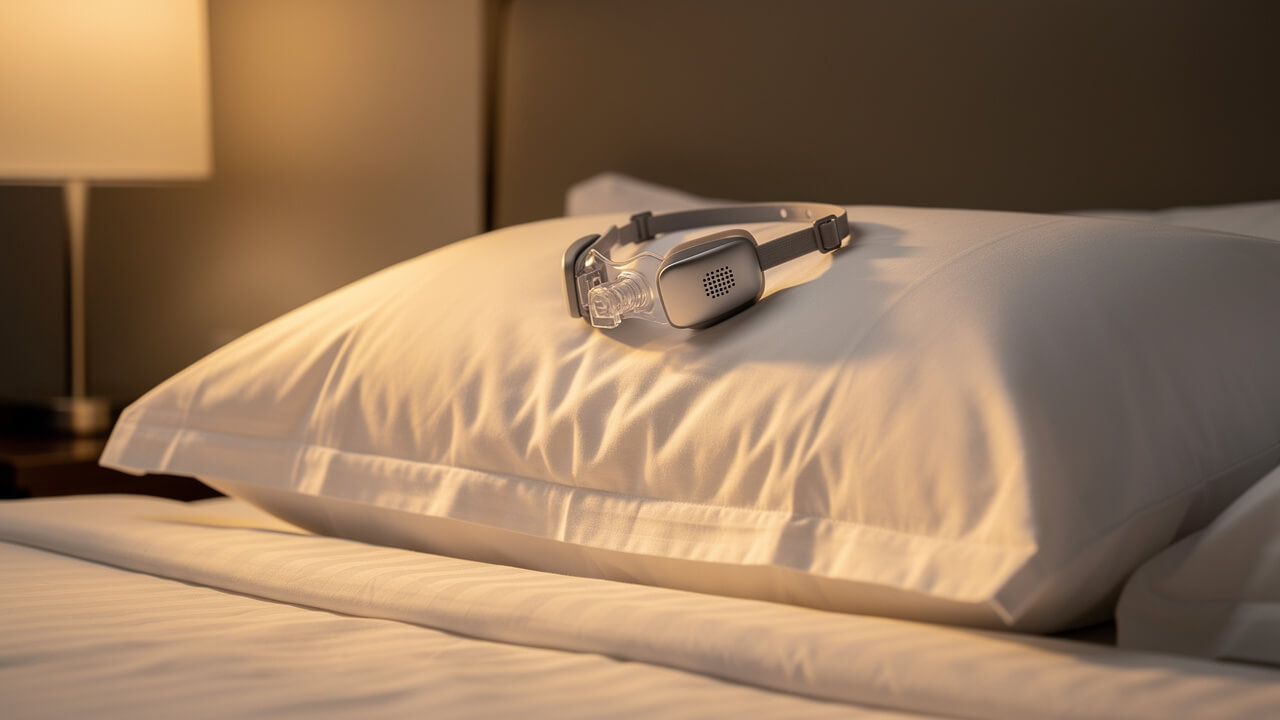
Hoseless CPAP systems represent a different engineering approach: instead of separating the motor from the mask with a six-foot hose, the motor integrates directly into or immediately adjacent to the mask interface.
This isn’t wireless therapy—you still need power—but it eliminates the component that causes the most travel frustration.
Primary Advantages
The primary advantage is packing simplicity. You’re carrying a mask assembly and a power cord rather than a machine, hose, mask, and humidifier chamber.
Hotel room setup takes 30 seconds: plug in the unit, put on the mask, sleep. No threading hoses through headboards or arranging equipment on nightstands. For business travelers hitting a different hotel every night, this simplicity compounds.
Freedom of movement during sleep is the second major benefit. Without a hose tethering you to a bedside machine, you can:
Roll over without disconnecting
Shift positions freely
Get up for the bathroom easily
Avoid managing slack or tube tangles
Couples sharing hotel rooms appreciate the discretion—the hoseless design is less visually prominent and feels more private than traditional setups.
Practical Limitations
The practical limitations deserve honest discussion. Hoseless doesn’t mean maskless—you still wear a mask interface over your nose or face.
The motor weight concentrates at your head rather than sitting on a nightstand, which some users find uncomfortable initially. Most hoseless systems run slightly louder than separated units because the motor sits inches from your ear rather than feet away.
Best use cases for hoseless systems include:
Frequent hotel stays
Shared sleeping spaces where privacy matters
Light packers who prioritize simplicity over every feature
Business travelers needing reliable therapy without complex setup
They’re less ideal for side sleepers sensitive to weight distribution or users who require high pressure settings (which generate more motor noise).
Snoring HQ recognizes that hoseless systems offer a compelling middle ground for travelers who find traditional CPAP setups cumbersome but need consistent therapy.
The improved comfort and quieter operation compared to skipping therapy entirely make these systems worth considering, especially since they maintain the airway pressure that eliminates snoring and prevents apnea episodes.
Maintenance simplicity is a genuine advantage. No hose means no hose to clean, dry, or replace. Fewer components mean fewer potential failure points during travel.
You’re carrying less equipment through security and managing fewer pieces in your hotel room. For many travelers, this simplicity outweighs the trade-offs.
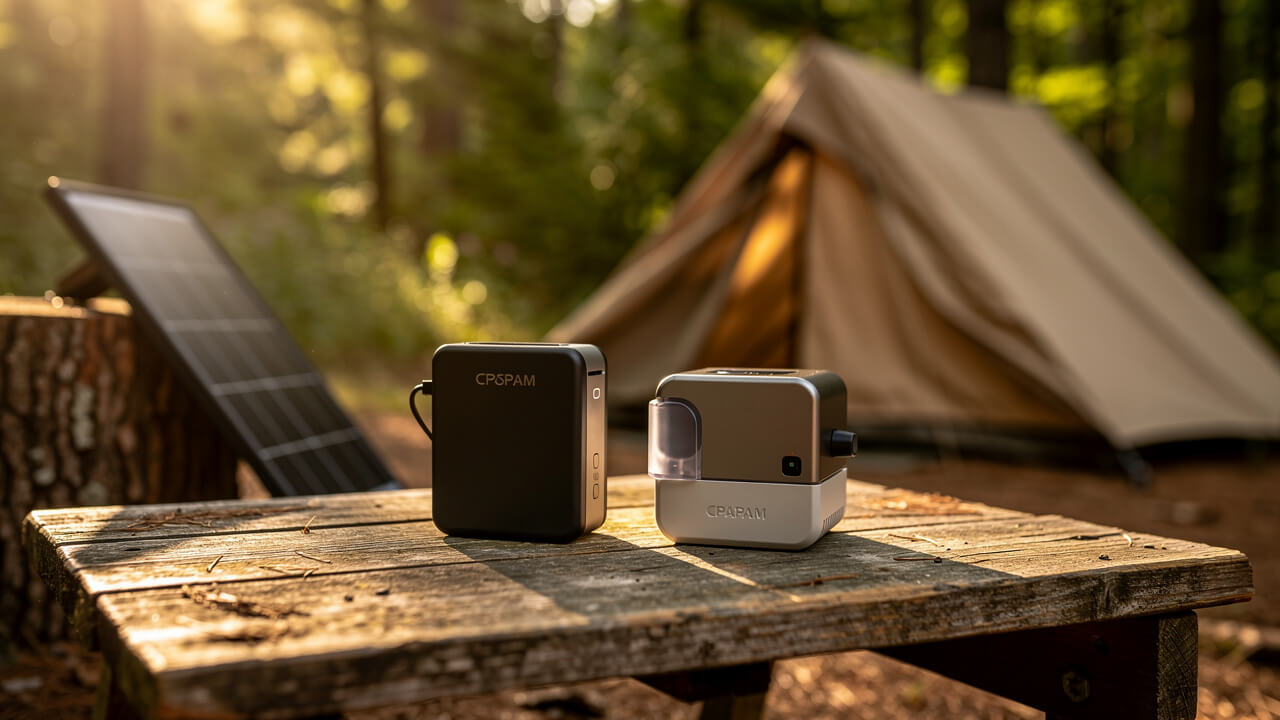
Power Solutions for Off-Grid and International Travel
Battery power separates casual travelers from serious adventurers. Understanding realistic battery performance prevents disappointment when you’re two nights into a camping trip and your machine dies.
Battery Runtime Expectations
Standard CPAP batteries provide 8-18 hours of runtime—roughly 1-2 nights depending on your pressure settings and whether you use humidification. Higher pressure prescriptions drain batteries faster.
A user at 15 cm H2O will get significantly less runtime than someone at 8 cm H2O. Humidification cuts battery life by 30-50%, so most off-grid users skip it.
Battery options vary by manufacturer:
Transcend PowerAway battery — Separate pack that connects via cable
Medistrom Pilot-24 Lite — Universal solution working with multiple CPAP brands
Breas Z2 PowerShell — Integrates directly into the machine body for compact setup
Each approach has merit depending on your packing style.
Multi-Night Camping Considerations
Multi-night camping trips require planning. A weekend trip needs one battery pack. A week-long backpacking expedition requires multiple packs (adding weight and bulk) or a solar charging setup.
Portable solar panels designed for CPAP charging exist, but they add 2-3 pounds to your pack and require sunny weather. Car camping makes this easier—you can recharge batteries from your vehicle’s DC outlet during the day.
International Travel Power Requirements
International electrical requirements are simpler than most travelers expect. Modern travel CPAPs feature universal power supplies (100-240V) that handle voltage conversion internally.
You only need physical plug adapters for different wall outlet shapes—no bulky voltage converters required. A $15 universal adapter kit covers most countries.
DC power options enable road trips and RV travel. Most travel CPAPs include or offer optional cigarette lighter adapters.
This lets you power the machine directly from your vehicle during overnight car camping or emergency situations. Some users keep a DC adapter in their car as backup power during hotel stays if outlets are inconveniently located.
In-Flight Power Considerations
In-flight power deserves special mention. While FAA-approved CPAPs can run on battery during flights, airplane power outlets are notoriously unreliable.
Some work, some don’t, and you won’t know until you’re at 35,000 feet. Always carry a fully charged battery as backup for long international flights. Request an aisle seat near an outlet to maximize your chances, but don’t depend on it.
“Planning your power needs before departure eliminates 90% of travel CPAP problems. Know your battery runtime at your prescribed pressure, and always pack one extra night’s capacity.” — Sleep Therapy Equipment Specialist
Cost Considerations
Cost considerations add up quickly:
Battery packs: $200-400 each
Solar charging kits: $150-300
Rental options: $50-75 per trip
For travelers who take 2-3 camping trips per year, calculate cost-per-trip. Renting a battery pack might make more financial sense than purchasing if you’re not a frequent off-grid traveler.
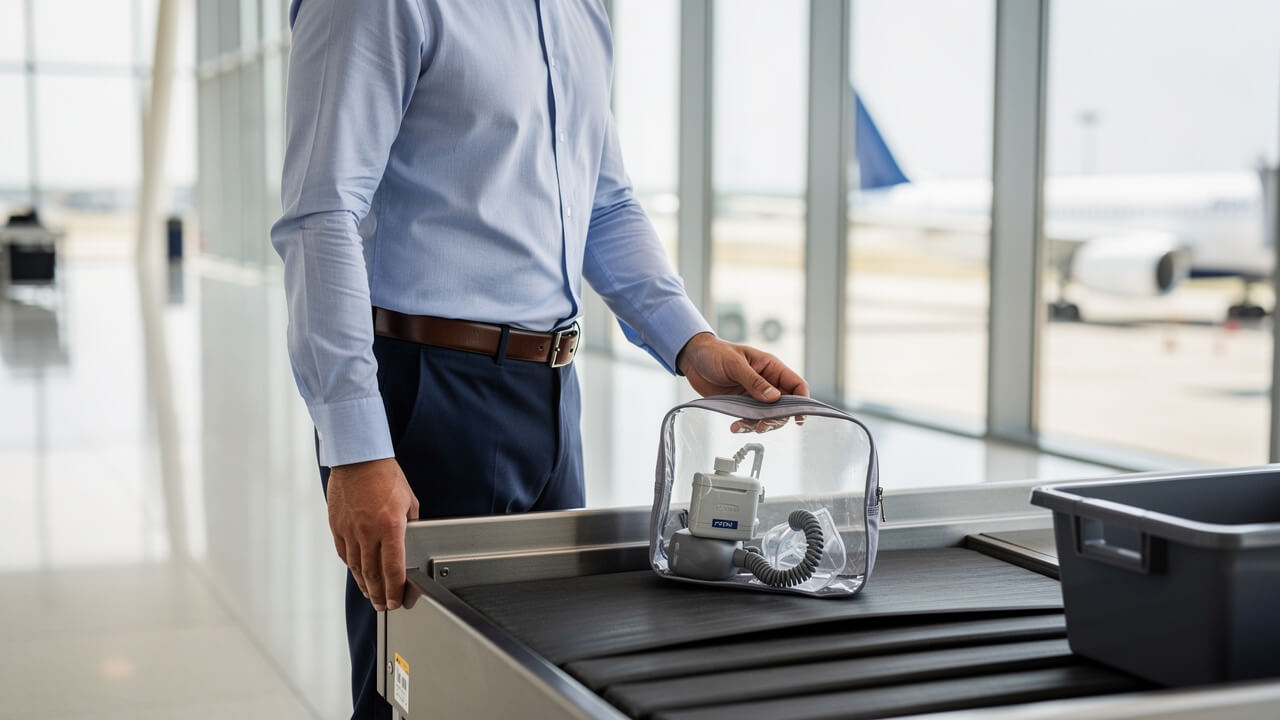
Traveling with Your CPAP: TSA, Airlines, and Hotel Logistics
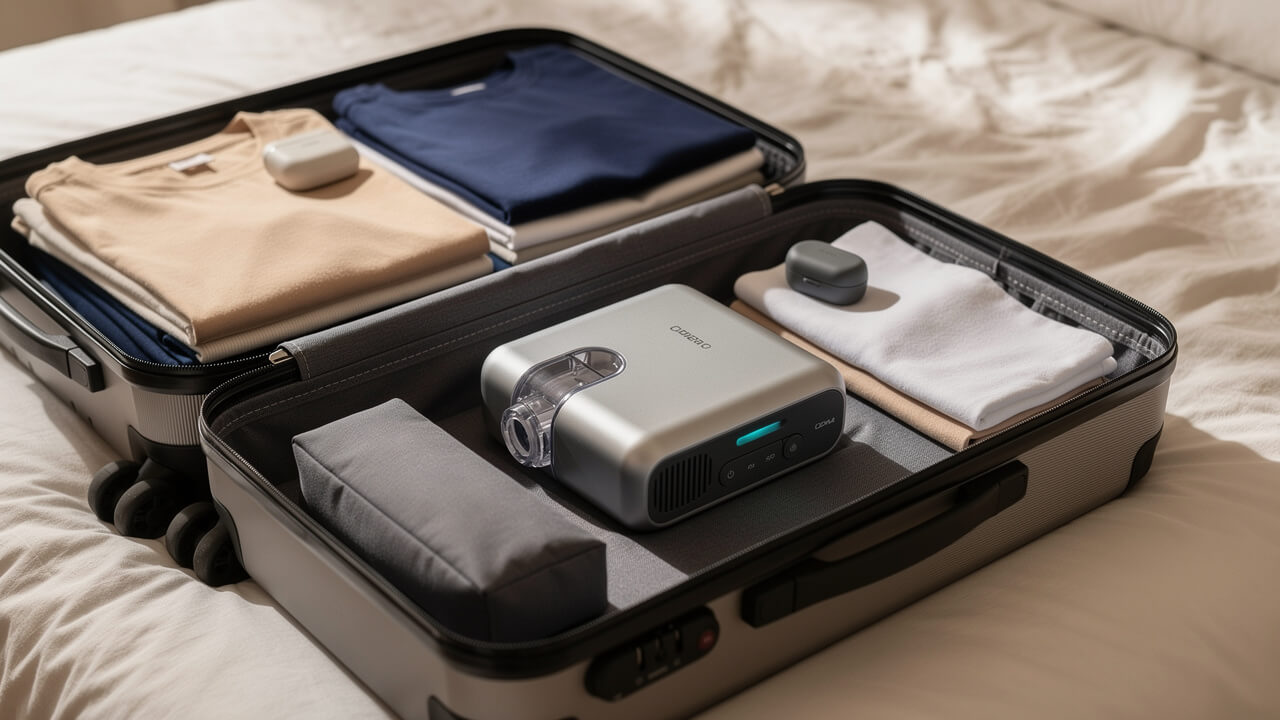
Airport security causes more anxiety than necessary. Under FAA regulations, your CPAP is a medical device and doesn’t count toward your carry-on luggage limit. You can carry your standard luggage plus your CPAP bag.
Never check your CPAP in luggage—it’s fragile, and you need it immediately upon arrival.
TSA Screening Process
TSA screening requires removing the motor unit from its bag for X-ray, similar to a laptop. Pack it in a clear travel pouch to keep it hygienic while sitting in the security bin.
Keep a copy of your prescription and the machine’s FAA compliance letter accessible, though agents rarely ask for them. The process takes 30 seconds once you know the routine.
Airline Policies and In-Flight Use
Airline policies require notification 48 hours ahead if you plan in-flight use. Call the airline directly rather than relying on website information.
Request an aisle seat near an outlet for long flights, though battery backup remains more reliable than airplane power. Most airlines accommodate medical device users, but advance notice prevents gate-agent confusion.
Hotel Room Preparation
Hotel room preparation starts before you arrive. Call ahead to confirm outlet placement near the bed. Many hotel rooms have outlets in inconvenient locations—behind furniture, across the room, or controlled by wall switches.
Pack a short 6-foot extension cord to solve this problem. Upon arrival, locate a nearby pharmacy for distilled water if your machine uses traditional humidification.
International Destinations
International destinations require minimal extra preparation. Verify the plug adapter type for your specific country—Europe, UK, Australia, and Asia all use different outlet shapes.
Your universal voltage power supply handles the electrical conversion, so you only need the physical adapter. Research local distilled water availability, though waterless humidification systems eliminate this concern entirely.
Packing Strategy
Packing strategy matters more than you’d think:
Use a clear travel pouch for faster TSA screening
Keep extra filters and mask cushions in your CPAP bag rather than checked luggage
Never pack your CPAP in checked luggage—it’s too fragile and too essential
Carry it with you always
Camping and Off-Grid Scenarios
Camping and off-grid scenarios favor hoseless and mini units significantly. Without AC power, traditional humidification becomes impossible anyway. Solar setups add weight but enable extended trips beyond your battery’s 1-2 night capacity.
Extra battery packs provide 2-3 nights of independence before requiring recharging. Plan your power budget carefully based on your pressure settings and trip duration.
Frequently Asked Questions
Your Sleep Health Doesn’t Take Vacations
Skipping CPAP therapy for even one night carries real consequences. Your blood oxygen levels drop, your blood pressure spikes, and your cardiovascular system experiences stress it shouldn’t endure.
The cognitive fog and daytime fatigue you feel after an untreated night aren’t just inconvenient—they’re symptoms of your body struggling without proper sleep.
The right travel CPAP removes every excuse for inconsistent therapy. Whether you choose a mini CPAP for its palm-sized portability, a hoseless system for its setup simplicity, or a battery-powered option for off-grid adventures, you’re investing in consistent treatment that protects your long-term health.
Your specific travel patterns should drive your decision: frequent flyers benefit from the AirMini’s quiet operation, backpackers need the Transcend Micro’s ultralight design, and campers require the Z2’s integrated battery option.
At Snoring HQ, we’ve built our reputation on helping users maintain therapy consistency regardless of location. We understand that life happens away from home—business trips, family vacations, camping weekends—and your sleep apnea doesn’t pause when you leave your bedroom.
Modern technology has eliminated the barrier between travel and treatment.
Your sleep health is as mobile as your lifestyle demands. The question isn’t whether you can maintain therapy while traveling—it’s which option fits your specific needs best.
Choose the machine that matches your travel style, pack it confidently, and sleep well wherever you go.