


Snoring and Dairy Products: The Hidden Connection Affecting Your Sleep
Quick Answer: Dairy products don’t create extra mucus, but they do thicken existing secretions in your throat, which narrows your airway and can worsen snoring. Eliminating dairy 3-4 hours before bedtime often reduces snoring symptoms, though it won’t cure snoring caused by structural issues like naturally relaxed soft tissues.
Last updated: May 20, 2026
Key Takeaways
- Dairy thickens throat secretions (not increases mucus production), creating a narrower airway that worsens snoring
- The thickening effect is strongest for 2-4 hours after consumption and gradually wears off
- Avoiding dairy after dinner may be enough for mild cases; severe snorers may need complete elimination
- Non-dairy calcium sources include chia seeds, sesame seeds, dark leafy greens, and fortified plant milks
- Dairy-free alternatives (almond, oat, coconut milk) don’t have the same throat-thickening effect
- Dietary changes work best when combined with other snoring solutions like anti-snoring mouthpieces for structural airway issues
Does Dairy Really Cause More Mucus Production?
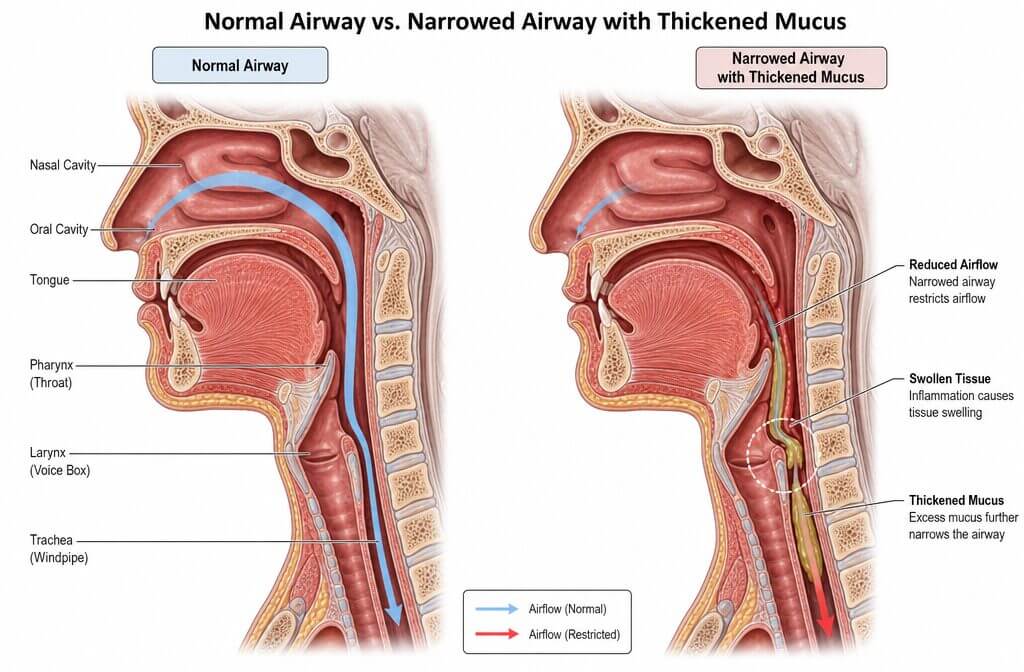
No, dairy doesn’t cause your body to produce more mucus. Research published in studies examining dairy and respiratory secretions has debunked this long-standing myth. However, the truth is almost as problematic for snorers: dairy products thicken the mucus and secretions already present in your throat.
This thickening creates a coating sensation that feels like excess mucus. When these thicker secretions settle in your throat overnight, they reduce the space available for air to pass through. Since your throat muscles naturally relax during sleep, the combination of relaxed tissues and thickened secretions creates the perfect conditions for snoring.
Why this matters for snorers:
- Thicker secretions mean a narrower airway
- Narrower airways increase air velocity and tissue vibration
- More vibration equals louder, more frequent snoring
- The effect compounds if you already have anatomical factors that narrow your airway
How Does Dairy Thicken Throat Secretions and Worsen Snoring?
When you consume dairy products, proteins in milk (particularly casein) interact with saliva and mucus membranes in your mouth and throat. This interaction changes the consistency of your secretions from thin and watery to thick and sticky.
During sleep, your body’s natural processes slow down. You swallow less frequently, which means these thickened secretions accumulate in your throat rather than being cleared. As air passes through this narrowed space with each breath, the soft tissues vibrate more intensely.
The snoring mechanism:
- Dairy consumption thickens throat secretions within 30-60 minutes
- Secretions accumulate as you prepare for sleep
- Throat muscles relax during sleep stages
- Thickened mucus further narrows the already-relaxed airway
- Increased air velocity causes tissue vibration (snoring sound)
If you’ve noticed that your partner complains more about your snoring on nights when you’ve had pizza, ice cream, or cheese-heavy meals, this thickening effect is likely the culprit. Even people who aren’t lactose intolerant or allergic to dairy experience this physical response.
What Dairy Products Are the Worst Offenders?
Not all dairy products affect throat secretions equally. The concentration of milk proteins and fat content both play roles in how much thickening occurs.
High-impact dairy products:
- Ice cream – High fat content and consumed cold, which can further thicken secretions
- Whole milk – Full protein and fat content
- Cream-based soups and sauces – Concentrated dairy in liquid form coats the throat
- Soft cheeses (cream cheese, brie, ricotta) – High moisture content spreads easily
- Yogurt – Thick consistency already present before consumption
Moderate-impact dairy:
- Hard cheeses (cheddar, parmesan) – Lower moisture, but still contain problematic proteins
- Butter – Primarily fat, less protein
- Milk chocolate – Contains milk solids but in smaller quantities
Hidden dairy sources to watch:
- Cream-based salad dressings
- Mashed potatoes made with milk or cream
- Baked goods (muffins, biscuits, pancakes)
- Protein shakes and smoothies with whey or casein
- Coffee creamers
The timing matters as much as the type. A slice of cheese at lunch will have minimal impact by bedtime, but a bowl of ice cream at 9 PM will still be thickening your throat secretions when you lie down at 10 PM.
Should You Reduce or Completely Eliminate Dairy?
The answer depends on your snoring severity and how sensitive your body is to dairy’s thickening effects. Most people fall into one of three categories.
Try reducing first if:
- Your snoring is mild to moderate
- You only snore occasionally or in certain positions
- Your partner can tolerate some snoring
- You’re willing to experiment with timing
Consider complete elimination if:
- You snore loudly every night regardless of position
- Your snoring disrupts your partner’s sleep regularly
- You wake yourself up snoring
- You have other symptoms like morning headaches or daytime fatigue (possible sleep apnea indicators)
- Reducing dairy after dinner didn’t help
Start with a 2-week trial:
Week 1: Eliminate all dairy after 5 PM. Track your snoring using a smartphone app or ask your partner to monitor changes.
Week 2: If you see improvement, continue. If not, eliminate dairy completely for the full week.
Document your results. Note whether you snore less frequently, less loudly, or if your sleep quality improves (feeling more rested upon waking). This data will help you decide whether the dietary change is worth maintaining long-term.
When Should You Stop Eating Dairy Before Bed?
The thickening effect of dairy peaks within 1-2 hours of consumption and gradually diminishes over 4-6 hours. For most people, avoiding dairy 3-4 hours before bedtime provides enough clearance time.
Practical timing guidelines:
- If you sleep at 10 PM: No dairy after 6-7 PM
- If you sleep at 11 PM: No dairy after 7-8 PM
- If you sleep at midnight: No dairy after 8-9 PM
This means your dinner can include dairy if you eat early enough, but skip the after-dinner ice cream or late-night cheese snack. If you’re highly sensitive, you may need to push the cutoff earlier or eliminate dairy from dinner entirely.
Test your personal threshold:
Start with a 4-hour window and adjust based on results. Some people find 3 hours sufficient, while others need 5-6 hours for complete clearance. Your body’s metabolism, the amount of dairy consumed, and the type of dairy all influence how long the effect lasts.
What Are the Best Non-Dairy Calcium Sources?
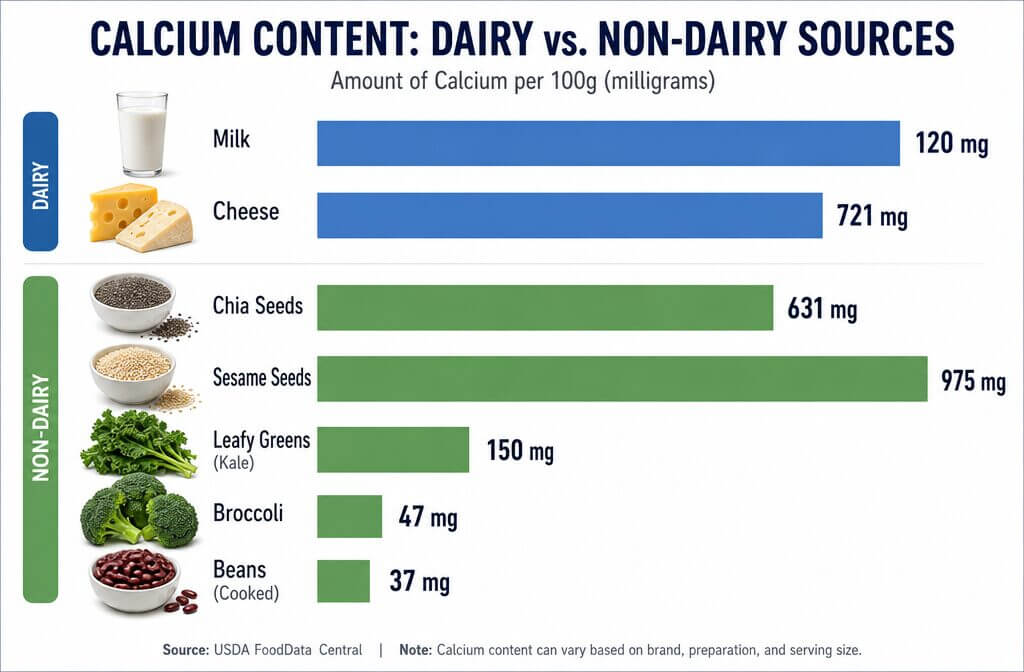
The dairy industry has spent decades promoting milk as essential for bone health, but plenty of foods provide calcium without the throat-thickening side effects.
Top calcium-rich alternatives (per 100g serving):
- Chia seeds – 631mg calcium (63% daily value)
- Sesame seeds – 975mg calcium (98% daily value)
- Sardines with bones – 382mg calcium (38% daily value)
- Collard greens – 232mg calcium (23% daily value)
- Kale – 150mg calcium (15% daily value)
- White beans – 161mg calcium (16% daily value)
- Almonds – 264mg calcium (26% daily value)
- Fortified plant milks – 300-450mg per cup (varies by brand)
Easy ways to increase calcium intake:
Add a tablespoon of chia or sesame seeds to smoothies, oatmeal, or salads. Snack on almonds instead of cheese. Include dark leafy greens with dinner. Choose fortified plant milks that provide comparable calcium to dairy milk.
Many plant-based calcium sources also provide fiber, healthy fats, and other nutrients without the saturated fat and hormones often found in conventional dairy products. Your bones will be fine, and your throat will thank you.
What Dairy Alternatives Won’t Worsen Snoring?
The explosion of plant-based alternatives makes avoiding dairy easier than ever. Most grocery stores now stock multiple options in every dairy category.
Milk alternatives:
- Oat milk – Creamy texture, works well in coffee
- Almond milk – Light, slightly nutty flavor
- Coconut milk – Rich, works well in cooking
- Cashew milk – Smooth, neutral taste
- Soy milk – Highest protein content among plant milks
- Hemp milk – Contains omega-3 fatty acids
Cheese alternatives:
Look for products made from nuts (cashew, almond), coconut oil, or soy. Brands have improved dramatically in recent years. Nutritional yeast provides a cheesy flavor for sprinkling on popcorn or pasta.
Ice cream alternatives:
Coconut milk, almond milk, oat milk, and cashew milk ice creams are widely available. Many people find them indistinguishable from dairy versions in taste and texture.
Butter and yogurt alternatives:
Plant-based butters made from olive oil, coconut oil, or nut oils work for cooking and spreading. Coconut, almond, and oat yogurts provide similar probiotic benefits without the mucus-thickening effect.
Shopping tip: Health food stores typically offer more variety, but mainstream grocery chains have expanded their plant-based sections significantly. Read labels carefully, as some products contain casein or whey (milk proteins) despite being marketed as “non-dairy.”
Will Eliminating Dairy Completely Stop Your Snoring?
Probably not by itself, but it can significantly reduce snoring intensity and frequency. Dairy elimination addresses one contributing factor, but snoring usually has multiple causes.
Dairy elimination helps most when:
- Your snoring worsened after consuming dairy products
- You notice throat congestion or post-nasal drip
- Your snoring is positional (worse on your back)
- You have mild to moderate snoring without sleep apnea
You’ll likely need additional solutions if:
- Your soft palate and uvula naturally obstruct your airway
- You have a recessed jaw or narrow throat anatomy
- You’re significantly overweight (excess neck tissue narrows airways)
- You have diagnosed obstructive sleep apnea
For structural airway issues, consider combining dietary changes with proven devices. Mandibular advancement devices reposition your jaw to open the airway, while tongue-retaining devices prevent the tongue from blocking airflow. Understanding the differences between MADs and TRDs can help you choose the right approach.
Realistic expectations:
Eliminating dairy might reduce your snoring from “chainsaw” to “moderate rumble,” or decrease snoring nights from seven per week to three. These improvements matter tremendously for sleep quality and relationship harmony, even if they don’t eliminate snoring entirely.
How Long Before You Notice Improvement?
Most people notice changes within 3-7 days of eliminating or reducing dairy, though individual responses vary.
Timeline for improvement:
- Days 1-2: Existing thickened secretions clear from your system
- Days 3-5: Throat tissues return to baseline; snoring may decrease
- Days 7-14: Clearer pattern emerges; you can assess whether dairy was a significant factor
- Weeks 3-4: Full adaptation; your body adjusts to new eating patterns
Keep a sleep journal or use a snoring app to track changes objectively. Your perception may differ from reality, especially since you can’t hear yourself snore. Ask your partner to rate your snoring on a scale of 1-10 each morning.
If you see no improvement after 2 weeks:
Dairy likely isn’t your primary snoring trigger. Other common causes include alcohol consumption, sleeping position, nasal congestion, excess weight, or anatomical factors. You may need to explore other anti-snoring solutions or consult a sleep specialist.
What Other Dietary Changes Help Reduce Snoring?
Beyond dairy, several foods and eating habits affect snoring intensity.
Foods that worsen snoring:
- Alcohol – Relaxes throat muscles excessively
- Heavy meals before bed – Causes acid reflux that irritates airways
- High-sugar foods – Can increase inflammation
- Processed foods high in sodium – Causes fluid retention and swelling
Foods that may help:
- Anti-inflammatory foods – Turmeric, ginger, fatty fish
- Hydrating foods – Cucumbers, watermelon, celery
- Honey – Coats and soothes throat tissues (one teaspoon before bed)
- Olive oil – May reduce throat tissue inflammation
Eating habits that reduce snoring:
Finish dinner 3-4 hours before bed. Stay hydrated throughout the day but limit fluids in the hour before sleep. Maintain a healthy weight, as excess tissue around the neck compresses airways. Avoid alcohol within 4 hours of bedtime.
Can Children’s Snoring Be Related to Dairy Consumption?
Yes, children can experience the same dairy-related throat thickening that affects adults. However, childhood snoring often has different underlying causes that require medical evaluation.
When dairy might be the culprit:
- Snoring started or worsened after introducing dairy products
- Child has no enlarged tonsils or adenoids (common childhood snoring causes)
- Snoring improves on nights without dairy consumption
- Child shows no signs of sleep apnea (gasping, pauses in breathing)
When to see a pediatrician:
- Loud snoring more than 3 nights per week
- Gasping or choking sounds during sleep
- Daytime sleepiness or behavioral problems
- Mouth breathing during the day
- Poor growth or development
Enlarged tonsils and adenoids cause most childhood snoring and may require surgical removal. Don’t assume dairy is the problem without ruling out structural issues. That said, a trial elimination of dairy is safe and worth attempting before more invasive interventions.

Frequently Asked Questions
Related Reading: