

SnoreRx Review: Three Clinicians Test the Adjustable MAD
I have tried a lot of mandibular advancement devices (MADs), so when the SnoreRx arrived I wanted to know whether its adjustability was real or a marketing line. It turned out to be real. This page also pulls in the three clinician reviews we commissioned (two dentists and a naturopathic doctor), so you get the complete picture of the original SnoreRx in one place.
Key Takeaways
- SnoreRx is a boil-and-bite MAD that moves your lower jaw forward in 1 mm steps. It is FDA cleared for snoring (510(k) K153200), not for sleep apnea.
- The original SnoreRx lists at $59.99 on the manufacturer site and the upgraded SnoreRx Plus at $99.99 (checked November 2026). Both carry a 30-night money-back guarantee.
- Our testers and three clinicians found it comfortable and effective for most people. Front-tooth soreness, dryness and a small mouth opening are the common complaints.
- Skip it if you wear dentures or a bridge, have loose teeth or very new implants, or have jaw-joint problems. Get a sleep study first if you gasp, choke or stop breathing at night.
Looking at the upgraded model? The SnoreRx Plus review covers it separately, and you can buy either one through our SnoreRx link.
Want More Adjustability? Meet The SnoreRx Plus
The SnoreRx Plus is the step-up model from the same maker. According to the manufacturer it lists at $99.99 against $59.99 for the original SnoreRx, and it keeps the 30-night money-back guarantee. If you want finer control over how far your lower jaw moves forward, or you are shopping for the upgraded version, read our separate SnoreRx Plus review before you buy.
SnoreRx At A Glance
- Type: Boil-and-bite mandibular advancement device (MAD)
- Adjustment: 1 mm increments, set with the built-in calibrator and locked until you unlock it
- Regulatory status: FDA 510(k) K153200, anti-snoring device (cleared August 2016); not cleared to treat sleep apnea
- Materials: Copolymer, latex-free, no metal hinges or rubber bands
- Price: $59.99 for the original design (manufacturer listing, November 2026)
- Guarantee: 30-night money-back guarantee
Advantages
- Fine-tuned jaw position: ten settings, one millimeter apart, read from a calibrator on the side of the device.
- Settings stay locked while you wear it, so the position does not drift overnight.
- Boil-and-bite molding gives a custom-feeling fit without a dental visit.
- Cushioned upper and lower trays that are gentle on the teeth, with a soft inner liner Dr. Christian singled out for comfort.
- No metal parts or rubber bands, so there is no torsion pressure on the jaw.
- Small and travel-friendly, which matters if you want to avoid CPAP for simple snoring.
- Backed by a 30-night money-back guarantee.
Disadvantages
- Cleaning takes more effort than a plain one-piece guard because of the adjustment mechanism. A denture cleaner reaches the crevices well.
- Not for denture or bridge wearers, and our earlier guidance advised against it for implants less than a year old.
- Sore teeth, drooling or dryness can show up in the first nights.
- One size only, which Dr. Goldstein found awkward for a petite mouth.
- The mouth opening can feel small if you breathe through your mouth.
What Makes SnoreRx Unique?
SnoreRx is a MAD: it holds your lower jaw slightly forward so the soft tissue at the back of your throat has less chance to collapse and vibrate. What separates it from many one-size mouthpieces is how finely you can tune that forward position.
The calibrator on the side of the device has ten settings spaced one millimeter apart. You squeeze to move it, and you can reset it if you overshoot. Most over-the-counter MADs either cannot be adjusted or move in coarse jumps, which makes it hard to find a position that is both comfortable and effective.
Like other boil-and-bite appliances, you soften it in hot water and bite down to mold it to your teeth. The difference is that you can keep fine-tuning the jaw position afterward as your comfort changes.
My Actual Results
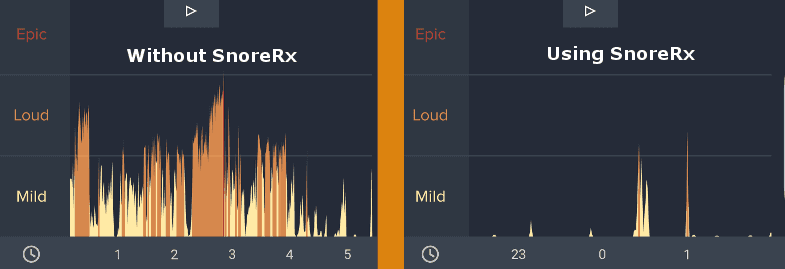
I recorded two nights with a snore-tracking app, one without the device and one with it. This is the comparison:
My Experience
I travel a lot for work, so I ordered two devices. After following the boil-and-bite steps I had to boil the second one twice, which did not hurt the material.
The number of jaw positions overwhelmed me at first. After some fine-tuning I settled on a comfortable one. The first night my mouth was a little sore in the morning, similar to wearing braces for the first time. My wife said I did not snore at all. The next night I eased the setting, woke up without pain, and she again heard nothing.
Cleaning takes longer than with other MADs I have worn, and a denture cleaner helped me reach every area. Overall, the jaw-position choices and the cushioning make it more comfortable than other MADs I have tried. Both of us sleep better now.

Pros
- very comfortable
- highly adjustable
- durable construction
- BPA free
- 30 day quarantee
Cons
- not recommended for denture wearers
You can read more customer feedback on the Verified Reviews page for SnoreRx, an independent third-party site.
What Our Specialists Found
We sent the SnoreRx to a dental sleep center, a dentist with a four-person test group, and a naturopathic doctor. Here is what each one reported, credited to them.
Dr. Tammy Balatgek, DDS, MS: Tested With Sleep Center Patients
Dr. Balatgek evaluated the SnoreRx on patients at the sleep apnea center she manages. She describes snoring as the sound of a narrowed nasal or oral airway: a deviated septum, enlarged turbinates, polyps or congestion in the nose, or a narrow pharynx, long soft palate, enlarged tonsils or uvula, or a tongue that falls back from a small lower jaw or crowded mouth. Air squeezing through the narrow space speeds up and vibrates the tissue.
In her opinion the SnoreRx works best for snoring caused by the tongue blocking the airway, and it resembles a custom oral appliance in three ways: it molds to your teeth with a boil-and-bite process, it is adjustable to move the lower jaw forward, and it has no metal hinges, straps or rubber bands.
She found the instructions clear, with a removable handle that keeps your fingers away from the boiling water. To mold it you bite down firmly and suction the air and water out; you can repeat the step if retention is poor. Her advice is to start with a small 1 mm advancement and stay at each setting for three to five nights, adjusting as needed, up to 6 mm, until the snoring is reduced.
Her patients reported an easy setup, comfort while wearing it and less snoring. She lists soreness in teeth or gums, excess saliva or dry mouth, tooth movement or bite changes, and jaw-joint (TMJ) problems as possible side effects. If you get jaw pain, headaches, facial pain, jaw noises or locking, stop using it, and see a dentist trained in TMJ disorders if the symptoms continue.
Compared with a custom appliance, she notes the SnoreRx is bulkier because of its roughly 2 mm outer shell around the moldable inner copolymer, which can keep the lips apart and lead to mouth breathing or dry mouth. She also cautions that soft mouthguard material may encourage clenching; if you wake with clenched teeth, facial pain or temple headaches, stop and see a dentist.
Her bottom line: the SnoreRx is a sound appliance for snoring, a stepping stone before a long-term custom device, or a temporary measure while waiting for definitive treatment.
Dr. Kate Christian, DDS, MS: Four Testers, Four Different Outcomes
Dr. Christian has contributed to our mouthpiece reviews for years and likes to have as many patients and friends test a device as possible. She had seen patients arrive wearing a SnoreRx, and this time ran her own group from start to finish.
The first prospective tester read the instructions and decided not to try it, because loose teeth and dental implants are contraindications. Dr. Christian explains why: clenching on any oral appliance can create suction strong enough to pull out loose or broken teeth, and a dentist can also record a baseline so you can spot tooth movement or bite changes later. The second tester, a man who snored nightly, fitted it without trouble. She liked the soft thermoplastic liner, which gives a little and makes it more comfortable, though clenching for the full minute while molding gets uncomfortable and the device has to be removed carefully to keep the impression.
Her husband, who has both a nasal and an oral snore, was the only one who disliked it. His front teeth became uncomfortable and he worried about tooth movement, so he stopped after a few days. She notes that front-tooth sensitivity is why many people move from a semi-custom MAD to a fully custom appliance. Her final tester, whose snoring carried through closed doors, had no fitting problems and it worked well.
She learned afterward that this tester owned a CPAP machine he was not using. The SnoreRx is cleared for snoring, not for sleep apnea, and an oral appliance for apnea has to be confirmed with a sleep study. Every tester who kept using it got remarkably quiet.
On adjustment, she found it easy to squeeze the upper unit and move the lower jaw in 1 mm steps. Advance both sides evenly: uneven tension can make your body fight the appliance and cause one-sided jaw pain. Go slowly, because you may not need much forward movement to stop the snoring. Her one design criticism is a mouth opening that is small for dedicated mouth breathers, although the limited opening also keeps your mouth from drying out and helps hold the jaw forward when you sleep on your back. Overall she calls it a good option to try before a physician checks you for sleep apnea, and a reasonable temporary or quick-fix snore guard.
Dr. Serena Goldstein, ND: A CPAP Alternative For Travel
Dr. Goldstein came to the SnoreRx from CPAP experience, which she finds tedious to put on and hard to sleep in. She was pleasantly surprised by how small and easy to handle the SnoreRx is, and says the portability beats a nightly CPAP hookup.
She found the box informative, with indications, contraindications and warnings, and the website full of instructions and support. Her key tip is to read the instructions fully before you start, because it is tempting to skip the boil-and-bite step. The steps were clearly labeled, the material was malleable, and a step-by-step video is available.
Sleeping with it took getting used to. As a very petite person she found adjusting it to her mouth difficult, had some dryness at first that eventually passed, and could not sleep through the night with it at first. She suggests two sizes would help smaller mouths, although she found that most users eventually get through the night without removing it.
Her main point: if you snore and do not like CPAP, this is a device worth trying, provided sleep apnea has been ruled out. The company advises seeing a medical professional first, does not promise a cure for snoring or sleep apnea, and offers a refund if it does not work. She would recommend it to clients who snore and want an alternative to CPAP.
Who Should Skip It (And When To See A Doctor)
Stay away from the SnoreRx if you wear dentures or a bridge, have loose teeth, have dental implants that are less than a year old, or already have jaw-joint trouble. Check with your dentist before you start any oral appliance; they can also set a baseline to watch for bite changes.
Loud snoring can be a sign of sleep apnea. If you or your partner notice gasping, choking or pauses in breathing, or you feel exhausted all day, get a sleep study first. A snoring mouthpiece is not a treatment for apnea, which is linked to high blood pressure, heart disease, type 2 diabetes, atrial fibrillation, stroke and depression. See our guides on snoring versus sleep apnea and the signs and symptoms of sleep apnea if you are unsure.
Price And Guarantee
As of November 2026 the manufacturer lists the original SnoreRx at $59.99 and the SnoreRx Plus at $99.99, and the 30-night money-back guarantee applies. Prices change often and retailers run sales, so confirm the current price on the SnoreRx site before you order.
How It Compares
Wondering how SnoreRx stacks up? We have head-to-head comparisons: ApneaRx vs. SnoreRx, SnoreRx vs. VitalSleep, SnoreRx Plus vs. SnoreMD Pro and Zyppah vs. SnoreRx. If you prefer a hinged design that lets your jaw move, read our ZQuiet review.
Our best anti-snoring mouthpieces list compares every option side by side.
SnoreRx Video: Unboxing And Features
SnoreRx FAQ
Is The SnoreRx Right For You?
The SnoreRx suits people who want a custom-feeling fit and fine control over jaw position, who snore without signs of sleep apnea, and who have healthy teeth and jaw joints. The clinicians who tested it agree it delivers for snoring, with a few predictable comfort trade-offs. If it does not suit you, the 30-night guarantee gives you room to find out.