

Review of SnoreClock App
SnoreClock is a snore recorder for your phone. You press a red button at bedtime, and in the morning it shows you when you snored and how loud it got.
It is one of the few snore apps with a published accuracy test of its own. The result is good, with a few catches worth knowing before you pay.
- What it does: records up to 11 hours of sound and marks likely snoring with red bars.
- Cost: about $9.99 on the App Store as of October 2026. On Google Play the app is free with ads and a paid Plus subscription.
- Evidence: a 2021 study of 11 patients found the app’s snoring rate tracked an ENT specialist’s count closely (r = 0.907).
- Catch: it is not a medical device, and it misses more snoring the louder and more constant your snoring gets.
How SnoreClock Works
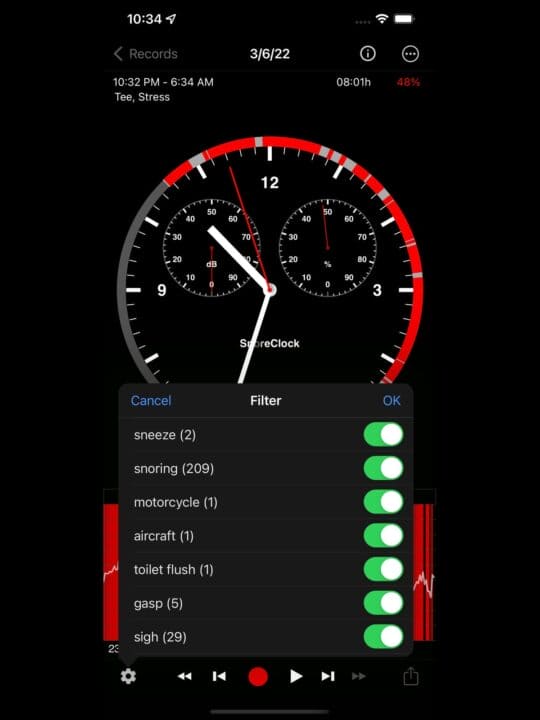
Put your phone near your bed, plug it in if you need a full battery, and press the red button. Press it again when you wake up.
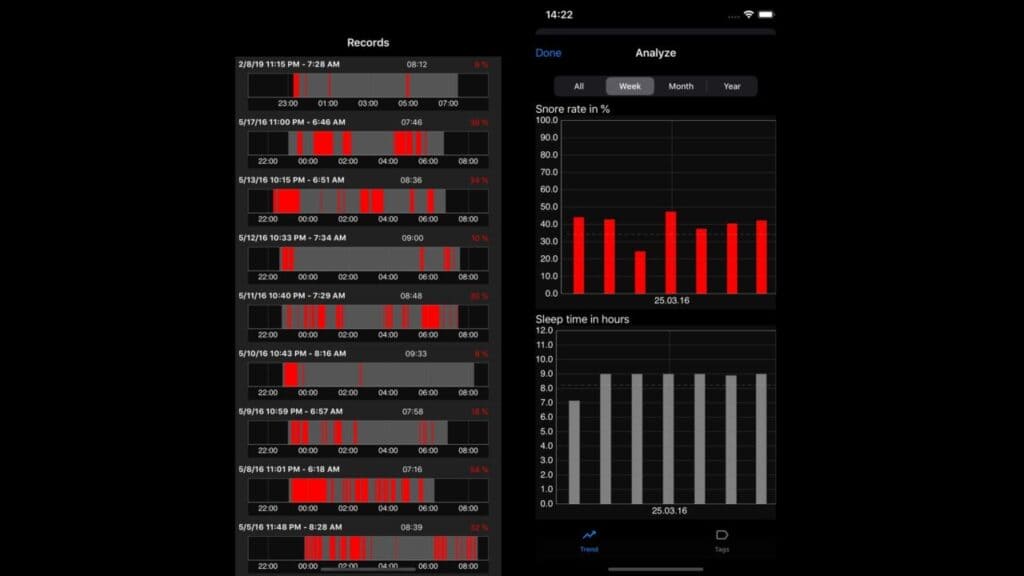
The app records the whole night and draws a graph of volume over time. Red bars mark the moments it thinks are snoring.
Rotate the phone sideways to see the full graph. You can pinch to zoom, drag to move, and tap anywhere to hear that part of the night.
Both store pages say it records for up to 11 hours. The App Store listing adds that it stops on its own when your battery runs low.
The app also tags other sounds, such as talking, whispering and coughing, so you can tell a snore from a sleep-talking spell. That helps if your partner swears you were loud and you swear you were not.
Android and iPhone Are Not the Same Deal Anymore
When this review was first written, the app was free on both platforms. That is no longer true.
The iPhone and iPad version is a paid app at about $9.99 as of October 2026. It has no ads, no tracking, and the listing says the developer collects no data.
It needs iOS 16.6 or later, and it holds 4.6 stars from 60 ratings.
The Android version is free to install, with in-app purchases. Google Play shows 4.6 stars from about 8,350 reviews and more than a million downloads, and its last update was December 2025.
The paid Plus subscription on Android removes ads and adds record-to-SD-card, a sound or vibration alert when you snore, audio sharing, and statistics backup. The old version of this review said nobody could tell what the paid tier added, and the listing now spells it out.
The app is sold in English plus six more languages. Prices change, so check the store before you buy.
What Testers Found
The original reviewer tested the free Android version over two nights and was not happy. The graph covered only part of the night, the sleep time ran hours long, and some controls froze.
That was an older release, and we have not rerun the test on the current one. Recent Google Play reviews still mention it, though.
One reviewer in October 2025 said the app stopped recording after less than an hour on some nights, and added that its snore detection isn’t amazing. Others praised the snore detection, and one paid to remove the ads.
So treat the first night as a test. Check in the morning that the graph runs the full length of your sleep before you trust it.
Does It Actually Detect Snoring?
Yes, with limits. A 2021 validation study compared the paid app to an ear, nose and throat specialist who listened to the recordings.
The study covered 201 snoring records from 11 patients. The app’s snoring rate and the specialist’s count correlated at 0.907, and average accuracy was 95%.
The details matter more than the headline. Sensitivity was 78% and specificity 97%, so the app rarely cries wolf but does miss some real snoring, and the misses rose as snoring rates went up.
That fits older findings. A German test of sleep apps found that apps count snores well in a soundproof room but struggle to separate snoring from traffic, talking and rustling sheets.
A 2015 review of snoring apps tested the top-rated app against lab sleep studies and found its sensitivity ranged from 64% to 96%. The authors called for more validation.
That study tested snoring detection only. It did not test whether SnoreClock can screen for sleep apnea.
Pros and Cons
Pros
- Strong match to a specialist’s count in one published test.
- Records the full night and lets you play back any moment.
- The iPhone version has no ads, no tracking and no data collection, according to its listing.
- Works well for comparing nights while you try snoring remedies.
Cons
- The test covered only 11 patients, and the app missed more snoring at higher rates.
- Android users see ads unless they pay for Plus, and some reviewers report the recording stopping early.
- It can’t tell you whether your snoring is a sign of sleep apnea.
- iPhone buyers pay up front.
Use It to Test a Remedy
The best use of a snore recorder is a before-and-after. Record a few nights as a baseline, change one thing, then record a few more.
Our guides to snoring aids cover options to try, and SnoreLab is the other big stand-alone recorder. If you want a recorder built into a pillow, read our review of the Nitelink2 app.
If your charts look bad, or you gasp or stop breathing at night, don’t wait on an app. Book a sleep study, and read about the link between lost sleep and insulin resistance while you wait.
The Verdict
SnoreClock earns a recommendation as a simple, honest snore recorder. It has real evidence behind its detection, which most rivals can’t claim.
It is not a diagnosis, and it is not a cure. Run it for a week, check that the graph covers the whole night, and show the results to your doctor if the numbers worry you.